
Overview and origins
The American civil rights movement emerged in the mid-1950s as a mass struggle for racial equality, seeking to end segregation and secure equal rights for African Americans across the United States. [5] The movement's roots trace to earlier legal challenges, but the spark that ignited widespread activism came when Rosa Parks refused to give up her seat to a white passenger in December 1955, an act that triggered the Montgomery bus boycott. [1,2] This boycott, lasting 381 days, demonstrated the power of organized, nonviolent resistance and propelled a young pastor, Martin Luther King Jr., into national prominence. [1] Simultaneously, the 1954 Supreme Court decision in Brown v. Board of Education declared state-sponsored school segregation unconstitutional, providing a legal foundation for the challenges ahead. [1] The murder of Emmett Till in 1955 also served as a galvanizing tragedy, drawing national attention to the violent consequences of racial injustice. [1] These events together created a momentum that would define the movement throughout the late 1950s and 1960s.
Tactics of protest and civil disobedience
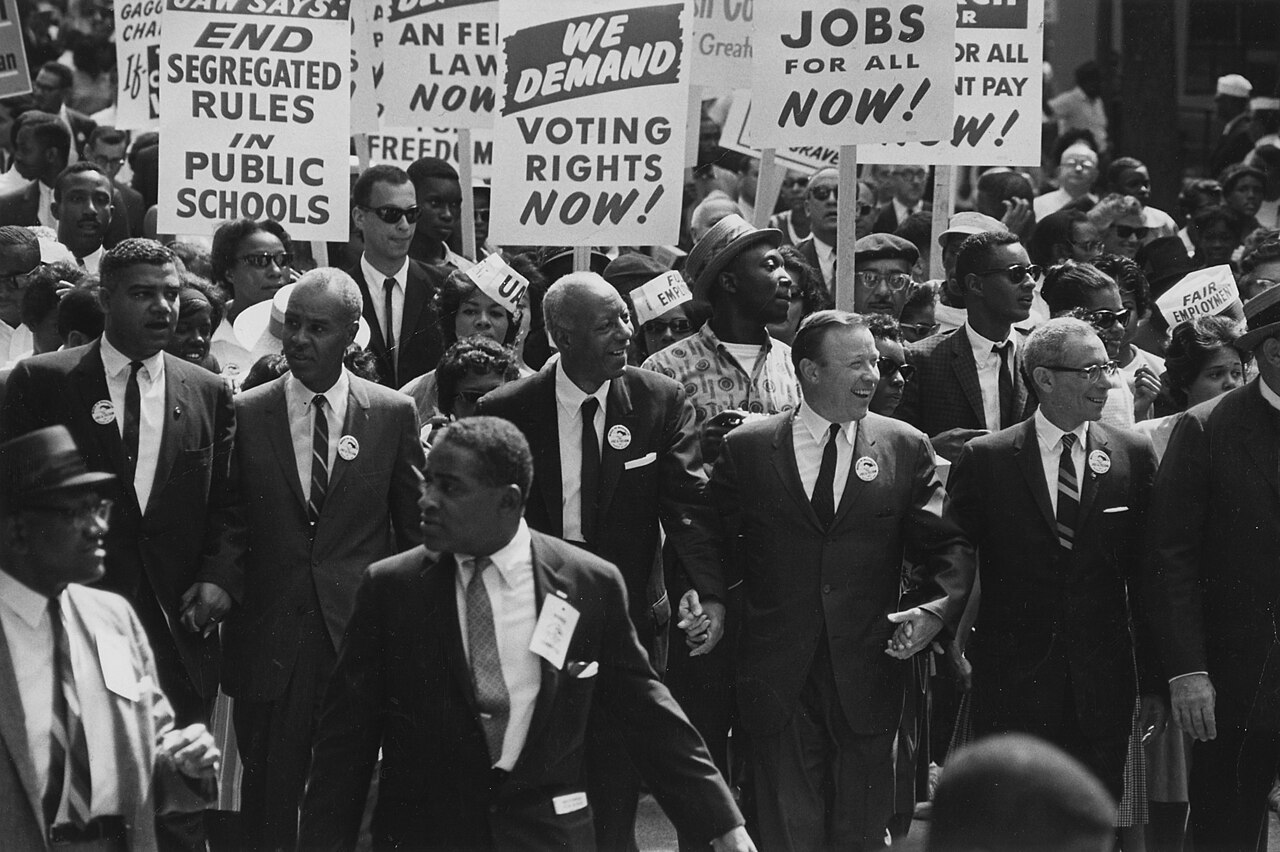
Activists employed a diverse arsenal of nonviolent tactics to confront segregation and demand change. Sit-ins, where protesters occupied segregated lunch counters and other public facilities, erupted across the South starting in 1958 and intensified through 1960, drawing participants from college campuses and churches. [1] The Freedom Rides of 1961, in which integrated groups of activists rode interstate buses into the segregated Deep South, tested federal desegregation laws and faced violent reprisals, drawing further media attention to the cause. [1] Marches and protest demonstrations, most notably the 1963 March on Washington where Martin Luther King Jr. delivered his "I Have a Dream" speech, mobilized hundreds of thousands and put pressure on Congress. [1] These tactics, ranging from boycotts to civil disobedience, relied on the strategic use of publicity to expose the moral contradiction of segregation in a democracy.
Legal milestones and federal intervention
Key events that shaped the movement
A chronological series of events marked the movement's progression from local protests to national confrontations. The Montgomery bus boycott from 1955 to 1956 was the first large-scale demonstration against segregation, setting a template for future campaigns. [1] In 1963, the Birmingham campaign used children in nonviolent marches, drawing global condemnation when police responded with fire hoses and dogs, which intensified federal pressure for civil rights legislation. [1] The Selma to Montgomery marches in 1965, met on "Bloody Sunday" with state troopers attacking peaceful demonstrators, directly precipitated the passage of the Voting Rights Act later that year. [1] Each of these events illustrated the movement's strategic use of nonviolent confrontation to expose injustice and provoke political response.
Legislative achievements and their impact
The movement's primary goal of legal equality was realized through a series of federal statutes. The Civil Rights Act of 1964 banned segregation in public facilities and outlawed employment discrimination, representing the most sweeping civil rights legislation since Reconstruction. [1] The Voting Rights Act of 1965 transformed the political landscape by eliminating literacy tests and other barriers that had disenfranchised African American voters, leading to a dramatic increase in Black voter registration in the South. [1] The Fair Housing Act of 1968, passed in the wake of Martin Luther King Jr.'s assassination, prohibited discrimination in the sale, rental and financing of housing. [1] While these laws marked monumental progress, activists noted that de facto segregation and economic inequality persisted, necessitating continued struggle beyond the legislative victories.
Leadership and organizational structure
The movement was propelled by a combination of charismatic leaders and grassroots organizations. Martin Luther King Jr. emerged as the most visible spokesperson, advocating nonviolent resistance inspired by Mahatma Gandhi's philosophy. [1] Organizations such as the Southern Christian Leadership Conference (SCLC), the Student Nonviolent Coordinating Committee (SNCC) and the NAACP provided the infrastructure for campaigns, coordinating voter registration drives, legal challenges and direct action. [5] The movement's leadership was not monolithic; figures like Malcolm X offered a more militant critique of systemic racism, arguing that self-defense was necessary against racial violence. [4] This diversity of strategy — nonviolent versus more confrontational approaches — reflected the broad coalition demanding racial justice.
Freedom Summer and the push for voting rights
In 1964, Freedom Summer brought hundreds of college students, many white Northerners, to Mississippi to register African American voters and establish Freedom Schools. [1] The campaign was marked by violence, including the murders of activists James Chaney, Andrew Goodman and Michael Schwerner, which shocked the nation and underscored the dangers faced by organizers. [1] The brutal repression of peaceful protesters, combined with the political calculus of the Johnson administration, created the conditions for the Voting Rights Act of 1965. [1] Freedom Summer demonstrated the movement's willingness to risk personal safety for political change and highlighted the centrality of voting rights to the broader struggle for equality.
Cultural legacy and historical reassessment
The American civil rights movement left an indelible mark on United States culture and politics. Its tactics of nonviolent protest have been adopted by subsequent social justice movements, from anti-war demonstrations to LGBTQ+ rights campaigns. [5] The movement's rhetoric, particularly Martin Luther King Jr.'s speeches, continues to influence American discourse on race and justice. [1] In recent decades, historians have reassessed the movement's scope, emphasizing the roles of women like Rosa Parks and Ella Baker, as well as the significance of local, community-level organizing beyond the national leadership. [5] This reassessment has broadened the narrative, recognizing the movement as a prolonged struggle involving diverse participants and strategies rather than a singular story of a few prominent figures.