
Overview: Population and Geographic Concentration
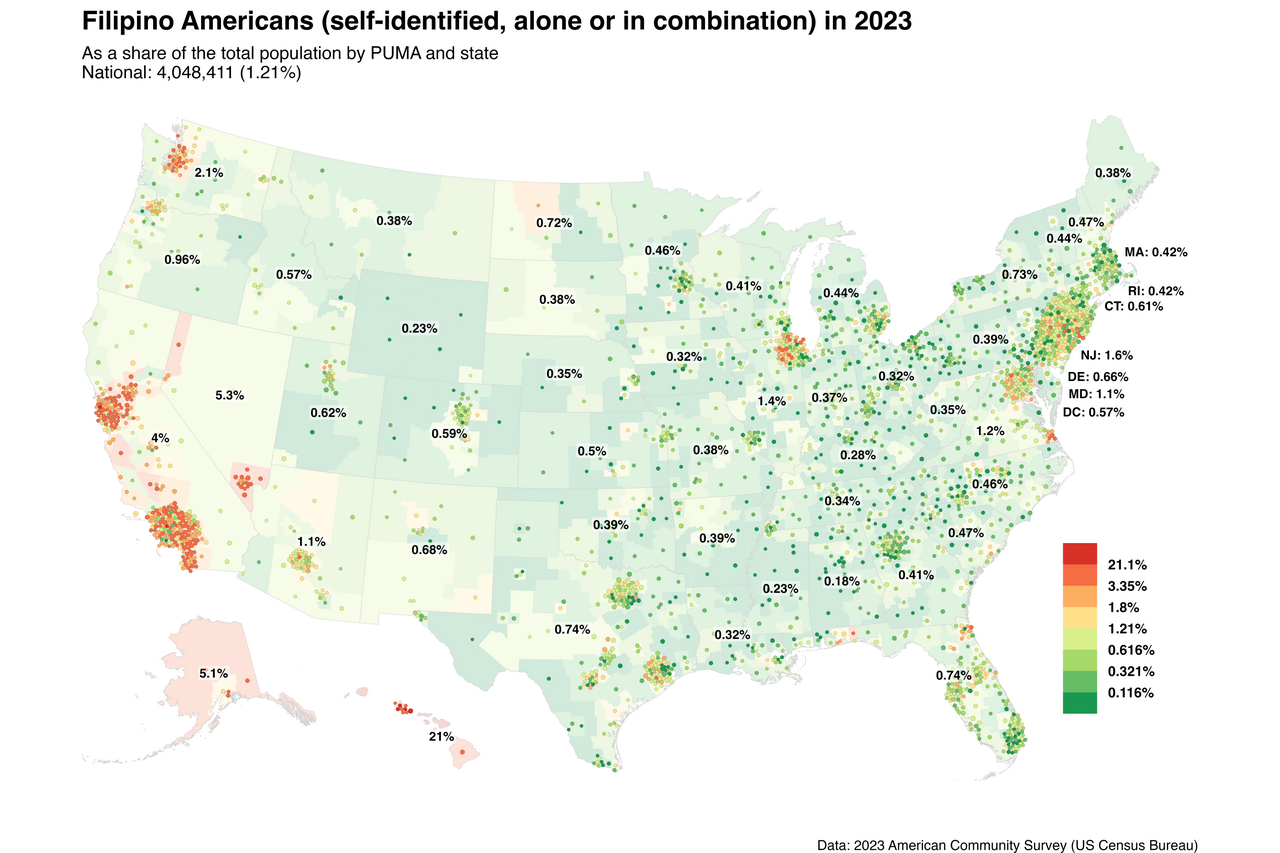
Filipino Americans constitute the third-largest Asian American group in the United States, numbering 4,640,313 by headcount or 5,000,000 by ancestry according to 2023 US Census data [1]. This population includes 2,051,900 foreign-born individuals born in the Philippines, representing the 1.5 generation who migrated during childhood or adolescence. Filipino Americans are heavily concentrated in the Western United States and Hawaii, particularly within metropolitan areas [1].
Headcount vs Ancestry Distinctions
The discrepancy between the 4.64 million headcount and 5 million ancestry figure reflects how census categories capture both self-identified race and ethnic origin. Headcount typically refers to those who selected Filipino as their race, while ancestry includes anyone reporting Filipino heritage regardless of other racial identifications. This distinction matters for understanding the full scope of the community's size and self-perception.
Western and Hawaiian Concentrations
The Filipino American population is not evenly distributed nationally. California alone hosts a significant plurality, with metropolitan areas like Los Angeles, San Francisco, and San Diego serving as major hubs. Hawaii maintains a particularly high per-capita concentration, reflecting historical labor migration patterns and territorial incorporation. Other Western states including Washington, Oregon, and Nevada also host substantial Filipino-American communities.
This geographic patterning stems from the 2,051,900 foreign-born individuals born in the Philippines who comprise the core of the community, many of whom settled in established ethnic enclaves before sponsoring family members through chain migration networks.
Generational Identity: The 1.5 and Second Generation Experience
The 1.5 Generation Framework
Scholarly examination of Filipino American identity frequently centers on the 1.5 generation — those who migrated to the United States during childhood or adolescence. This group navigates a unique position straddling Filipino cultural traditions acquired in the Philippines and American social environments encountered upon migration. The fluidity of identity among this cohort reflects both developmental transition and the practical necessity of adaptation.
Second-Generation Negotiation
Second-generation Filipino Americans, born in the United States to immigrant parents, negotiate identity formation across multiple cultural spheres. Research indicates that this generation often exhibits different identity patterns than their parents, balancing Filipino heritage with American cultural mainstream. The interplay between parental expectations, peer influences, and personal agency shapes how second-generation Filipino Americans articulate their racial and ethnic identity.
Fluidity Across Cultural and Racial Groups
The fluidity of Filipino American identity is examined in relation to both cultural and racial groups. This fluidity is not indicative of instability but rather reflects the dynamic process of identity work that occurs across the lifespan, particularly as individuals transition between different social contexts such as family, school, workplace, and community organizations.
Source [2] specifically examines how these generational dynamics interact with broader Asian American identity formations, revealing that Filipino Americans occupy a distinct position within the pan-Asian American umbrella while maintaining unique cultural characteristics.
Historical Migration Patterns and Settlement
Early Labor Migration (1900s-1940s)
Filipino migration to the United States began in significant numbers during the early 20th century, driven by economic opportunities and American colonial presence in the Philippines. Early migrants often worked in agricultural sectors, canneries, and service industries, establishing the foundational population that would later grow through family-based immigration.
Post-1965 Immigration Waves
The Immigration and Nationality Act of 1965 abolished national-origin quotas, leading to a substantial increase in Filipino immigration. This legislative change facilitated the reunification of families and attracted highly skilled immigrants, particularly in healthcare, engineering, and other professional fields. The 2,051,900 foreign-born Filipinos counted in 2023 data reflect this post-1965 migration trend.
Suburban and Metropolitan Shift
Beginning in the late 20th century, Filipino American communities expanded beyond initial urban ethnic enclaves into suburban areas across the West Coast and Hawaii. This shift correlates with broader American residential patterns and increased economic mobility within the community. Metropolitan areas offered greater employment opportunities in healthcare, technology, and service sectors that disproportionately employ Filipino Americans.
The concentration of Filipino Americans in Western states and Hawaii thus reflects both historical labor migration patterns and later economic migration driven by professional opportunities.
Cultural Practices and Community Life
Family Structure and Extended Kinship
Filipino American communities maintain strong family ties that often extend beyond the nuclear unit to include extended kinship networks. These relationships provide social support, economic cooperation, and cultural transmission across generations. The concept of "bayanihan" — communal work and cooperation — frequently translates into community organizing and mutual aid within Filipino-American contexts.
Religious and Spiritual Life
Religious practice among Filipino Americans reflects the Philippines' predominantly Catholic heritage, with many participating in Catholic parishes that serve as both spiritual and social centers. However, religious affiliation varies, and Filipino American communities include diverse faith traditions. Churches often serve as important gathering spaces, particularly for older immigrants and community events.
Language Maintenance and Code-Switching
Language use within Filipino American households varies significantly, influenced by generation, immigration status, and intermarriage patterns. Many households maintain Tagalog or other Philippine languages alongside English, with code-switching becoming a common practice. Language maintenance often declines in later generations, though heritage language programs and community initiatives seek to preserve linguistic connections.
These cultural practices reflect the ongoing process of identity formation that adapts traditional Filipino cultural elements to American contexts while maintaining connections to homeland culture.
Professional and Economic Participation
Healthcare Professions
Filipino Americans are disproportionately represented in healthcare professions, particularly nursing and medicine. This occupational concentration stems from both the post-1965 immigration wave of skilled professionals and intergenerational patterns within the community. The 75 MIFA 2026 recognition includes a healthcare category, reflecting the significant contributions of Filipino Americans to the medical field [4].
Business and Entrepreneurship
Filipino American entrepreneurs contribute to local economies across the United States, particularly in food services, retail, and professional services. Business ownership rates within the community reflect broader American trends while incorporating cultural products and services that cater to both Filipino and broader consumer markets. The 75 MIFA 2026 recognition includes a business category acknowledging these contributions [4].
Community Leadership and Civic Engagement
Filipino Americans participate in civic life at varying rates, with community organizations addressing needs ranging from immigrant services to youth development. The 75 MIFA 2026 recognition includes a community leadership category, highlighting individuals who have made significant contributions to Filipino-American community building and broader civic engagement [4].
These professional and civic patterns demonstrate the community's multifaceted contributions to American society while maintaining distinct cultural identifiers and community ties.
Media Representation and Cultural Production
Entertainment Industry Presence
Filipino Americans have increasingly visible presence in American entertainment, including film, television, music, and digital media. This representation ranges from mainstream Hollywood roles to independent and Asian American media productions. The 75 MIFA 2026 recognition includes an entertainment category, acknowledging Filipino Americans who have made significant contributions to media and arts [4].
Literary and Artistic Contributions
Filipino American writers, artists, and creators produce work that explores identity, migration, family, and cultural hybridity. These creative expressions contribute to broader American cultural discourse while offering specific perspectives on the Filipino-American experience. Literary and artistic venues provide spaces for identity exploration and community dialogue.
Digital and Social Media Presence
Social media platforms have become important spaces for Filipino American community building, identity exploration, and cultural transmission. Digital communities allow connection across geographic distances and generational divides, particularly for younger Filipino Americans navigating identity formation. Online platforms also enable the preservation and sharing of cultural traditions in contemporary contexts.
Media representation both reflects and shapes societal perceptions of Filipino Americans, while Filipino American cultural production creates spaces for self-definition and community narrative control.
Identity Politics and Pan-Asian Dynamics
Position Within the Asian American Category
Filipino Americans occupy a distinctive position within the broader Asian American umbrella. While sharing certain experiences common to Asian American communities, Filipino Americans have unique historical, cultural, and migration patterns that shape their specific identity formation. The fluidity examined in source [2] highlights how Filipino American identity interacts with — and sometimes differs from — other Asian American groups.
Anti-Asian Racism and Solidarity
Like other Asian American groups, Filipino Americans have experienced increased racism during various political periods, particularly during the COVID-19 pandemic. However, specific experiences differ; for instance, the history of Filipino migration and labor differs from East Asian immigration patterns. Solidarity across Asian American groups often occurs, but Filipino Americans also articulate distinct concerns and perspectives within broader anti-racist movements.
Political Representation and Advocacy
Filipino Americans have increasingly sought political representation and advocacy at local, state, and federal levels. This includes elected officials, political appointees, and advocacy organizations addressing community-specific issues such as immigration policy, healthcare access, and education. Political participation reflects the community's growing institutional presence and efforts to influence policy affecting Filipino-American constituents.
The relationship between Filipino American identity and broader pan-Asian American politics involves both coalition-building and the assertion of distinct community needs and priorities.
The 75 MIFA 2026 Recognition Framework
Selection Categories and Criteria
The 75 MIFA 2026 initiative recognizes 75 influential Filipino-Americans across 10 professional categories including entertainment, business, healthcare, and community leadership [4]. This recognition serves to highlight the diverse contributions of Filipino Americans to American society and global impact. The multi-category structure reflects the community's broad engagement across various sectors of public life.
Impact on Community Visibility
Recognition initiatives like MIFA 2026 contribute to increased visibility of Filipino American achievements and contributions. By showcasing diverse individuals across multiple professional fields, such programs challenge stereotypes and demonstrate the community's wide-ranging impact. Visibility also inspires younger Filipino Americans by providing role models across different career paths.
Critiques and Broader Significance
While recognition programs celebrate individual achievement, some critics argue that such initiatives may inadvertently reinforce hierarchies or fail to address systemic issues facing the broader Filipino-American community. However, proponents contend that visibility and celebration of achievement serve important functions in identity formation and community building, particularly when combined with efforts to address structural inequities.
The 75 MIFA 2026 recognition thus operates both as celebration of individual accomplishment and as a marker of the growing recognition of Filipino American contributions to American public life.
Challenges and Ongoing Issues
Economic Disparities Within the Community
Despite aggregate indicators of success, Filipino Americans experience economic diversity within the community. Some subgroups face higher rates of poverty, limited English proficiency, and occupational segregation. The model minority myth sometimes obscures these disparities by aggregating Filipino American outcomes with other Asian American groups that may have different migration histories and socioeconomic profiles.
Immigration Policy and Status Uncertainty
The 2,051,900 foreign-born Filipinos counted in 2023 include individuals with various immigration statuses. Policy debates regarding family-based immigration, skilled visa programs, and pathways to citizenship directly affect Filipino-American families. Status uncertainty particularly affects mixed-status families and those awaiting visa processing, creating stress and limiting full community integration for some members.
Intergenerational Cultural Conflict
Cultural transmission between immigrant parents and US-born children sometimes generates conflict regarding values, expectations, and life choices. These tensions reflect broader immigrant experience patterns but may be shaped by specific Filipino cultural values regarding family honor, education, and career expectations. Resolution often involves negotiation and redefinition of cultural expectations across generations.
These challenges demonstrate that Filipino American identity formation occurs within a context of both achievement and ongoing struggle, with the community navigating complex socioeconomic and cultural dynamics.
Future Directions and Emerging Trends
Generational Shifts and Identity Evolution
As third and later generations of Filipino Americans come of age, identity formation patterns are likely to evolve further. Research on the fluidity of identity [2] suggests that later generations may express Filipino American identity in ways that differ from both their immigrant parents and the 1.5 and second generations. These evolutions reflect broader American identity trends while maintaining connections to heritage.
Increased Political and Institutional Power
With nearly 5 million Filipino Americans in the United States, the community's political influence is growing. Increased elected representation, appointment to governmental positions, and advocacy capacity reflect this trajectory. The 75 MIFA 2026 recognition coincides with this growing visibility and institutional presence.
Cultural Production and Global Connections
Filipino American cultural production increasingly connects with the Philippines and global Filipino diaspora communities. Digital platforms facilitate these connections, while Filipino Americans contribute to cultural exchange between the United States, the Philippines, and other diaspora locations. This global dimension adds complexity to identity formation but also expands community networks and cultural resources.
The ongoing evolution of Filipino American identity reflects the community's dynamic position at the intersection of migration history, cultural tradition, and American social dynamics. With a population exceeding 5 million and growing geographic and institutional presence, Filipino American identity will continue to adapt and expand across generations and contexts.