
Origins and Legislative Foundation
Corporate average fuel economy standards trace their origin to the 1973-74 Arab Oil Embargo, which exposed the United States vulnerability to supply disruptions and spurred congressional action. In response, Congress enacted the Corporate Average Fuel Economy law in 1975 to improve the average fuel economy of cars and light trucks sold in the United States [3]. The legislation reflected a bipartisan recognition that reducing oil dependence required regulatory intervention rather than market alone.
Early Standard-Setting Authority
The secretary of transportation was tasked with administering the program through the National Highway Traffic Safety Administration, establishing NHTSA as the primary regulator of passenger car and light-truck fuel economy [3,4]. From the outset, the framework delegated rulemaking authority to a federal agency, ensuring that standards could be updated as technology and market conditions evolved.
Parallel EPA Role in Emissions and Window Stickers
While NHTSA focused on the corporate average calculations, the Environmental Protection Agency assumed responsibility for fuel-economy window stickers on new vehicles and greenhouse gas emissions from passenger cars and trucks [5]. This dual-regulator structure meant that fuel economy and emissions objectives were addressed simultaneously, even though the statutory mechanisms differed.
The Energy Independence and Security Act of 2007 further expanded the regulatory scope by developing and implementing efficiency standards for heavy-duty pickup trucks and commercial medium-duty and heavy-duty vehicles [3]. This legislative update reflected growing acknowledgment that light-duty standards alone could not address the full range of U.S. vehicle fleets.
How CAFE Standards Are Calculated and Enforced
NHTSA sets CAFE standards for passenger cars and for light trucks separately, treating light-duty vehicles as a distinct category from medium- and heavy-duty trucks and engines [4]. The calculation aggregates each automaker fleet average, and penalties are triggered when an manufacturer falls below the prescribed threshold. This penalty mechanism makes it more expensive for automakers to build inefficient vehicles, indirectly steering production toward higher efficiency rather than offering direct customer incentives or affecting fuel prices [3].
Separate Standards for Light Trucks and Passenger Cars
The statutory distinction between passenger cars and light trucks allows NHTSA to set different average targets for each category, reflecting the different purchasing patterns and usage profiles of consumers who choose trucks over sedans [4]. This bifurcation has been a consistent feature of the program, though it has also drawn criticism for potentially encouraging fleet reclassification.
Heavy-Duty and Medium-Duty Vehicle Standards
The 2007 Energy Act extended efficiency mandates beyond light-duty vehicles, establishing fuel consumption standards for medium- and heavy-duty trucks and engines [3,4]. This expansion required NHTSA and EPA to develop testing procedures and target levels for vehicles that haul freight and serve commercial purposes, broadening the program scope significantly.
EPA's role in regulating fuel consumption standards for heavy-duty vehicles complements NHTSA's CAFE program, creating a coordinated but distinct set of requirements that address both fuel economy and greenhouse gas reductions [5]. The interplay between the two agencies sometimes leads to overlapping rulemaking, but also offers opportunities for aligned standards.
The 2026 Trump Administration Rollback and Legal Challenge
The Trump administration pursued a sharply lower set of fuel economy standards for vehicles, targeting 2026 model year targets that would have represented a significant rollback from previously established trajectories [1]. The rollback was framed by the administration as a means to reduce regulatory burden on automakers, though it simultaneously sought to freeze Corporate Average Fuel Economy requirements at 2020 levels.
Automaker Support for the Rollback
Several major automakers, including General Motors, Toyota, and Volkswagen, backed the Trump administration in its legal challenge to the rollback, arguing that the administration's approach provided needed regulatory certainty [1]. Their participation underscored the industry's preference for a stable, predictable standard-setting process over frequent revisions.
Industry Opposition and Environmental Concerns
Environmental groups and some consumer advocates opposed the rollback, arguing that lower fuel economy standards would increase greenhouse gas emissions and raise long-term fuel costs for consumers [1]. Their opposition highlighted the tension between short-term industry preferences and broader climate and energy security objectives.
The legal challenge ultimately questioned whether the administration had the authority to set standards that deviated from the statutory mandates established by Congress in 1975 and refreshed in the 2007 Energy Independence and Security Act [3,4]. The outcome of that challenge would determine the future trajectory of U.S. fuel economy policy for the remainder of the decade.
Economic and Environmental Rationale
CAFE standards attempt to improve fuel economy indirectly by making it more expensive for automakers to build inefficient vehicles through penalties, rather than offering customer incentives or affecting fuel prices directly [3]. This market-based approach leverages the cost sensitivity of manufacturers to drive fleet-wide improvements, rather than relying on consumer behavior change.
Impact on Vehicle Pricing and Consumer Choice
Because the penalty structure increases the cost of non-compliant production, automakers typically recoup expenses through vehicle pricing, which can affect the affordability of certain models, particularly larger light trucks [4]. The economic incidence of the standards thus shifts between manufacturers, buyers, and the broader market.
Greenhouse Gas Reduction and Energy Security
Higher fuel economy standards directly reduce per-vehicle fuel consumption, which in turn lowers greenhouse gas emissions tailpipe emissions [5]. Over the fleet lifetime, these reductions contribute to national energy security goals first articulated during the oil embargo era, creating a cumulative effect that justifies the regulatory approach.
The 2007 Energy Independence and Security Act's heavy-duty standards complement light-duty reductions by addressing a segment of the fleet that had previously been outside the CAFE framework [3]. This holistic expansion reflects an understanding that comprehensive policy must cover all major vehicle classes.
Historical Evolution of Target Levels
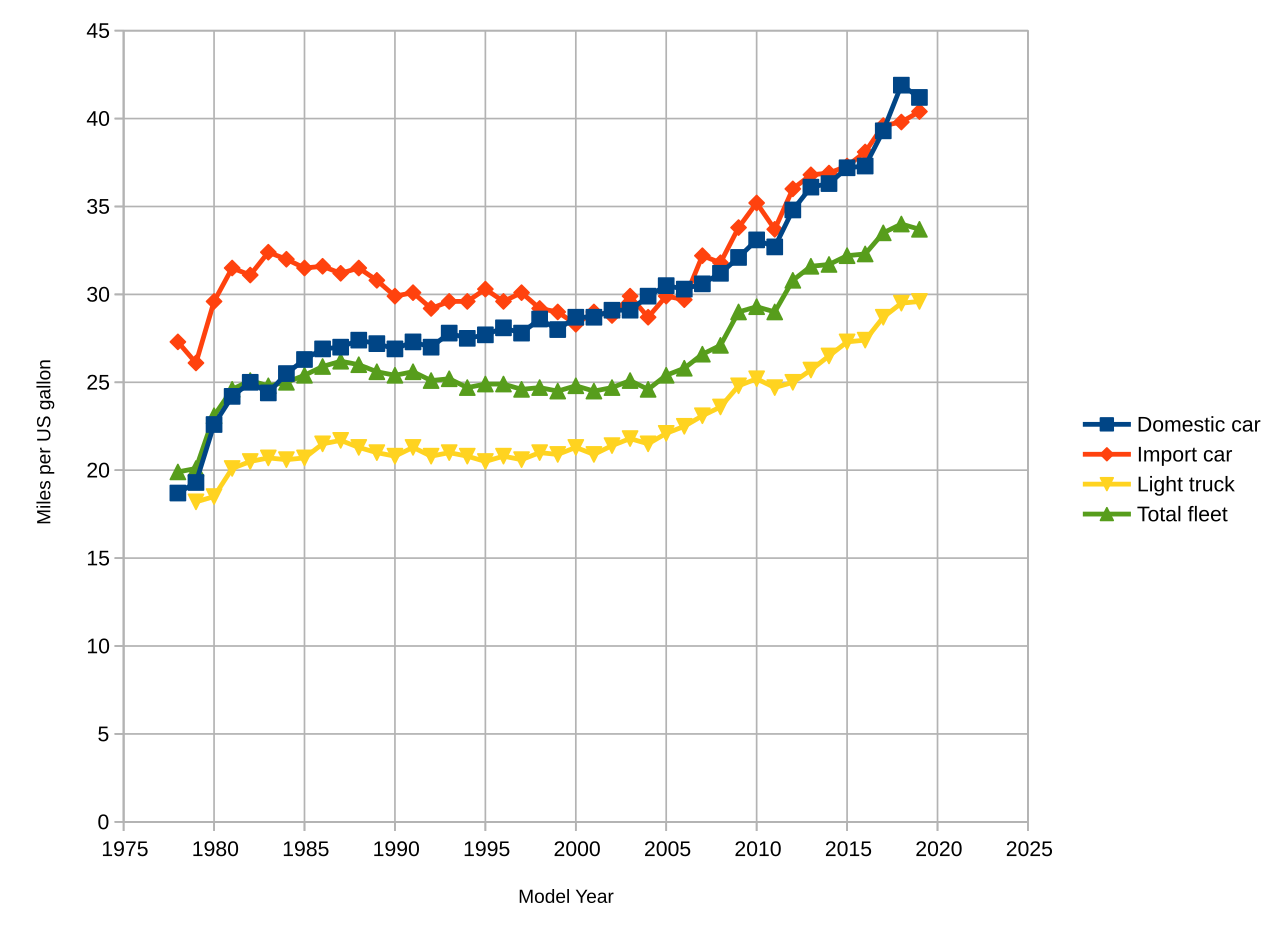
Since their inception in 1975, CAFE standards have been periodically tightened to reflect advancing technology, changing market conditions, and updated congressional intent [3]. Early standards focused on modest improvements, but subsequent rounds of rulemaking introduced more aggressive targets, particularly during the 2010s when the Obama administration pursued significant increases.
Obama-Era Standards and the 2025 Fleet Goal
The Obama administration set standards that required new vehicles to achieve a fleet-wide average of approximately 54.5 miles per gallon by 2025, a target that represented one of the most aggressive regulatory pushes in the program's history [5]. Industry complied through a combination of engine improvements, transmission efficiencies, and early electrification.
Trump Administration's Target Adjustments
The Trump administration's rollback sought to set lower targets for the 2026 model year, arguing that the Obama-era goals were unattainable without compromising vehicle size, performance, or affordability [1]. The administration's approach reflected a philosophical shift toward deregulation, even as it faced legal and political resistance.
The Biden administration subsequently pledged to restore and exceed prior target levels, signaling a return to the more aggressive trajectory established under the Obama framework [5]. This policy pendulum illustrates how fuel economy standards remain a contested arena between regulatory ambition and industry pushback.
Key Stakeholders and Their Positions
The primary regulators, NHTSA and EPA, operate under different statutory authorities but share the objective of reducing fuel consumption and emissions from the U.S. vehicle fleet [3,4,5]. Their coordination, while sometimes administratively complex, ensures that fuel economy and greenhouse gas objectives are addressed across the regulatory spectrum.
Automaker Coalition and Trade Associations
Automakers including General Motors, Toyota, and Volkswagen have been at the forefront of industry engagement with CAFE rulemaking, often participating in negotiated rulemaking committees and lobbying for standards they consider feasible [1]. Their positions balance the cost of compliance with the need for regulatory predictability.
Environmental and Consumer Advocacy Groups
Organizations focused on climate change, air quality, and consumer fuel costs have consistently advocated for stronger standards, arguing that the public health and environmental benefits outweigh the compliance costs borne by manufacturers [1]. Their research and advocacy shape the political dimension of rulemaking proceedings.
State governments, particularly California, have sought to implement their own fuel economy and emissions standards, sometimes leading to conflicts with federal preemption claims [4]. These state-federal tensions have historically driven litigation and legislative negotiations in Washington.
Legal and Political Dimensions
The legality of the Trump administration's rollback hinged on interpretations of the original 1975 statute and the 2007 Energy Independence and Security Act, which both mandate that NHTSA set standards based on what is technologically feasible and in the public interest [3,4]. Courts have at times been called upon to resolve disputes over whether administrative actions align with congressional intent.
Judicial Review and Precedent
Legal challenges to fuel economy standards often focus on whether the agency providing the regulation followed required procedural steps, such as public comment periods and quantitative impact analysis [4]. The outcomes of these cases shape the boundaries of agency discretion and the stability of standards over time.
Congressional Oversight and Legislation
Congress retains the authority to amend the underlying statutes, override agency rules, or provide funding that influences the pace and stringency of standard-setting [3]. Legislative activity often follows major regulatory shifts, as seen in the post-rollback debates over the future of U.S. fuel policy.
The interplay between statutory mandates, agency discretion, and political administration ensures that fuel economy standards will continue to evolve in response to both technological change and shifting policy priorities [5]. This dynamic makes the program a persistent subject of debate in U.S. energy and environmental policy.
Significance and Future Trajectory
Fuel economy standards represent one of the longest-running and most impactful regulatory frameworks in U.S. transportation policy, with origins in the 1970s oil crisis and ongoing relevance in the context of climate change [3]. Their endurance reflects the persistent tension between energy security, environmental protection, and economic competitiveness.
Transition to Electrification
As the vehicle fleet increasingly includes electric and hybrid models, the methodology for calculating fuel economy equivalents is evolving to account for electricity consumption and zero-emission technology [5]. Regulators are grappling with how to maintain the spirit of CAFE goals while adapting to a fundamentally different powertrain landscape.
Global Comparisons and Harmonization
The United States is not alone in implementing fuel economy standards; the European Union, Japan, and other major markets have their own frameworks, sometimes with different testing procedures and target structures [4]. These international comparisons provide benchmarks for evaluating the stringency and effectiveness of the U.S. approach.
The long-term significance of CAFE standards will depend on whether future administrations maintain, increase, or roll back targets, and how the industry adapts through technology investment rather than regulatory avoidance [1,3]. The program's ability to balance these competing interests will determine its legacy in U.S. policy history.