
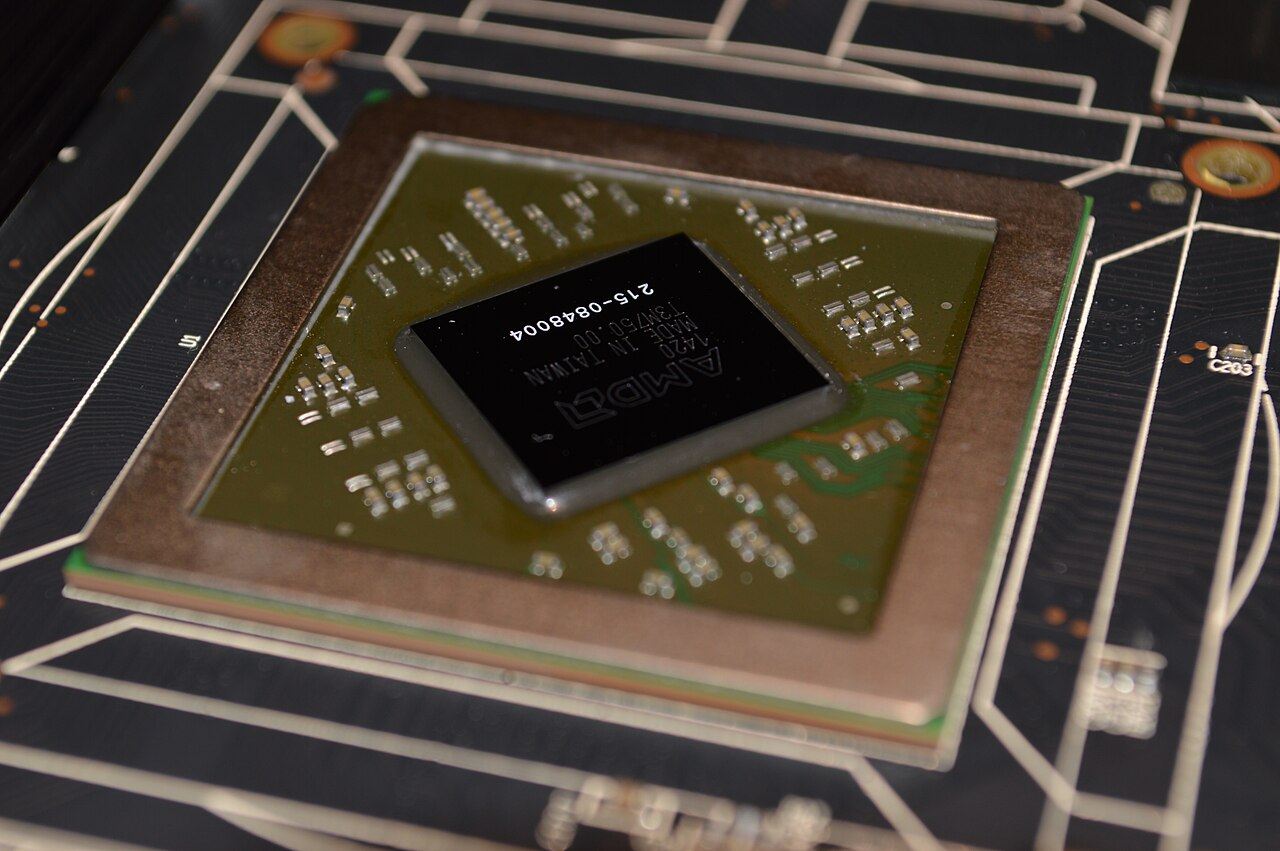
Historical Evolution of GPUs
The term Graphics Processing Unit emerged in the late 1990s as a marketing label for add-in cards that accelerated rendering beyond what general-purpose CPUs could handle. Early GPUs featured fixed-function pipelines designed specifically for triangle setup, texture mapping, and framebuffer operations. The introduction of programmable shaders in the early 2000s transformed GPUs into general parallel processors capable of arbitrary calculations on pixel and vertex data. This architectural shift opened the door for compute workloads beyond graphics, establishing the foundation for modern AI and scientific computing acceleration. [1]
From Fixed-Function to Programmable Shaders
Before the year 2000, graphics cards relied on fixed-function hardware that could perform a limited set of operations per polygon. The arrival of programmable vertex and fragment shaders, first exposed through APIs like DirectX 8.0 and OpenGL 2.0, allowed developers to write custom code that ran on the GPU. This innovation not only improved visual fidelity but also demonstrated that the same hardware could accelerate non-graphics tasks such as physics simulation and cryptographic hashing. [1]
The Rise of GPU Computing and General-Purpose GPU
The release of NVIDIA Compute Unified Device Architecture (CUDA) in 2006 marked the first widespread API that allowed developers to access GPU parallelism using familiar programming languages like C. CUDA exposed the underlying streaming multiprocessor architecture, enabling tasks such as Monte Carlo simulation, signal processing, and linear algebra to run orders of magnitude faster than CPU-only implementations. This capability blurred the line between graphics and compute hardware, creating a new class of accelerator-dependent workloads. [1]
GPU Architecture and Microarchitecture
Streaming Multiprocessors and Thread Hierarchy
Modern GPUs organize their transistor budget into large arrays of streaming multiprocessors (SMs), each containing multiple integer and floating-point cores, special function units, and on-chip memory. Threads are grouped into warps or wavefronts that execute in lockstep, enabling high throughput when adjacent threads follow similar execution paths. Divergence within a warp serializes execution, reducing effective utilization. Understanding this hierarchy is essential for optimizing both graphics pipelines and compute kernels. [1]
Memory Subsystem and Bandwidth
The memory subsystem constitutes a significant portion of GPU die area, typically featuring high-bandwidth GDDR or HBM memory connected via wide buses. Peak bandwidth numbers often exceed 500 GB/s on enthusiast-class parts, which is necessary to feed the massive parallelism of thousands of concurrent threads. On-chip caches, including L1 and L2 hierarchies, reduce latency for frequently accessed data, while explicit scratchpad memories give compute kernels explicit control over data movement. This bandwidth ceiling frequently becomes the bottleneck for both rasterization and matrix multiplication workloads. [1]
Fixed-Function Units alongside ALUs
Despite the growth of programmable execution, modern GPUs retain substantial fixed-function blocks for tasks such as rasterization, depth testing, and texture filtering. These units operate alongside arithmetic logic units (ALUs) and can process data independently, allowing the programmable cores to focus on shading and compute kernels. The coexistence of fixed and programmable logic enables efficient implementation of graphics APIs while retaining flexibility for AI tensor operations that do not map neatly onto traditional raster pipelines. [1]
Gaming and Real-Time Rendering
Rasterization Pipeline and Shading
The dominant rendering technique in modern games remains rasterization, which converts geometric primitives into fragment candidates that are shaded and tested against depth and stencil buffers. Programmable shaders determine color, lighting, and material properties per fragment, while fixed-function stages perform early-z culling and attribute interpolation. The performance of this pipeline is directly tied to GPU clock rates, memory bandwidth, and the number of concurrent thread contexts the hardware can manage. [1]
Ray Tracing and Acceleration Structures
Ray tracing simulates physical light transport by tracing rays through a scene and computing intersections with geometric primitives. Dedicated hardware acceleration units, often called ray tracing cores, traverse bottom-level and top-level bounding volume hierarchies (BVH) in hardware, reducing the software overhead that previously limited real-time adoption. The integration of ray tracing into mainstream gaming APIs such as DirectX 12 Ultimate and Vulkan 1.3 has expanded the installed base, but the technique still demands significantly more transistor budget and memory bandwidth than rasterization-only workloads. [1]
Frame Generation and Upscaling Technologies
To achieve higher effective frame rates without proportional hardware cost, GPU vendors have introduced frame generation and super-resolution algorithms. These technologies render at a lower internal resolution and use AI-based interpolation to produce additional frames or upscale the output to target display resolution. While they improve perceived smoothness, they introduce latency and image quality trade-offs that vary by scene complexity and motion vector accuracy. [1]
Artificial Intelligence and Machine Learning Acceleration
Tensor Cores and Mixed-Precision Math
The introduction of Tensor Cores in the Volta architecture marked a turning point for GPU AI acceleration. These specialized matrix multiply-accumulate units operate on mixed-precision data types, typically combining FP16 inputs with FP32 accumulation, to deliver up to 125x the throughput of general-purpose FP64 operations for deep learning workloads. Mixed-precision training and inference have become the standard for neural network workloads because they maintain model accuracy while dramatically reducing memory footprint and energy consumption. [1]
Software Stacks for AI Development
Beyond raw hardware, GPU vendors provide software ecosystems that simplify AI development. NVIDIA's cuDNN, TensorRT, and RAPIDS libraries optimize common neural network operations for GPU execution, while tools like DLSS use super-resolution neural networks to upscale frames in real time. Open-source alternatives such as ROCm enable AMD GPUs to participate in the same workflows, though feature parity and performance tuning require additional engineering effort. These software layers are as critical as the underlying hardware for determining real-world AI productivity. [1]
Large Language Model Inference on GPUs
The transformer architecture that powers large language models consists of matrix multiplications that map almost perfectly onto GPU tensor cores. Inference workloads such as ChatGPT and Claude benefit from the high memory bandwidth and parallel throughput of modern GPUs, which can generate hundreds of tokens per second for a single user request. The Azure AI supercomputing infrastructure that trained ChatGPT leveraged thousands of GPUs coordinated across network fabrics, demonstrating that GPU clusters remain the dominant platform for both training and serving state-of-the-art AI models. [4]
Market Landscape and Competitive Dynamics
Primary Vendors and Product Segments
The discrete GPU market is dominated by three primary vendors: NVIDIA, AMD, and Intel. NVIDIA maintains the largest share in both gaming and data center segments, driven by its early investment in CUDA and tensor core technology. AMD competes primarily on price-performance ratio in the gaming segment and has expanded its data center offerings through the MI300 series. Intel entered the discrete market relatively recently with its Arc product line, targeting integrated and entry-level discrete workloads. Market share data varies by region and workload, but the competitive dynamics continue to shift as each vendor invests in new architectures and software ecosystems. [1]
Gaming Market Trends and Unit Shipments
Unit shipments of gaming GPUs correlate closely with PC sales cycles and the release of new game titles that leverage advanced rendering features. The transition to higher resolutions such as 4K and the adoption of ray tracing have increased the average selling price of enthusiast-class cards. Meanwhile, the growth of cloud gaming services shifts some demand away from local hardware, as streaming architectures can deliver high-fidelity graphics to lower-end devices. The long-term trajectory remains uncertain as both local hardware improvements and cloud infrastructure evolve. [1]
Data Center and AI Accelerator Growth
Revenue from data center GPUs has grown faster than any other segment, reflecting the explosion of AI model training and inference demand. Hyperscale clouds and enterprise AI labs are the primary purchasers, often ordering tens of thousands of units per deployment. This demand has created supply constraints and extended lead times for high-end parts. The concentration of orders among a few large customers gives them significant pricing power, prompting vendors to introduce modular and subscription-based purchasing models to maintain flexibility for both buyers and sellers. [1]
Power Efficiency and Thermal Design
Transistor Count and Power Draw Trends
GPU transistor counts have grown exponentially, exceeding 100 billion on the latest data center parts. This growth is driven by both increased core counts and larger on-chip caches and memory controllers. However, power density has become a limiting factor, with top-end gaming cards drawing over 450 watts and data center accelerators exceeding 700 watts when fully loaded. Manufacturers have responded with more sophisticated power delivery architectures, including 12-pin and 16-pin connectors, and software-level power management that can adjust clock speeds and voltage bins based on workload characteristics. [1]
Thermal Solutions and Form Factor Constraints
The high power draw of modern GPUs necessitates substantial cooling solutions, typically consisting of large heatsinks, multiple heat pipes, and fan assemblies that occupy three or more expansion slots. Laptop and mobile GPUs face additional constraints, requiring hybrid fan designs and dynamic power limits to remain within thermal envelopes. The industry has also explored liquid cooling options for enthusiast and data center parts, which can maintain lower junction temperatures and allow sustained boost frequencies over longer periods. [1]
Energy Proportionality and Data Center Implications
In data center environments, GPU energy consumption directly impacts operational expenditure through electricity costs and cooling requirements. Energy-proportional computing, where power use scales linearly with utilization, is an ideal that GPU workloads approximate but do not fully achieve due to fixed leakage and overhead costs. The growing ratio of AI compute to graphics compute in data center mixes has shifted the priority from raw performance-per-dollar to performance-per-watt, influencing both architectural choices and procurement decisions across the industry. [1]
Software Ecosystems and Developer Tools
Graphics APIs and Cross-Platform Standards
The feature set available to developers depends heavily on the underlying GPU vendor and the graphics API in use. DirectX 12 and DirectX 12 Ultimate are the dominant standards on Windows, while Vulkan provides a cross-platform alternative that works on Windows, Linux, and Android. These APIs expose low-level control over command queues, descriptor heaps, and resource heaps, allowing engines to minimize driver overhead and maximize GPU utilization. The choice of API often dictates which hardware features can be used, making cross-platform rendering pipelines a complex engineering challenge. [1]
Debugging and Profiling Tools
Effective GPU development requires tools that can capture command streams, analyze kernel execution, and identify memory bottlenecks. Commercial profilers such as NVIDIA Nsight and AMD Radeon GPU Profiler offer timeline views, source-level debugging, and hardware counter integration. Open-source options such as RenderDoc provide capture and replay capabilities that are widely used in both industry and academia. These tools are essential for optimizing both graphics pipelines and compute kernels, as the parallel nature of GPUs makes traditional CPU-centric debuggers insufficient. [1]
Cross-Platform Compute Standards
Standardization efforts such as OpenCL, OpenGL Compute, and Vulkan Compute aim to provide portable interfaces for general-purpose GPU execution. While they enable code to run on hardware from different vendors, performance portability remains limited because each vendor's hardware exposes unique features and performance characteristics. Newer standards like oneAPI attempt to address this by providing a unified programming model that abstracts away vendor-specific details, though adoption is still growing and maturing across the industry. [1]
Future Directions and Emerging Technologies
Photorealistic Real-Time Rendering Research
Research institutions and GPU vendors continue to pursue rendering techniques that approach film-quality photorealism in real time. Path tracing, which simulates all light paths without the simplifications of ray tracing, remains computationally expensive but has been demonstrated in interactive applications through a combination of denoising algorithms and hardware acceleration. The integration of such techniques could fundamentally change the visual fidelity gap between real-time graphics and pre-rendered content, though significant algorithmic and hardware breakthroughs are required. [1]
Hardware Support for Neural Rendering
The next frontier for GPUs involves integrating neural networks directly into the rendering pipeline. Techniques such as learned upsampling, neural texture synthesis, and physics-based rendering with learned priors could offload computationally expensive stages to dedicated AI hardware within the GPU. Early experiments have shown promise in reducing the artist workload and improving visual quality, but widespread adoption will depend on developer tooling, content creation pipelines, and the preservation of artistic control. [1]
Sustainability and Carbon-Aware Computing
As GPU deployment scales to meet AI and graphics demand, the industry faces increasing scrutiny regarding energy consumption and carbon emissions. Initiatives such as carbon-aware scheduling, which shifts workloads to regions and times when the electrical grid has lower marginal emissions, are being explored by large cloud providers. Hardware-level improvements in efficiency, longer product lifecycles, and recycling programs also contribute to reducing the environmental footprint. The balance between performance growth and sustainability will be a defining consideration for GPU architecture and deployment strategies in the coming decade. [1]
GPUs in Mobile and Embedded Devices
Integrated Graphics and System-on-Chip Design
Most smartphones and tablets use integrated GPUs that share system memory rather than possessing dedicated high-speed memory modules. These designs prioritize power efficiency and die area over raw performance, utilizing simplified shader models and lower clock rates. Integrated GPUs such as those found in Apple's M-series chips and Qualcomm Adreno designs have become capable of driving high-resolution displays and playing casual games, but they cannot match the throughput of discrete parts for professional workloads. The tight integration with CPU and other IP blocks within system-on-chip packages enables coherent memory access and power management advantages. [1]
Mobile Gaming and AI Workloads
The growth of mobile gaming has driven GPU vendors to add features such as adaptive shading rate and variable rate shading, which reduce pixel processing cost in less important screen regions. These techniques extend battery life while maintaining acceptable visual quality. Additionally, mobile GPUs are increasingly used for on-device AI inference, powering features such as computational photography, real-time language translation, and on-device assistant functions. The same tensor-like operations that accelerate neural networks in data centers find applications in the constrained but power-rich environment of mobile devices. [1]
Embedded Graphics for Automotive and Industrial Applications
Beyond consumer devices, GPUs find applications in automotive infotainment, advanced driver assistance systems (ADAS), and industrial visualization. These embedded GPUs must meet strict reliability, safety, and real-time response requirements, often featuring extended temperature ranges and functional safety certifications. The compute demands of processing camera feeds for perception pipelines have made GPUs a natural fit, though the software stack must be validated for safety-critical deployments. The market for automotive GPUs is expected to grow as levels of vehicle automation increase. [1]
Reception, Criticism, and Community Perspectives
Gaming Community Feedback on Pricing and Features
The gaming community has expressed mixed reactions to the rising prices of high-end graphics cards, particularly when new generations offer incremental performance improvements over previous models. Features such as ray tracing and DLSS have been praised for enhancing visual quality, but some players argue that the cost-to-benefit ratio does not justify upgrades at current price points. The secondary market for used GPUs has also seen price volatility, reflecting both cryptocurrency mining demand and the natural upgrade cycle of the gaming install base. Community forums frequently discuss the trade-offs between raster performance, ray tracing capability, and feature sets offered by different vendors. [1]
Developer Challenges and Optimization Experiences
Software developers frequently cite the complexity of optimizing for multiple GPU architectures as a significant challenge. Writing code that performs well across NVIDIA, AMD, and Intel hardware requires either deep knowledge of each vendor's architecture or the use of high-level engines that abstract away low-level details. The fragmentation of driver versions, firmware revisions, and operating system updates further complicates reproducibility and performance tuning. Many development studios invest in dedicated graphics engineers whose primary responsibility is to maintain acceptable frame rates and visual fidelity across target hardware configurations. [1]
Academic and Research Community Perspectives
In academic circles, GPUs are recognized as one of the most significant developments in high-performance computing in the past two decades, democratizing access to parallel processing that was previously limited to supercomputing facilities. Researchers have leveraged GPU acceleration for simulations in physics, chemistry, biology, and climate science, often achieving speedups of 10x to 100x compared to CPU-only implementations. However, the rapid pace of hardware evolution means that research code can become obsolete within a few years, requiring continuous porting and optimization effort. The sustainability of this model is a subject of ongoing discussion within the research community. [1]
Summary and Significance
From their origins as fixed-function graphics accelerators, GPUs have evolved into massively parallel processors that underpin gaming, artificial intelligence, scientific simulation, and mobile computing. The architectural innovations of programmable shaders, tensor cores, and high-bandwidth memory have each expanded the range of workloads that GPUs can handle efficiently. As transistor budgets continue to grow and new application domains emerge, the GPU will remain a central component of computing infrastructure, though the industry must balance performance gains with power efficiency, cost, and environmental considerations. [1]