
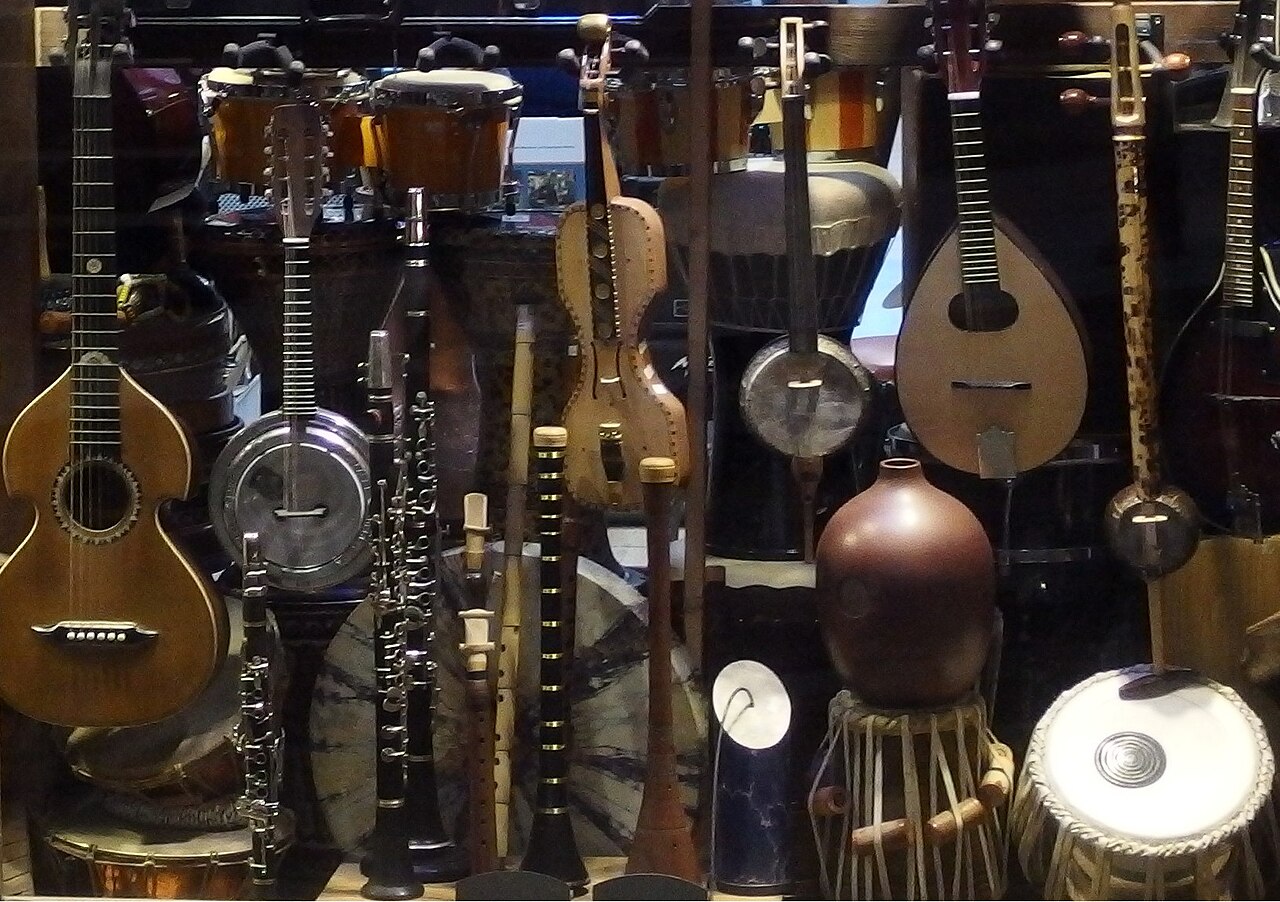
Overview and Prehistoric Foundations
The story of musical instruments begins at the very origins of human civilization, where any object capable of producing sound could serve a musical purpose. [2] Prehistoric peoples demonstrated early technological ingenuity by hand-drilling holes in bones to create simple flutes, representing the earliest known applications of technology to music. [4] These bone flutes mark the first deliberate modification of natural objects to produce controlled pitches, establishing a foundation for all subsequent instrument development.
Early Sound-Making and Material Use
Before the formal classification of instruments, early humans utilized readily available materials such as bone, wood, and animal hide. The act of hand-drilling bone required specific tool use and an understanding of acoustics, suggesting that even in prehistoric times, humans possessed both the technical skill and aesthetic motivation to shape sound. [4] These simple flutes likely served ritual, communal, or individual expression purposes, indicating that music was integral to social life from the earliest stages of civilization.
Archaeological Evidence and Significance
Archaeological findings of bone flutes across various prehistoric sites provide concrete evidence of the human drive to create musical sound. [4] The presence of drilled holes indicates a sophisticated understanding of how tube length and diameter affect pitch, suggesting that these early instruments were not merely noise-makers but carefully designed sound-producing devices. This technological approach to sound production set the stage for the complex instruments that would emerge in later civilizations.
Ancient Egyptian Developments
Ancient Egyptian civilization made significant contributions to the evolution of musical instruments, developing both stringed and wind instruments that required sophisticated construction techniques. [4] Egyptians crafted harps, lyres, and lutes, which relied on thin strings and peg systems for precise pitch adjustment. These stringed instruments represented a major advancement in material science and mechanical design, as the tension and length of strings directly affected the resulting pitch.
Stringed Instruments and Peg Systems
The development of harps, lyres, and lutes in ancient Egypt required innovative solutions for pitch control. [4] Peg systems allowed musicians to adjust string tension, enabling the performance of different scales and melodies. This technological innovation distinguished Egyptian stringed instruments from earlier simple chordophones and demonstrated an understanding of the relationship between string tension and pitch that would influence instrument design for millennia.
Wind and Percussion Instruments
Egyptian musicians also employed a variety of wind and percussion instruments, including double clarinets and cymbals. [4] Double clarinets, with their dual reed systems, required complex breath control and embouchure techniques. Cymbals, while seemingly simple, provided rhythmic foundation and were often used in religious and ceremonial contexts. The coexistence of these diverse instrument types in Egyptian culture illustrates the civilization's sophisticated musical ecosystem.
Cultural and Religious Context
Musical instruments in ancient Egypt were deeply intertwined with religious and cultural practices. [4] Many instruments were depicted in tomb paintings and temple reliefs, suggesting their role in funerary rites and worship of the gods. The harp, for instance, was often associated with divine beings and was played during important religious ceremonies. This integration of music into spiritual life highlights the profound importance of instruments beyond mere entertainment.
Ancient Greek Innovations
Ancient Greek civilization further refined musical instrument design, creating instruments that would influence Western musical tradition for centuries. [4] Greek instruments included the double-reed aulos, a loud woodwind instrument often played in pairs, and the lyre, which combined elements of the harp and zither. These instruments reflect the Greek appreciation for harmony, rhythm, and the mathematical relationships between pitches.
The Aulos and Double-Reed Technology
The aulos represented a significant advancement in wind instrument technology. [4] This double-reed instrument produced a loud, penetrating sound suitable for outdoor performances and military contexts. The use of double reeds required sophisticated embouchure techniques and breath control, demonstrating the Greeks' understanding of air column vibration and resonance. The aulos' presence in Greek art and literature indicates its importance in public life, religious festivals, and theatrical performances.
The Lyre and Stringed Harmony
The lyre became one of the most iconic symbols of ancient Greek culture. [4] Combining a wooden soundbox with strings of varying lengths, the lyre allowed for the production of melodic harmonies and was often associated with education and the ideal of the educated Greek citizen. The instrument's design, with its specific string length ratios, reflects the Greek interest in mathematical relationships in music, a tradition that would later influence Pythagorean tuning systems.
Cultural Significance and Mythology
Greek mythology and literature are replete with references to musical instruments, particularly the lyre and aulos. [4] The lyre was associated with Apollo, the god of music and prophecy, while the aulos was linked to various deities and heroes. These mythological connections underscore the cultural importance of instruments in Greek society, where music was considered essential to education, religious ritual, and the expression of civic identity.
Biblical and Ancient Near Eastern Instruments
The Hebrew Bible and other ancient Near Eastern texts reference a wide variety of musical instruments, providing insight into the musical practices of the region. [4] Instruments such as the cornu, pipe, lyre, harp, and bagpipe are mentioned, demonstrating the diversity of sound-producing devices in ancient societies. These references indicate that musical instruments were integral to religious worship, ceremonial occasions, and daily life across the ancient Near East.
Wind and Reed Instruments
Biblical references to instruments like the cornu and pipe highlight the prevalence of wind instruments in ancient religious and ceremonial contexts. [4] The cornu, a large bronze wind instrument, was used for military signals and public announcements, while pipes of various types were employed in temple worship. The technical requirements of these instruments, including breath control and finger hole placement, suggest a developed understanding of acoustic principles.
Stringed and Percussion Traditions
The lyre and harp held prominent positions in biblical texts, often associated with worship and poetic expression. [4] These stringed instruments were frequently played during religious ceremonies, royal events, and personal devotion. Percussion instruments, though less frequently named, provided rhythmic structure and were integral to the overall musical texture of ancient Near Eastern worship practices.
Bagpipe Origins and Diffusion
The bagpipe, referenced in biblical texts, represents one of the earliest examples of an instrument combining a wind reservoir with melodic pipes. [4] This design principle, where air is stored in a bag and then directed through pipes, represents a significant technological innovation that would spread across many cultures. The bagpipe's appearance in ancient texts suggests its early diffusion across the Mediterranean and Near Eastern regions.
Middle Ages and Musical Notation
The Middle Ages marked a crucial period in the preservation and transmission of musical knowledge, particularly through the development of musical notation. [4] During this era, scholars and monks developed systems to write down plainchant melodies, allowing music to be preserved beyond oral tradition and performed consistently across different regions. This innovation fundamentally changed how music was composed, taught, and preserved.
Neumes and Early Notation Systems
The earliest medieval notation system, called neumes, indicated the melodic direction of plainchant melodies without specifying exact pitches. [4] These neumes appeared above the text and showed whether the melody rose or fell, providing a framework for performers familiar with the chant tradition. This system represented the first step toward precise musical notation and allowed for the standardization of chant across Christian Europe.
Staff Notation and Pitch Precision
The development of the staff system, with its lines and spaces, allowed for precise pitch specification in medieval music. [4] By placing neumes on specific lines and spaces of a staff, composers could indicate exact melodic intervals, making it possible to learn and perform music without prior oral transmission. This innovation enabled the creation of complex polyphonic works and laid the groundwork for the notated music of later periods.
Preservation of Plainchant
The notation of plainchant melodies served both practical and theological purposes during the Middle Ages. [4] By preserving the specific melodies of the Catholic Mass and other liturgical texts, notation ensured theological consistency in worship across vast geographical areas. This preservation of sacred music through written notation represents one of the most significant contributions of medieval music theory to Western musical culture.
Renaissance Printing and Musical Dissemination
The Renaissance era, approximately spanning 1400–1600, witnessed a revolutionary change in music distribution with the invention of the printing press. [4] This technological innovation allowed sheet music to be mass-produced for the first time, breaking the monopoly of hand-copied manuscripts and enabling musical styles to spread quickly across larger areas. The printing press democratized access to music and accelerated the evolution of musical styles.
Mass Production of Sheet Music
Before the printing press, music manuscripts were painstakingly copied by hand, limiting the availability of musical works to wealthy patrons and institutions. [4] The advent of movable type adapted for musical notation changed this landscape entirely. Printers could now produce multiple copies of the same composition relatively quickly and at lower cost, making sheet music accessible to a much broader segment of the population, including the emerging middle class.
Standardization of Musical Styles
Printed music facilitated the rapid spread and standardization of musical styles across Europe. [4] Composers' works could now reach audiences far beyond their immediate geographic location, leading to the cross-pollination of musical ideas. This dissemination contributed to the development of a more unified European musical language, as certain styles and techniques became widely known and imitated.
Impact on Composers and Publishers
The printing press created new opportunities and challenges for composers and music publishers. [4] Composers could now publish their works to reach a wider audience, while printers could profit from selling printed music. This economic model encouraged the creation of new compositions tailored to print, as certain musical forms and styles translated better to the printed page than others, shaping the trajectory of Renaissance music.
Baroque Keyboard Technology
The Baroque era, approximately spanning 1600–1750, saw significant technological advancements in keyboard instruments, representing a golden age of keyboard development. [4] Technologies for keyboard instruments developed rapidly, leading to improvements in pipe organs and the harpsichord, and the emergence of the piano as a new keyboard instrument. This period marked the transition from plucked to struck keyboard mechanisms.
Pipe Organ Refinements
During the Baroque period, pipe organs underwent significant refinements in both construction and sound production. [4] Builders improved pipe design, wind supply systems, and keyboard mechanisms, allowing for greater dynamic control and tonal variety. The Baroque organ became a centerpiece of both church and secular music, capable of producing a wide range of colors and dynamics that suited the era's elaborate musical style.
Harpsichord Evolution
The harpsichord, already established in earlier periods, reached new levels of sophistication during the Baroque era. [4] Instrument makers refined the mechanism that plucks strings when keys are pressed, allowing for more complex tonal variations. The harpsichord's distinctive sound became synonymous with Baroque music, featuring prominently in solo works, chamber ensembles, and continuo accompaniments.
The Emergence of the Piano
Perhaps the most significant innovation of the Baroque period was the development of the piano, a keyboard instrument that could produce dynamics through the force of key depression. [4] Early piano designs experimented with hammer mechanisms that struck strings, offering expressive potential that the harpsichord could not match. This innovation would eventually replace the harpsichord as the dominant keyboard instrument, fundamentally changing the trajectory of Western music.
Technological Principles Across Eras
Throughout the history of musical instruments, certain technological principles have recurred and evolved, reflecting humanity's growing understanding of acoustics and sound production. [3] [4] From the hand-drilling of bone flutes in prehistoric times to the sophisticated peg systems of Egyptian harps and the keyboard mechanisms of Baroque instruments, each technological advancement represented a step toward greater control over pitch, tone, and expression.
Material Science and Construction
The materials used in instrument construction have always been chosen for their acoustic properties and durability. [3] [4] Bone, wood, metal, and later synthetic materials each offer different resonant qualities that instrument makers have exploited throughout history. The evolution from simple bone flutes to complex metal pipes and wire strings demonstrates a continuous exploration of material sonic potential.
Mechanism Development for Pitch Control
A consistent thread in instrument history is the development of mechanisms to control pitch. [3] [4] Whether through finger holes on flutes, peg systems on stringed instruments, or keyboard mechanisms on organs and harpsichords, humans have continually devised ways to alter the effective length, tension, or mass of sound-producing elements. This technological progression reflects a growing sophistication in acoustic engineering.
Cultural Transmission of Innovations
Musical instrument technologies have rarely remained confined to their culture of origin, instead spreading through trade, conquest, and cultural exchange. [3] [4] The peg system from Egyptian harps likely influenced later stringed instruments, while Greek aulos design may have impacted Roman and medieval wind instruments. This cross-cultural transmission of technological knowledge accelerated the evolution of instruments across continents and millennia.
Instrument Classification Systems
As the variety of musical instruments grew across civilizations, the need for systematic classification became apparent, leading to organology as a formal field of study. [4] Various cultures developed their own classification systems, often based on the manner in which sound is produced - whether by blowing, plucking, striking, or bowing. These systems reflect different cultural priorities and understandings of what constitutes a musical instrument.
Hornbostel-Sachs System
The most widely recognized modern classification system, the Hornbostel-Sachs system, categorizes instruments into four main types: membranophones, chordophones, aerophones, and idiophones. [4] This system, developed in the early 20th century, provides a universal framework for classifying instruments from around the world, based on the mechanism that produces sound. It represents the culmination of centuries of observation and categorization of musical instruments.
Historical Classification Approaches
Ancient and medieval societies developed their own classification methods, often blending practical categorization with cultural or religious significance. [4] Greek philosophers like Aristotle classified instruments by material, while medieval theorists sometimes grouped them by function in liturgical or secular contexts. These historical systems, though less systematic than modern approaches, reveal how different cultures organized their musical world.
Impact on Musical Practice
Classification systems have practical implications for how instruments are learned, taught, and performed. [4] Understanding whether an instrument is classified as a chordophone or aerophone, for instance, informs playing technique, repertoire selection, and historical performance practice. These systems also aid in the preservation and study of instruments from different historical periods and cultural contexts.
Reception and Cultural Significance
Throughout history, musical instruments have served purposes far beyond mere sound production, functioning as status symbols, religious artifacts, political tools, and expressions of cultural identity. [4] The reception of new instruments often reflected broader societal values, technological capabilities, and aesthetic preferences of the era. Instruments that represented significant technological or artistic advances were frequently embraced, while others faced resistance or were adapted to fit existing cultural frameworks.
Status and Power Symbolism
In many historical contexts, certain instruments were reserved for the elite or associated with specific social ranks. [4] Elaborate harps, ornate organs, and finely crafted instruments often appeared in art depicting royalty, religious leaders, and wealthy patrons. The materials, craftsmanship, and complexity of an instrument frequently signaled the status of its owner or player, making musical instruments visible markers of power and prestige.
Religious and Ceremonial Functions
Religious institutions have been among the most consistent patrons of musical instrument development throughout history. [4] From the temple rituals of ancient Egypt to the liturgical music of the medieval church, instruments were selected and sometimes specially created for their suitability in sacred contexts. The spiritual significance of certain sounds and instruments shaped their design, distribution, and the roles they played in religious life across cultures and millennia.
Cultural Identity and Preservation
Musical instruments often serve as touchstones of cultural identity, with specific traditions preserving ancient instrument-making techniques. [4] Communities around the world maintain traditional instrument construction methods, passing down knowledge through generations. These living traditions connect contemporary musicians with their ancestral heritage, while also adapting ancient designs to modern musical contexts, ensuring that the history of instruments remains a living, evolving story.
Legacy and Continuing Evolution
The history of musical instruments is not a static narrative but a continuing story of innovation, adaptation, and cultural exchange. [4] [3] The technological principles established in prehistoric times, refined in ancient civilizations, systematized in the Middle Ages, mass-produced in the Renaissance, and improved during the Baroque period all contribute to the rich tapestry of instruments available today. Each era built upon the foundations of its predecessors while introducing new possibilities for musical expression.
Modern Descendants of Historical Instruments
Many contemporary musical instruments can trace their lineage directly to historical predecessors. [4] The modern piano descends from Baroque keyboard experiments, orchestral strings evolved from Renaissance and Baroque designs, and woodwind instruments still utilize acoustic principles first explored by ancient Greeks and Egyptians. This continuity demonstrates how historical instrument design continues to shape the modern musical landscape.
Future Directions and Innovation
Today's instrument makers continue to draw from historical knowledge while exploring new materials, technologies, and acoustic understandings. [3] [4] Digital technologies, new synthetic materials, and interdisciplinary collaborations are creating instruments that would have been unimaginable to our ancestors. However, the fundamental human drive to create tools for musical expression - the same motivation that led to bone flutes in prehistoric times - remains constant, suggesting that the history of musical instruments will continue to evolve in response to human creativity and technological possibility.