
Overview and Definition
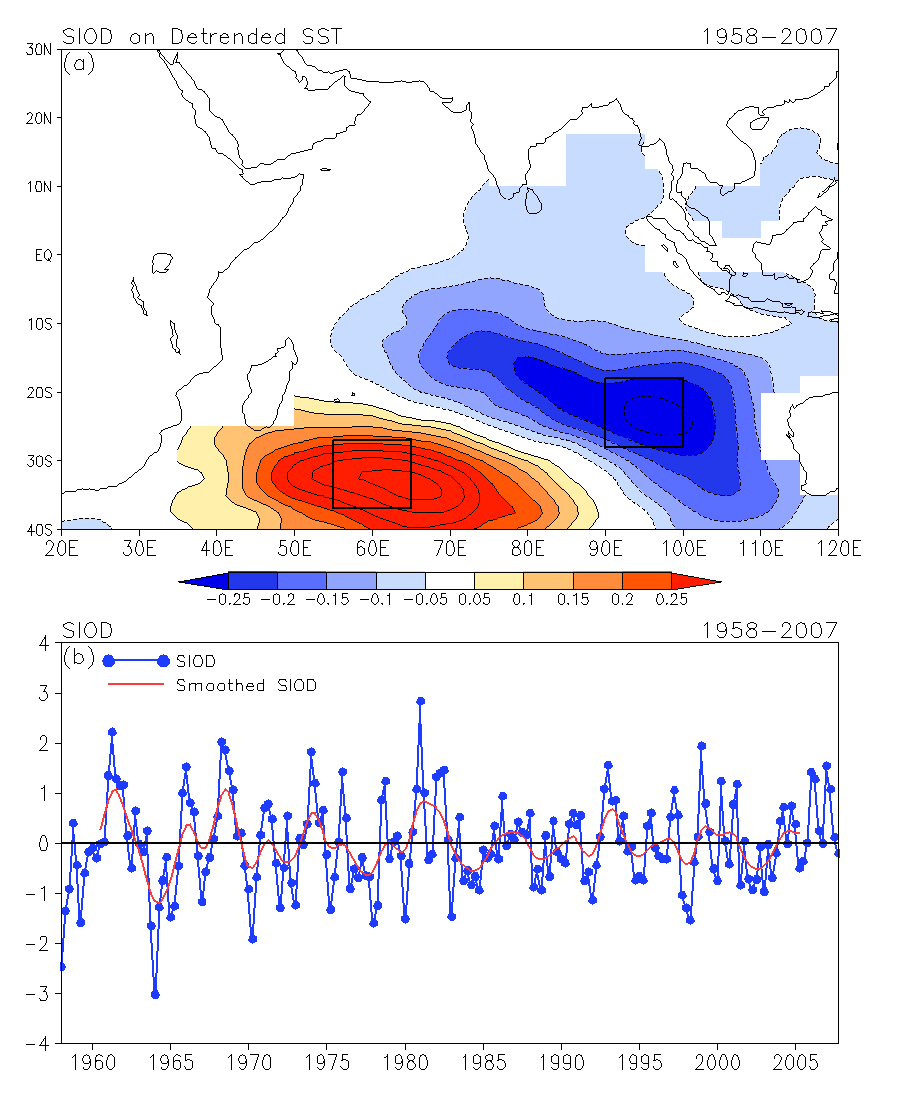
The Indian Ocean Dipole (IOD) is an irregular oscillation of sea surface temperatures in which the western Indian Ocean becomes alternately warmer (positive phase) and then colder (negative phase) than the eastern part of the ocean [1]. This temperature seesaw is defined by the Dipole Mode Index (DMI), which measures the difference between sea surface temperatures in the tropical western and eastern Indian Ocean basins [5].
Positive Phase Characteristics
During a positive IOD phase, greater-than-average sea-surface temperatures and increased precipitation occur in the western Indian Ocean, while the eastern Indian Ocean experiences cooling [1]. This pattern typically brings droughts to adjacent land areas of Indonesia and Australia [1].
Negative Phase Characteristics
The negative phase of the IOD brings about opposite conditions, with warmer water and greater precipitation in the eastern Indian Ocean and cooler, drier conditions in the western region [1]. This phase can influence monsoon dynamics over the Indian subcontinent [1].
Analysis: The IOD operates as a coupled ocean-atmosphere phenomenon, where wind stress and sea surface temperature anomalies reinforce each other across the Indian Ocean basin. The temperature difference between the western and eastern boxes drives atmospheric convection patterns that redistribute rainfall far from the ocean itself.
Phases, Monitoring and Criteria
Three Phases Defined
The IOD has three phases: neutral, positive and negative [3]. Neutral conditions prevail when the DMI lies between minus 0.4 degrees Celsius and plus 0.4 degrees Celsius [2]. A positive IOD phase is defined when the DMI exceeds plus 0.4 degrees Celsius, and a negative IOD when it falls below minus 0.4 degrees Celsius [2].
Monitoring the Dipole Mode Index
The Dipole Mode Index quantifies the IOD by measuring the sea surface temperature difference between the western box (near Africa) and the eastern box (near Indonesia) [5]. In October 2026, the observed Dipole Mode Index was plus 0.75 degrees Celsius, indicating positive IOD conditions across the Indian Ocean [2].
Forecast Probabilities and Outlook
The outlook strongly favors a positive IOD in the near term, with probabilities of 97 percent in November, 75 percent in December, and 58 percent in January 2027 [2]. A clear transition toward neutral conditions is then indicated, with neutral probabilities rising to 71 percent in February and remaining near 70 percent or higher through April [2].
Analysis: The forecast cycle shows the IOD typically developing around May or June, peaking between August and October, and then rapidly decaying when the southern hemisphere monsoon arrives at the end of spring [3]. This seasonal rhythm helps climatologists anticipate IOD impacts on regional weather patterns months in advance.
Historical Events and Significant Episodes
Notable Positive IOD Events
A significant positive IOD occurred in 1997-98, with another in 2006 [1]. These events are associated with widespread climate anomalies, including droughts in Australia and Indonesia and altered monsoon rainfall patterns over the Indian subcontinent [1].
Identification and Research History
The IOD phenomenon was first identified by Indian climate researchers in 1999 from the Indian Institute of Science [1]. Since its formal recognition, the dipole has become a standard component of climate outlooks and seasonal forecasts for the Indian Ocean region [1].
Compound Effects with ENSO
When El Niño coincides with a positive IOD, this can reinforce dry effects across Australia and Indonesia [3]. When La Niña coincides with a negative IOD, there is usually a greater chance of above-average winter-spring rainfall [3]. These compound interactions amplify climate impacts beyond what either phenomenon would produce alone.
Analysis: The 1997-98 and 2006 positive IOD events demonstrate the phenomenon's capacity to synchronize with other climate modes. The Indian Institute of Science's 1999 identification marked a pivotal moment in Indian climate science, establishing the country as a leader in dipole research and forecasting.
Impacts on Monsoons and Agriculture
Indian Monsoon Interactions
The IOD also affects the strength of monsoons over the Indian subcontinent [1]. A positive IOD tends to suppress monsoon rainfall, while a negative IOD can enhance it, creating significant implications for agriculture-dependent regions [1].
Australian Climate Extremes
In Australia, a positive IOD typically brings drought conditions to the southeast and north, while a negative IOD can bring above-average rainfall [1]. The 2019 positive IOD contributed to the severity of the Black Summer bushfires by drying out vegetation across eastern Australia [1].
Indonesian Rainfall Patterns
Indonesia experiences opposite rainfall patterns to Australia during IOD phases. Positive IOD conditions suppress rainfall in western Indonesia, often leading to fire-prone dry conditions, while negative IOD events bring enhanced precipitation [1]. These patterns directly affect agricultural scheduling and water resource management.
Analysis: The IOD's influence on monsoon strength creates a see-saw effect across the Indo-Australian region. When the dipole is positive, the Indian subcontinent often receives below-average monsoon rain, while Australia experiences drought. Conversely, a negative IOD can bring relief rainfall to India but drought to Indonesia. This spatial redistribution of precipitation makes the IOD a critical factor for food security in both regions.
Oceanic Mechanisms and Development
Wind-Driven Ocean Dynamics
The IOD arises from wind-driven ocean dynamics across the Indian Ocean. During positive IOD development, westerly wind anomalies over the equatorial Indian Ocean reduce upwelling in the east and enhance it in the west, warming the western box and cooling the eastern box [5].
Sea Surface Temperature Patterns
Warmer than average sea surface temperatures in the east of the Indian Ocean basin can provide more moisture for frontal systems and lows crossing the continent [5]. This additional moisture fuel can intensify rainfall events when systems move onto land, particularly during negative IOD phases.
Seasonal Cycle and Decay
IOD events usually start around May or June, peak between August and October and then rapidly decay when the monsoon arrives in the southern hemisphere around the end of spring [3]. The seasonal timing of IOD development is closely tied to the progression of the Australian and Indian monsoons.
Analysis: The wind-evaporation-SST feedback mechanism is central to IOD growth. Easterly winds normally enhance upwelling in the east, cooling those waters. When westerly wind anomalies reverse this pattern, the temperature gradient accelerates, reinforcing the atmospheric convection shift that defines the dipole phase.
2026 Forecast Context and Current Conditions
Current Positive IOD Status
In October 2026, the observed Dipole Mode Index was plus 0.75 degrees Celsius, indicating positive IOD conditions across the Indian Ocean [2]. This reading places the system above the plus 0.4 degrees Celsius threshold that defines a positive IOD phase according to CCSR/IRI criteria [2].
Probabilistic Outlook Through Early 2027
The forecast indicates a strong likelihood of positive IOD conditions persisting into early 2027, with 97 percent probability in November, 75 percent in December and 58 percent in January [2]. By February, neutral conditions become increasingly likely at 71 percent probability, and neutral conditions remain near 70 percent or higher through April [2].
Implications for Regional Climate
Given the current positive IOD state, above-average temperatures and below-average rainfall are expected in the western Indian Ocean region, with corresponding drought risk in Indonesia and Australia [1]. The Indian monsoon may receive suppressed rainfall, while Australian winter-spring precipitation could be below average [1][3].
Analysis: The persistence of positive IOD conditions through late 2026 and into early 2027 aligns with the typical lifecycle of these events. The rapid decay expected when the southern hemisphere monsoon arrives suggests that the most intense climate impacts will likely occur before monsoon onset, making the November to January period critical for disaster preparedness and agricultural planning in affected regions.
Climate Change Context and Future Projections
Changing Frequency and Intensity
Research suggests that climate change may alter the frequency and intensity of IOD events. Warmer background sea surface temperatures in the Indian Ocean could potentially enhance the temperature contrasts that drive dipole phases [5]. However, changes to atmospheric circulation patterns associated with greenhouse gas forcing introduce uncertainty into future IOD projections.
Interaction with ENSO Under Changing Climate
As El Niño and La Niña patterns shift under climate change, the ways in which they interact with the IOD may also change. Warmer eastern Indian Ocean temperatures could provide more moisture for extratropical systems, potentially altering rainfall patterns far from the ocean basin [5].
Societal and Economic Risks
Given the IOD's strong influence on agriculture, water resources and disaster risk, understanding how its characteristics may change under climate change is crucial for adaptation planning. The 1997-98 and 2006 positive events already caused significant economic disruption, and future events occurring against a warmer baseline could have amplified impacts [1].
Analysis: The IOD does not operate in isolation from the broader climate system. Its interactions with ENSO, the seasonal march of the monsoons, and background warming all shape its expression. Continued monitoring through the Dipole Mode Index and improved seasonal forecasting will be essential for managing climate risks in the coming decades.