
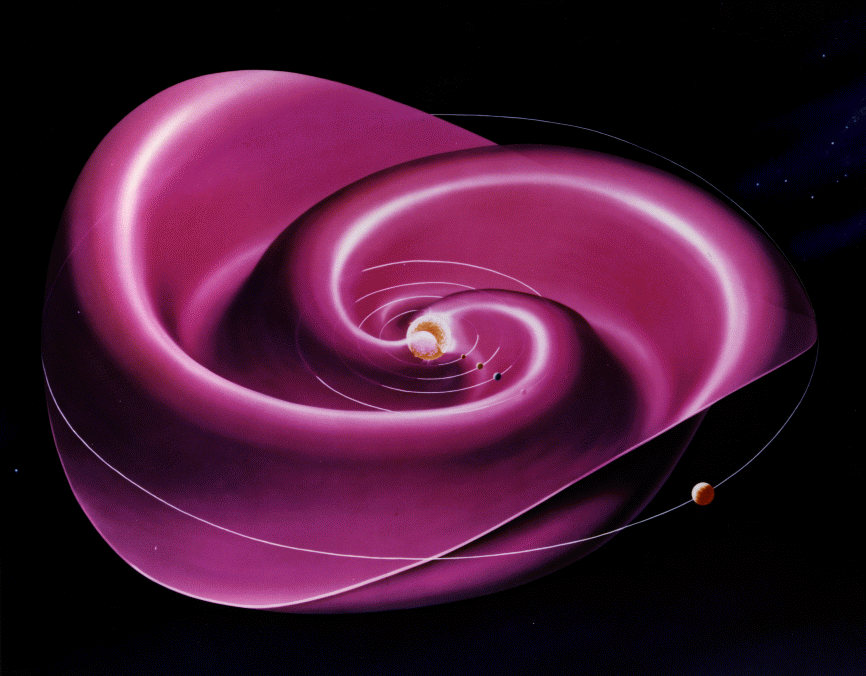
Origins in the Solar Corona
The interplanetary magnetic field (IMF), also called the heliospheric magnetic field (HMF), is the component of the solar magnetic field dragged out from the solar corona by the solar wind to fill the Solar System [2]. In the solar corona, the magnetic pressure greatly exceeds the plasma pressure and thus the plasma is primarily structured and confined by the magnetic field [2]. This fundamental condition means that plasma and magnetic field lines remain effectively "frozen" together, preventing diffusion on relevant time scales [2].
Magnetic Dominance and Plasma Confinement
Because coronal magnetic pressure dominates, the plasma follows field lines rather than the reverse. This confinement shapes active regions, quiet-Sun corridors, and the large-scale topology that the solar wind later carries outward. The frozen-in condition ensures that any twist or structure imposed at the Sun is preserved as the field is dragged into interplanetary space.
Energy Extraction and Acceleration
With increasing altitude through the corona, the solar wind accelerates as it extracts energy from the magnetic field through the Lorentz force interaction, resulting in the flow momentum exceeding the restraining magnetic tension force [2]. This acceleration is the decisive step that frees the coronal magnetic field and allows it to become the IMF.
The Parker Spiral Geometry
Rotation and Outward Motion
The Parker spiral results from the solar wind traveling outward from the Sun at 200–800 km/s while an individual jet of solar wind from a particular feature on the Sun's surface rotates with the solar rotation, making a spiral pattern in space [2]. The combination of radial outflow and solar rotation imposes an Archimedean spiral geometry on the otherwise radial field.
Field Line Winding and Supersonic Flow
As the Sun rotates, its magnetic field twists into an Archimedean spiral (the Parker spiral) after Eugene Parker's work that predicted the structure of the interplanetary magnetic field [1]. This acceleration often leads the IMF to be locally supersonic up to 160 AU away from the Sun [2], meaning the magnetic field is carried well beyond planetary orbits at speeds exceeding the local solar wind sound speed.
Dynamic Pressure and Field Shape
The dynamic pressure of the wind dominates over the magnetic pressure through most of the Solar System, so that the magnetic field is pulled into an Archimedean spiral pattern (the Parker spiral) by the combination of the outward motion and the Sun's rotation [2]. This shape is a direct consequence of the solar wind's momentum overwhelming magnetic tension at large distances.
Current Sheet Structure and the Heliospheric Current Sheet
Current Sheet Formation
The heliospheric current sheet is a three-dimensional form of a Parker spiral that results from the influence of the Sun's rotating magnetic field on the plasma in the interplanetary medium [2]. It separates regions of the heliosphere where the interplanetary magnetic field points toward and away from the Sun [1].
Current Density and Thickness
A small electrical current with a current density of about 10⁻¹⁰ A/m² flows within the heliospheric current sheet, forming a current sheet confined to this surface [1]. The thickness of the current sheet is about 10,000 km (6,200 mi) near the orbit of the Earth [1].
Solar Rotation and Sheet Warping
Because the current sheet is derived from the Parker spiral, its orientation varies with solar latitude and heliographic latitude. The warping of the current sheet over the solar cycle reflects the changing tilt of the solar magnetic dipole and the evolving solar wind speed distribution.
Earth-Oriented Orientation and Near-Space Environment
Mean Field Angle and Solar Wind Speed
In near-Earth space, the IMF nominally makes an angle of approximately 45° to the Earth–Sun line, though this angle varies with solar wind speed [2]. Faster solar wind streams produce smaller spiral angles, while slower streams yield larger deviations from the radial direction.
IMF Orientation and Space Weather
The 45° nominal angle means that Earth's magnetosphere frequently encounters southward IMF components, which can drive geomagnetic storms via magnetic reconnection. The variability of this angle with solar wind speed introduces a predictable seasonal and latitudinal dependence in geomagnetic activity.
Solar Wind Acceleration and Field Dragging
Lorentz Force and Energy Transfer
The solar wind accelerates through the Lorentz force interaction, which transfers energy from the magnetic field to the kinetic energy of the outflowing plasma [2]. This process is essential: without magnetic energy extraction, the wind would not reach the speeds necessary to drag the coronal field into interplanetary space.
Supersonic Regime and Extent
The IMF becomes locally supersonic up to 160 AU from the Sun [2], demonstrating that the magnetic field is not merely a passive passenger but an active participant in heliospheric dynamics. At these distances, the wind's ram pressure continues to dominate magnetic pressure, maintaining the Parker spiral shape across the entire heliosphere.
Historical Prediction and Observational Confirmation
Eugene Parker's Theoretical Framework
Eugene Parker's pioneering work predicted the existence and structure of the interplanetary magnetic field, including the solar wind and the Parker spiral [1]. His theory provided the first quantitative description of how a magnetized, expanding solar corona could produce a structured interplanetary field.
Spacecraft Measurements and Validation
Direct measurements from missions such as Helios, Ulysses, and ACE have confirmed the Parker spiral geometry, the current sheet's thickness and current density, and the 45° nominal IMF angle at Earth [1][2]. These observations have refined the theoretical models and revealed fine-scale structure not captured in early analytic descriptions.
Variability Across the Solar Cycle
Current Sheet Warping and Heliospheric Current Sheet Neutral Line
As the Sun rotates, its magnetic field twists into an Archimedean spiral, and the heliospheric current sheet warps in response to the changing dipole tilt over the solar cycle [1][2]. During solar maximum, the sheet becomes more complex and warped; during solar minimum, it approaches a simple Parker spiral configuration near the ecliptic.
Sector Structure and Sector Boundaries
The heliospheric current sheet separates regions where the IMF points toward versus away from the Sun, creating magnetic sectors [1]. Sector boundaries are sites of enhanced current density and are frequently associated with corotating interaction regions (CIRs) that drive recurrent geomagnetic activity.
Implications for Space Exploration and Technology
Radiation Environment and Spacecraft Charging
The interplanetary magnetic field, together with the solar wind, determines the radiation environment experienced by spacecraft beyond Earth's magnetosphere. The Parker spiral's orientation affects the access of solar energetic particles to different heliographic longitudes, influencing spacecraft charging risk and single-event upsets.
Forecasting and Space Weather Operations
Because the IMF orientation at Earth varies with solar wind speed and heliographic latitude, space weather forecasters monitor solar wind parameters to predict geomagnetic disturbance likelihood. The 45° nominal angle and its deviations serve as a baseline for models that predict storm sudden commencements and prolonged intervals of southward field.