
Overview
John of Patmos is traditionally identified as the author of the Book of Revelation, the final book of the New Testament. He is known for receiving apocalyptic visions while exiled on the island of Patmos, which he recorded under the influence of the word of God and the testimony of Jesus. His identity and exile remain central to the origin and interpretation of the Revelation text.
Traditional Attribution and Apostolic Connection
Christian tradition considers the Book of Revelation's writer to be the same person as John the Apostle, one of the Twelve Apostles of Jesus. This identification links the author directly to the inner circle of Jesus's followers, though the text itself does not name the author explicitly. The traditional view holds that John the Apostle and John of Patmos are one and the same individual.
Exile on Patmos Under Domitian
Revelation 1:9 states John was on Patmos because of the word of God and the testimony of Jesus. Early Christian writers such as Eusebius later identified this exile as occurring under the Roman emperor Domitian, who persecuted Christians in the late 1st century. John does not explicitly say he was sent, banished, or condemned; he uses the Greek verb 'I came to be,' suggesting a voluntary or providential presence on the island rather than a legal condemnation.
The island of Patmos is located off the coast of Roman Asia in the Aegean Sea. Ancient sources describe it as a place of exile, and tradition holds that John received the visions that became the Book of Revelation while living there. The Cave of the Apocalypse on Patmos is traditionally shown as the site where John received his visions, and the island's remote location made it a typical destination for political and religious exiles in the Roman era.
Identification with John the Apostle
The Two Johns in Early Christianity
Christian tradition identifies John of Patmos with John the Apostle, the son of Zebedee and brother of James. However, a minority of ancient clerics and scholars, such as Eusebius, recognize at least one further John as a companion of Jesus known as John the Presbyter. This distinction reflects an early debate over which John authored the Johannine literature, including the Gospel of John, the Epistles of John, and the Book of Revelation.
Evidence from the Revelation Text
The Book of Revelation does not explicitly identify its author by name. Revelation 1:9 refers to John as a brother and companion in the persecution and kingdom and patient endurance in Jesus, but he does not say he was sent, banished, or condemned. The use of the Greek verb 'I came to be' rather than a passive construction of being sent or banished has led some scholars to argue the author was describing his own presence on Patmos as a voluntary act of faith rather than a legal punishment.
Patmos as the Exile Location
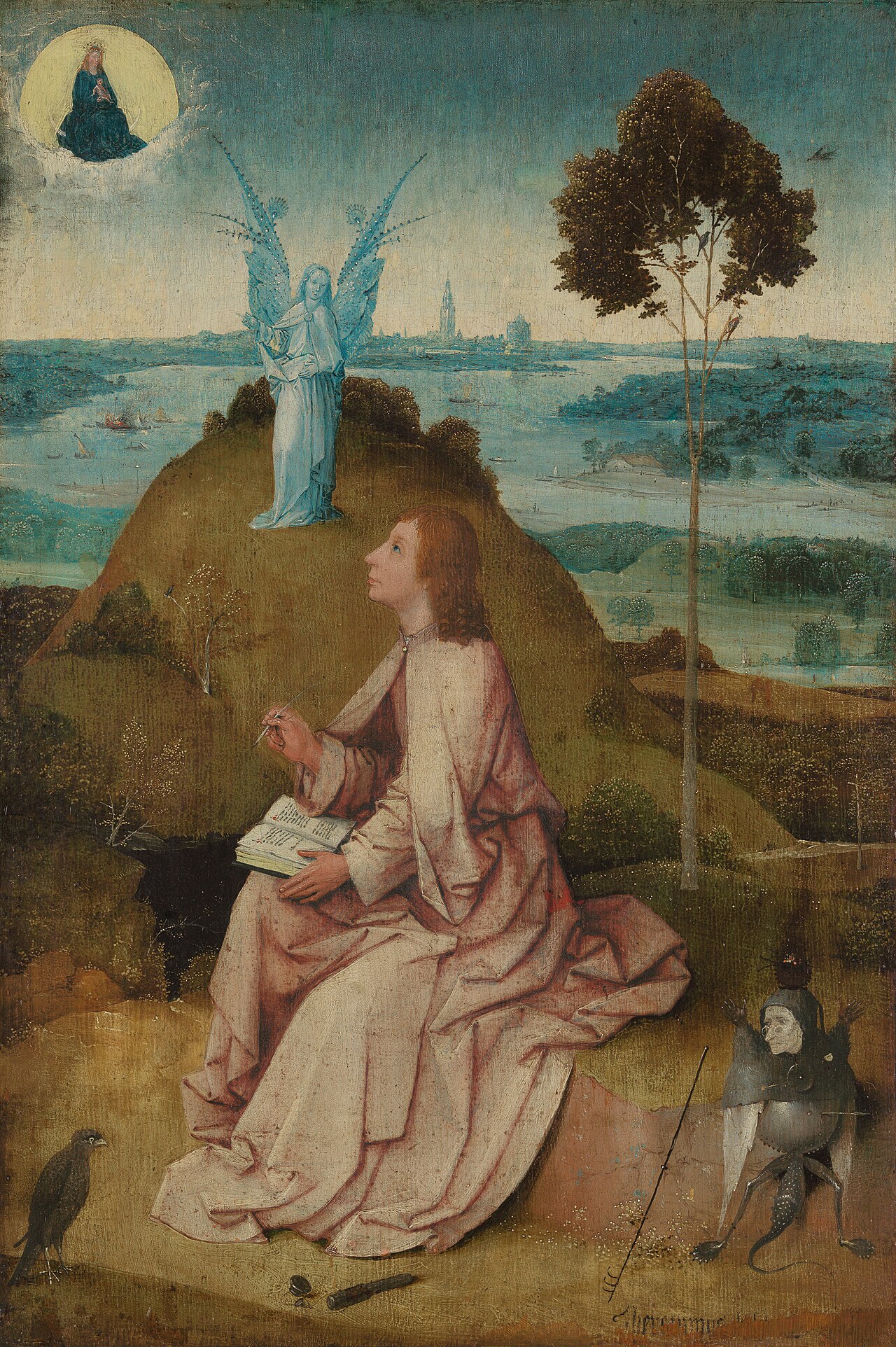
Early church tradition consistently places John's exile on the island of Patmos, located off the coast of Roman Asia in the Aegean Sea. The island's geography and its status as a Roman exile site support the historical plausibility of the tradition. Nicolas Poussin painted 'Landscape with Saint John on Patmos' in 1640, and Hieronymus Bosch painted 'Saint John the Evangelist on Patmos' in 1488, both depicting the traditional site of his visionary experience.
The Cave of the Apocalypse on Patmos is traditionally shown as the site where John received visions. This location has become a place of pilgrimage and is recognized as a UNESCO World Heritage site as part of the 'Historic Centre of the Island of Patmos'. The identification of this cave as the setting for the Revelation visions reinforces the connection between the place and the text.
The Writing of the Book of Revelation
Dictation to Prochorus
Prochorus is traditionally identified as John's disciple who wrote down what John dictated. This tradition suggests that John received the visions orally or through revelation and communicated them to Prochorus, who recorded them in writing. This method of transmission was common in the ancient world for preserving sacred texts, and it explains how the apocalyptic content of Revelation was preserved and circulated.
Apocalyptic Style and Content
The Book of Revelation is written in an apocalyptic style, using symbolic language, visions of future events, and imagery drawn from Jewish prophetic tradition and Roman imperial propaganda. The text describes a cosmic conflict between good and evil, the fall of Babylon, and the ultimate triumph of God's kingdom. Its style reflects the genre of apocalyptic literature that was prevalent in the 1st century CE, particularly during times of persecution.
Canonical Status and Acceptance
The Book of Revelation was eventually accepted into the Christian canon, though its acceptance was not immediate. Some early church figures questioned its authorship and its use of symbolic language. Its eventual inclusion solidified the tradition identifying John of Patmos as its author and reinforced the connection between the author's exile and the divine origin of the message.
The text's reception history includes both veneration and controversy. Its vivid imagery has inspired countless works of art, literature, and theology, while its complex symbolism has led to diverse interpretive traditions across Christian history. The book's survival and canonical status attest to its enduring significance for the Christian community.
Historical Context of the Exile
Roman Persecution Under Domitian
John was on Patmos during a time of persecution under the Roman emperor Domitian. Domitian's reign (81-96 CE) was marked by a renewal of imperial cult worship and the persecution of those who refused to acknowledge the emperor as lord. Christians, who refused to worship the emperor, were particularly targeted. John's presence on Patmos aligns with the historical pattern of sending political and religious dissidents to remote islands during this period.
Geography of Patmos
The island of Patmos is located off the coast of Roman Asia in the Aegean Sea. In the 1st century, it was used as a place of exile for political and religious offenders. Its remote location made it suitable for isolating individuals who were seen as threats to the stability of the Roman Empire. The island's name appears in the New Testament only in connection with John's exile, and it has since become synonymous with the author of the Book of Revelation.
Relationship to Other Exile Sites
Patmos was one of several islands used by the Romans for exile, along with Patara and others in the Aegean. The use of islands for exile was a common practice in the Roman legal system, allowing the government to remove troublesome individuals from the mainland while keeping them within the empire's control. John's exile to Patmos fits this pattern, though the specific reasons for his exile are not detailed in the surviving texts.
The historical context of Domitian's persecution provides a plausible backdrop for the tradition of John's exile. While the New Testament does not explicitly state that Domitian sent John to Patmos, the timing and location are consistent with the imperial policy of using exile to manage perceived threats. This context helps explain why the tradition of John's exile on Patmos gained traction in the early church.
Artistic and Cultural Depictions
Renaissance and Baroque Art
Nicolas Poussin painted 'Landscape with Saint John on Patmos' in 1640, depicting the saint on the island receiving his visions. Hieronymus Bosch painted 'Saint John the Evangelist on Patmos' in 1488, showing the saint in a landscape setting. These artworks reflect the enduring cultural impact of the tradition of John's exile and visionary experience. They often include symbolic elements such as the cave, the scroll, and the divine light associated with the Revelation narrative.
Visual Symbolism in Art
Artistic depictions of John of Patmos frequently include specific symbolic elements: the cave where he received visions, the scroll or book containing the Revelation text, and sometimes an eagle, symbolizing the divine inspiration of his writing. These visual conventions have been established over centuries of artistic tradition and continue to influence how the figure is portrayed in religious art.
Modern Cultural References
The figure of John of Patmos continues to appear in modern cultural works, including literature, film, and music. His story of exile and revelation resonates with themes of persecution, hope, and divine communication. Modern adaptations often reinterpret the narrative for contemporary audiences, while maintaining the core elements of the traditional account.
The cultural legacy of John of Patmos extends beyond religious contexts. His story has been invoked in discussions of freedom of thought, the rights of conscience, and the role of the prophetic voice in society. The Cave of the Apocalypse on Patmos remains a site of pilgrimage and cultural interest, drawing visitors interested in the historical and spiritual dimensions of the Revelation narrative.
Theological Significance
Role in Christian Eschatology
The Book of Revelation plays a central role in Christian eschatology, the study of last things. Its visions of the end times, the return of Christ, and the final judgment have shaped Christian thought about the future. John of Patmos, as the traditional author, is seen as the channel through which these divine revelations were communicated. His exile on Patmos is interpreted by some as a symbol of the faithful suffering for their witness.
Relationship to Other Johannine Writings
The identification of John of Patmos with John the Apostle links the Book of Revelation to other writings attributed to John, such as the Gospel of John, the Epistles of John, and the Johannine literature. This connection has implications for understanding the theological themes that run throughout these texts, such as the nature of Christ, the role of love, and the promise of eternal life. The question of whether one author wrote all these works remains a subject of scholarly debate.
Interpretive Traditions
Throughout Christian history, interpreters have offered various readings of the Book of Revelation. Some view its imagery as symbolic of the ongoing struggle between good and evil in the present age, while others see it as a prediction of future events. The diversity of interpretive traditions reflects the text's richness and the challenges of interpreting apocalyptic literature. John of Patmos' role as the traditional author gives these interpretations a focal point, even as scholars continue to debate the historical realities of his life and exile.
The theological significance of John of Patmos extends to his representation as a model of faithful endurance. His presence on Patmos, whether as a voluntary act of devotion or a result of persecution, is seen as an example of steadfastness in the face of adversity. This aspect of his story has inspired Christians facing persecution throughout history.
Scholarly Debates and Historical Criticism
Authorship Debates
Scholarly debate continues over the authorship of the Book of Revelation. While traditional identification places the author as John of Patmos, equated with John the Apostle, critical scholarship has questioned this connection. Some scholars argue that the literary style, theological themes, and linguistic features of Revelation differ from those of the Gospel and Epistles attributed to John, suggesting a different author or a community of writers.
Historical Reliability of the Exile Tradition
The historical reliability of the tradition that John was exiled to Patmos under Domitian is assessed by critical historians. The New Testament text itself does not provide explicit details about the circumstances of John's exile. The connection between the author of Revelation and the John mentioned in other New Testament writings is not definitively established. Historians evaluate the plausibility of the tradition based on the historical context of Roman exile practices and the early church's testimony.
The Role of John the Presbyter
A minority of ancient clerics and scholars, such as Eusebius, recognize John the Presbyter as a separate figure from John the Apostle. Eusebius distinguishes between the Apostle John, author of the Gospel and Epistles, and John the Presbyter, who is mentioned as a companion of Jesus. This distinction reflects an effort to reconcile the various Johannine writings and the tradition of John's exile. The existence of John the Presbyter suggests that early Christianity held multiple traditions about which John was authoritative.
Scholarly analysis of the evidence continues to weigh the internal claims of the Revelation text, the testimony of early church fathers, and the historical context of 1st-century Christianity. The debate over John of Patmos' identity is not merely academic; it touches on how the early church understood its origins, the transmission of sacred texts, and the relationship between the apostolic age and the subsequent development of Christian doctrine.
The Island of Patmos as a Pilgrimage Site
Monastic Tradition
The Holy Monastery of St John of Patmos, located on the island, has been a center of monastic life and pilgrimage since the 11th century. The monastery was founded to honor John of Patmos and to protect the relics and manuscripts associated with him. It remains an active monastery and a major destination for Orthodox Christian pilgrims, who visit the Cave of the Apocalypse and other sites associated with the saint.
UNESCO World Heritage Status
The 'Historic Centre of the Island of Patmos' is designated as a UNESCO World Heritage site, recognizing its cultural and historical significance. The designation includes the monastery, the cave of the Apocalypse, and the urban fabric of the island's main settlement, Chora. This status reflects the island's importance as a place where religious tradition and historical landscape have been preserved together.
Contemporary Pilgrimage and Tourism
Today, visitors to Patmos can tour the Cave of the Apocalypse, the monastery, and other sites associated with John of Patmos. The island's reputation as a place of spiritual significance continues to attract pilgrims, as well as tourists interested in its history and natural beauty. The combination of religious heritage and Mediterranean scenery makes Patmos a unique destination in the Aegean.
The island's status as a pilgrimage site has economic and cultural implications for the local community. Monastery life, guided tours, and the sale of religious artifacts contribute to the local economy, while the preservation of historical sites maintains the island's cultural identity. The legacy of John of Patmos thus continues to shape the life of the island in the 21st century.
Legacy in Christian Liturgy
Feast Days and Commemorations
John of Patmos is commemorated in various Christian calendars. In the Western tradition, his feast day is often celebrated on September 26 or May 8, depending on the denomination. In the Eastern Orthodox and Eastern Catholic churches, he is honored as a saint and apostle, with feast days that may coincide with the celebration of the Book of Revelation's themes. These commemorations reflect his role as the traditional author of the last book of the New Testament.
Scripture Readings
Passages from the Book of Revelation are read in Christian liturgical settings, particularly during seasons focusing on eschatology, the end times, or the triumph of good over evil. The lectionary selections vary by denomination, but the book's imagery of the Lamb, the new heaven, and the new earth are recurrent themes. John of Patmos' authorship is presupposed in these readings, linking the liturgical use of the text to his traditional identity.
Hymns and Liturgical Poetry
The figure of John of Patmos and the content of the Book of Revelation have inspired hymns and liturgical poetry. Texts that reference the 'word of God and the testimony of Jesus,' as Revelation 1:9 states, are used in worship services that focus on perseverance, divine revelation, and the hope of redemption. These hymns often portray John as a model of faithful witness under trial.
The integration of Revelation's themes into liturgical practice demonstrates the enduring impact of John of Patmos' traditional authorship. Even as scholarly debate continues, the book's words are woven into the fabric of Christian worship, shaping the spiritual life of congregations around the world. The cave on Patmos, where the visions were received, remains a symbol of the divine origin of these sacred words.
Comparative Religious Context
Apocalyptic Literature in Antiquity
The Book of Revelation is part of a broader tradition of apocalyptic literature that appeared in Judaism and early Christianity during the 2nd century BCE to the 2nd century CE. Works such as the Book of Daniel, the Temple Scroll, and the various Jewish apocalypses share themes of cosmic conflict, divine judgment, and the deliverance of the righteous. John of Patmos' use of symbolic language and visionary imagery reflects this wider literary context, even as his work has a distinct Christian theological focus.
Roman Imperial Propaganda and Resistance
The imagery in the Book of Revelation, particularly the fall of 'Babylon' and the beast, has been interpreted by scholars as a critique of Roman imperial power and the imperial cult. During the reign of Domitian, who demanded worship as lord, the book's message of the ultimate triumph of God's kingdom over earthly powers would have resonated with persecuted Christians. The text's use of Roman political language and symbols, subverted to serve a different kingdom, illustrates the complex relationship between early Christian literature and the imperial context.
Jewish Apocalyptic and Early Christian Interpretation
The relationship between Jewish apocalyptic literature and the Book of Revelation is a subject of scholarly study. Many features of Revelation, such as the use of numbers, the structure of visions, and the theme of the final deliverance, have parallels in Jewish texts. John of Patmos, whether understood as a Jewish Christian or a Gentile Christian writing in a Jewish milieu, drew on this shared literary heritage. The resulting synthesis contributed to the development of distinctively Christian eschatological thought.
Understanding John of Patmos within this comparative context highlights how his work both participated in and transformed the apocalyptic genre. The text's survival and canonical status indicate that early Christian communities found value in its message, even as they navigated the challenges of interpreting a work that drew on diverse religious and political traditions.
Gender and Identity in Early Christian Traditions
The Question of Authorial Identity
The tradition identifying John of Patmos as a male apostle reflects the gender norms of the early Christian communities that preserved and transmitted the text. The name John was common, and the distinction between John the Apostle, John the Presbyter, and John of Patmos shows how early Christians navigated the question of authorial identity. The assumption of male authorship was typical of the period, though modern scholarship has begun to re-examine the possibilities of female contributors to early Christian literature.
Women in Exile and Prophecy
While the traditional account focuses on John of Patmos, the historical reality of Roman exile affected both men and women. Women who were perceived as threats to Roman order or Christian orthodoxy could also be sent to remote islands. The apocalyptic genre, with its themes of divine deliverance and the reversal of fortunes, has often been interpreted as having particular resonance for those who experienced marginalization or persecution. Some feminist scholars have re-read apocalyptic texts to uncover voices of women within the tradition.
The Silence of the Text on Gender
The Book of Revelation itself does not address questions of gender in the authorial voice. The text's references to 'seven churches,' 'seven spirits,' and symbolic figures have been interpreted in various ways, but the text does not provide explicit information about the author's gender or social location. The traditional identification of the author as John of Patmos has shaped subsequent interpretation, but the silence of the text on this point leaves room for diverse readings.
The question of gender and identity in relation to John of Patmos illustrates how the traditions about the author have been used to shape understandings of early Christian community, authority, and the transmission of sacred texts. As scholarly methods evolve, the figure of John of Patmos continues to be a point of reference for discussions about the origins of the New Testament and the diversity of early Christian voices.
The Textual History of Revelation
Manuscript Transmission
The Book of Revelation was transmitted through manuscript copies in the early Christian centuries. The survival of these manuscripts, from the 2nd century to the present, provides evidence of the text's popularity and importance. Variations in the manuscripts, including differences in wording and ordering of sections, reflect the process of textual transmission and the efforts of scribes to preserve the author's intended message.
Early Canonical Lists
Early church fathers and councils produced lists of authoritative books, or canons, for Christian worship and teaching. The Book of Revelation's inclusion in these lists was not universal at first. Its eventual acceptance by the broader Christian community solidified the tradition of John of Patmos as its author. The canonical history of Revelation demonstrates the dynamic process by which Christian scripture was formed.
Textual Variants and Interpretation
Textual variants in the manuscripts of Revelation have influenced its interpretation over the centuries. Some variants affect the meaning of key passages, while others reflect scribal adjustments or regional theological preferences. The study of these variants, combined with the tradition of John of Patmos' authorship, offers insight into how the text was understood and used in different Christian communities.
The textual history of Revelation is inseparable from the tradition of its authorship. As manuscripts were copied and distributed, the identification of John of Patmos as the author became embedded in the textual tradition. This connection between text and author has shaped how the book has been read, interpreted, and preserved throughout Christian history.
Modern Reception and Popular Culture
Influence on Modern Thought
The Book of Revelation, attributed to John of Patmos, continues to influence modern thought beyond strictly religious contexts. Its imagery of conflict, judgment, and new creation has been invoked in political discourse, environmental thought, and popular culture. The figure of John of Patmos, as the traditional author, serves as a touchstone for discussions about the end times, moral crisis, and the hope of transformation.
Adaptations in Film and Literature
The narrative of John of Patmos and the content of the Book of Revelation have been adapted in numerous film and literary works. These adaptations range from direct dramatizations of the text to loose inspirations that use the framework of exile and revelation to explore contemporary themes. The enduring appeal of the story reflects its capacity to speak to anxieties and hopes in different eras.
Debates in Public Discourse
The Book of Revelation and its traditional author are sometimes invoked in public debates about politics, social change, and cultural values. Different groups claim the text's imagery to support their positions, while others critique its use in public discourse. The figure of John of Patmos, whether understood historically or symbolically, remains a recognizable element in these conversations.
The modern reception of John of Patmos illustrates how a figure from the 1st century can remain relevant in the 21st. The combination of historical interest, theological significance, and cultural resonance ensures that the traditional account of his exile and visionary experience continues to be discussed, debated, and deployed in various fields of human endeavor.