
Foundations of the Leaky Integrate-and-Fire Model
The Leaky Integrate-and-Fire (LIF) model stands as one of the most widely used phenomenological descriptions of neuronal dynamics, capturing essential features of spiking behavior while remaining mathematically tractable [4]. This model emerged from the need to describe how neurons integrate incoming signals and generate discrete output events, providing a bridge between detailed biophysical models and abstract neural computations [4].
Membrane Potential and Resting State
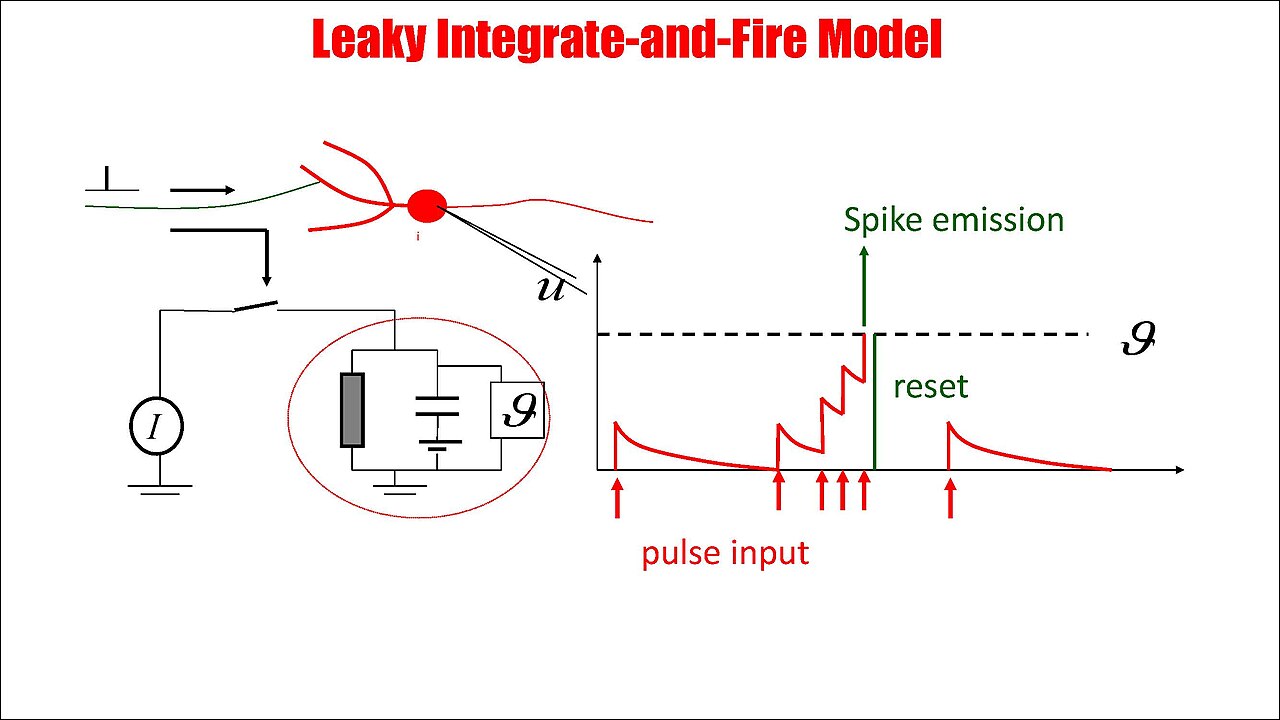
In the LIF framework, the membrane potential u_i(t) represents the momentary voltage across the neuronal membrane, with the variable i indexing individual neurons within a network [4]. In the absence of any external input, this potential rests at a baseline value known as the resting potential u_rest, representing the equilibrium state maintained by the neuron's intrinsic ionic conductances [4].
Capacitance and Leak Conductance
The cell membrane possesses properties analogous to an electrical capacitor with capacity C, storing charge as voltage changes [4]. However, the membrane is not a perfect insulator; charge slowly leaks through the membrane over time through leak channels, creating a decay in the membrane potential toward rest even in the absence of active pumping mechanisms [4]. This leak phenomenon is fundamental to the model's name and distinguishes it from idealized integrate-and-fire variants.
These passive membrane properties form the basis for how the LIF model represents temporal integration of inputs, with the membrane time constant tau = C/g_leak determining how quickly the potential decays toward rest [4].
Input Current and Membrane Dynamics
Current Injection and Potential Deflection
When a current I(t) is injected into a neuron—whether through external electrical stimulation or synaptic input from other neurons—the membrane potential u_i deflects from its resting value u_rest [4]. This deflection represents the neuron's response to both exogenous and endogenous sources of electrical current, forming the core mechanism by which information enters the integrate-and-fire framework.
Linear Differential Equation Governance
The LIF model employs a linear differential equation linking the momentary voltage deviation (u_i(t) - u_rest) to the input current I(t), derived from elementary laws of electricity including Kirchhoff's laws and the capacitor equation I = C(dv/dt) [4]. This mathematical formulation allows analytical solutions for the membrane potential evolution and provides a clear relationship between input current and voltage trajectory.
Temporal Integration Window
The linear nature of the differential equation means that the membrane potential integrates input current over time, with the leak term causing older contributions to decay exponentially [4]. This creates a temporal window of integration where recent inputs have greater influence on the membrane potential than older ones, enabling the neuron to respond to time-varying input patterns.
This integration property underlies the LIF model's ability to encode information in the timing and pattern of input currents, with the neuron's state at any moment representing a weighted sum of recent input history.
Spike Generation and Threshold Mechanism
Threshold Crossing and Firing
A defining feature of the LIF model occurs when the membrane potential u_i(t) reaches a critical threshold value from below [4]. This threshold crossing constitutes the moment of spike generation, with the precise timing of this event defining the neuron's firing time [4]. The threshold mechanism serves as the nonlinear element in an otherwise linear system, creating the transition from subthreshold voltage fluctuations to discrete spike output.
Reset Mechanism After Spike
Following spike generation, the membrane potential is typically reset to a value below threshold, often to the resting potential or a reset potential V_reset [4]. This reset ensures that the neuron cannot fire repeatedly in immediate succession without new input, establishing a refractory period governed by the model's parameters rather than biophysical absolute refractory periods.
Event-Based Output Representation
The LIF model reduces action potentials to 'events' that happen at a precise moment in time [4]. This reduction reflects the biological observation that neuronal action potentials of a given neuron always have roughly the same form and cannot transmit information through shape [4]. The spike timing itself becomes the carrier of information, enabling temporal coding schemes where the precise moment of firing conveys meaning.
This event-based output scheme allows the LIF model to participate in rate coding, where firing frequency encodes information, as well as temporal coding schemes where precise spike timing matters for information transmission.
Generalized Integrate-and-Fire Extensions
Part II Variations in Neuronal Dynamics
The basic Leaky Integrate-and-Fire model serves as the foundation for a family of generalized integrate-and-fire models discussed in Part II of the Neuronal Dynamics online book [4]. These variations extend the core framework to incorporate additional biological realism while maintaining mathematical tractability.
Model Variations and Extensions
Generalized integrate-and-fire models can incorporate adaptive thresholds, multiple conductances, spike-frequency adaptation, and other biophysical features that the basic LIF model omits [4]. Each variation preserves the core integrate-and-fire structure while adding layers of complexity to better match experimental observations.
Computational Advantages of the Framework
The integrate-and-fire family maintains the computational advantages of the LIF approach—analytical solvability, parameter interpretability, and efficient simulation—while addressing specific limitations of the basic model [4]. This balance between biological realism and computational efficiency explains the family's enduring popularity in computational neuroscience.
Researchers can select appropriate model variants based on the specific questions addressed, from studying basic integration properties with the LIF model to investigating adaptation phenomena with more complex variants.
Information Encoding in LIF Networks
Rate Coding Schemes
In LIF networks, information can be encoded through the firing rate of individual neurons, with higher input currents producing more frequent spike output [4]. This rate coding scheme forms the basis for many neural network models and allows the LIF framework to participate in population coding where ensembles of neurons collectively represent information.
Temporal Coding Possibilities
The precise spike timing output of LIF neurons enables temporal coding schemes where the exact moment of each spike carries information [4]. This approach can exploit the millisecond-scale precision of neural spiking and allows for more efficient information transmission in certain network configurations.
Synaptic Input Integration
When neurons receive synaptic input from other neurons in a network, the input current I(t) becomes a function of the spike trains of presynaptic partners [4]. This creates rich dynamical behaviors where network topology, connection strength, and synaptic dynamics shape the overall network dynamics and information processing capabilities.
The LIF framework thus serves as a foundational component for spiking neural network models, enabling the study of how biological or artificial networks of integrate-and-fire units can perform computation through spike-based communication.
Mathematical Properties and Analysis
Analytical Solvability
The linear differential equation governing the LIF model admits analytical solutions for the membrane potential evolution given constant or piecewise-constant input currents [4]. This solvability allows researchers to derive explicit formulas for firing times, interspike intervals, and response properties without resorting to numerical simulation alone.
Phase Plane Analysis
The LIF model's two-dimensional structure (membrane potential and input current) enables phase plane analysis revealing the qualitative dynamics of neuronal firing [4]. Trajectories in the phase plane show how the membrane potential evolves toward threshold and how different input patterns affect the firing behavior.
Parameter Sensitivity and Firing Rate
The steady-state firing rate of an LIF neuron in response to constant input I is given by explicit formulas involving the membrane time constant, threshold, and reset potential [4]. This relationship allows direct prediction of how changes in model parameters affect output frequency, providing insight into the parameter space governing neuronal excitability.
Such analytical tractability makes the LIF model particularly valuable for studying how biological parameters influence neural computation and for designing experiments to test theoretical predictions.
Biological Plausibility and Limitations
Simplifications of Real Neuronal Dynamics
While the LIF model captures essential features of neuronal spiking, it represents significant simplifications of real neuronal dynamics [4]. Real neurons exhibit complex spike shapes, afterhyperpolarizations, spike-frequency adaptation, and voltage-dependent conductances that the LIF model's linear framework cannot represent.
Structural Determinants of Information
The model's reduction of action potentials to identical events means it cannot account for information transmission through spike shape variability, which exists in biological neurons [4]. This limitation necessitates more detailed models when studying phenomena where spike shape carries information.
Context-Dependent Conductances
The LIF model's fixed leak conductance and membrane capacitance do not capture context-dependent changes in neuronal properties, such as neuromodulatory effects, voltage-dependent ion channels, or activity-dependent plasticity [4]. These biological realities require model extensions or more detailed conductance-based formulations.
Despite these limitations, the LIF model's value lies in its ability to provide a tractable framework for studying principles that apply across more detailed models, serving as a null hypothesis against which more complex models can be compared.
Applications in Computational Neuroscience
Spiking Neural Network Simulations
The LIF model forms the core of many spiking neural network simulators and frameworks, enabling the study of network-level phenomena such as synchrony, oscillations, and information processing [4]. These simulations can incorporate thousands or millions of LIF units, exploring how network structure gives rise to emergent dynamics.
Theoretical Studies of Neural Coding
Researchers use the LIF framework to investigate fundamental questions about neural coding, including how information represents in spike timing, how networks achieve robustness to parameter variations, and what network architectures support specific computational functions [4]. The model's simplicity allows systematic exploration of these questions.
Prosthetic and Brain-Computer Interface Design
The LIF model's tractability extends to practical applications such as neural prosthetics and brain-computer interfaces, where understanding the relationship between intended movement and neural spike output is essential [4]. The model can inform decoding algorithms that translate neural activity into control signals.
These applications benefit from the LIF model's balance of biological relevance and mathematical simplicity, enabling both theoretical insight and practical implementation.
Historical Development and Context
Integration of Membrane Principles
The LIF model emerged from the integration of elementary electrical principles—capacitance, conductance, and current flow—into a dynamical framework for neuronal modeling [4]. This synthesis represented a significant step toward mathematically rigorous computational neuroscience, providing a quantitative foundation for studying neuronal dynamics.
Role in Neuronal Dynamics Literature
As documented in the Neuronal Dynamics online book, the LIF model occupies a central position in the theoretical landscape of neuronal modeling, with extensive discussion of its properties, extensions, and applications [4]. The model's inclusion in comprehensive theoretical treatments underscores its importance as a foundational concept.
Enduring Relevance in the Field
Decades after its formulation, the LIF model remains one of the most widely used neuronal models in computational neuroscience, continuing to serve both as a research tool and an educational foundation [4]. Its enduring relevance speaks to the successful balance it strikes between biological realism and computational tractability.
The model's longevity also reflects the vibrant ongoing research program around integrate-and-fire variants, with new extensions and applications regularly appearing in the literature.
Comparison with Alternative Modeling Approaches
Against Hodgkin-Huxley and Conductance-Based Models
Compared to detailed conductance-based models like Hodgkin-Huxley, the LIF model sacrifices biological detail for mathematical simplicity [4]. Hodgkin-Huxley models incorporate voltage-dependent sodium and potassium conductances, producing realistic spike shapes and complex dynamical behaviors that the LIF model's linear framework cannot reproduce.
Against Spike Response Models
Spike response models and other phenomenological approaches offer alternative nonlinear frameworks for describing neuronal firing, sometimes incorporating spike-afterdepolarization effects and other features beyond the LIF structure [4]. These models may better capture certain aspects of neuronal dynamics while maintaining some of the integrate-and-fire philosophy.
Advantages of the LIF Framework
The LIF model's primary advantage lies in its analytical tractability, parameter interpretability, and computational efficiency, making it suitable for large-scale network simulations and parameter studies where detailed models would be computationally prohibitive [4]. Researchers can explore broad parameter spaces and network configurations that would be infeasible with more detailed approaches.
This trade-off between biological realism and computational practicality explains the LIF model's continued prominence despite the availability of more detailed alternatives.
Future Directions and Emerging Research
Hybrid Models Combining LIF with Deep Learning
Recent research explores hybrid approaches that incorporate LIF neuron models into deep learning architectures, enabling spiking neural networks that can learn through backpropagation while maintaining the event-driven computation characteristic of integrate-and-fire neurons [4]. These efforts seek to combine the energy efficiency of spiking computation with the training flexibility of deep learning.
Quantum-Inspired Extensions
Quantum-inspired variational approaches have begun to explore connections between integrate-and-fire dynamics and quantum information processing, suggesting novel directions for research at the intersection of quantum computing and neural modeling [3]. These theoretical investigations may reveal new computational principles applicable to both quantum and classical neural systems.
Adaptive and Heterogeneous Network Models
Future research continues to extend the LIF framework to incorporate adaptive thresholds, heterogeneous parameter distributions, and stochastic input currents, creating more realistic representations of biological neuronal populations [4]. These extensions aim to capture population-level phenomena such as variability, noise-induced transitions, and statistical properties of neural coding.
The ongoing expansion of the integrate-and-fire family ensures that the LIF model will remain at the forefront of computational neuroscience research for the foreseeable future.