
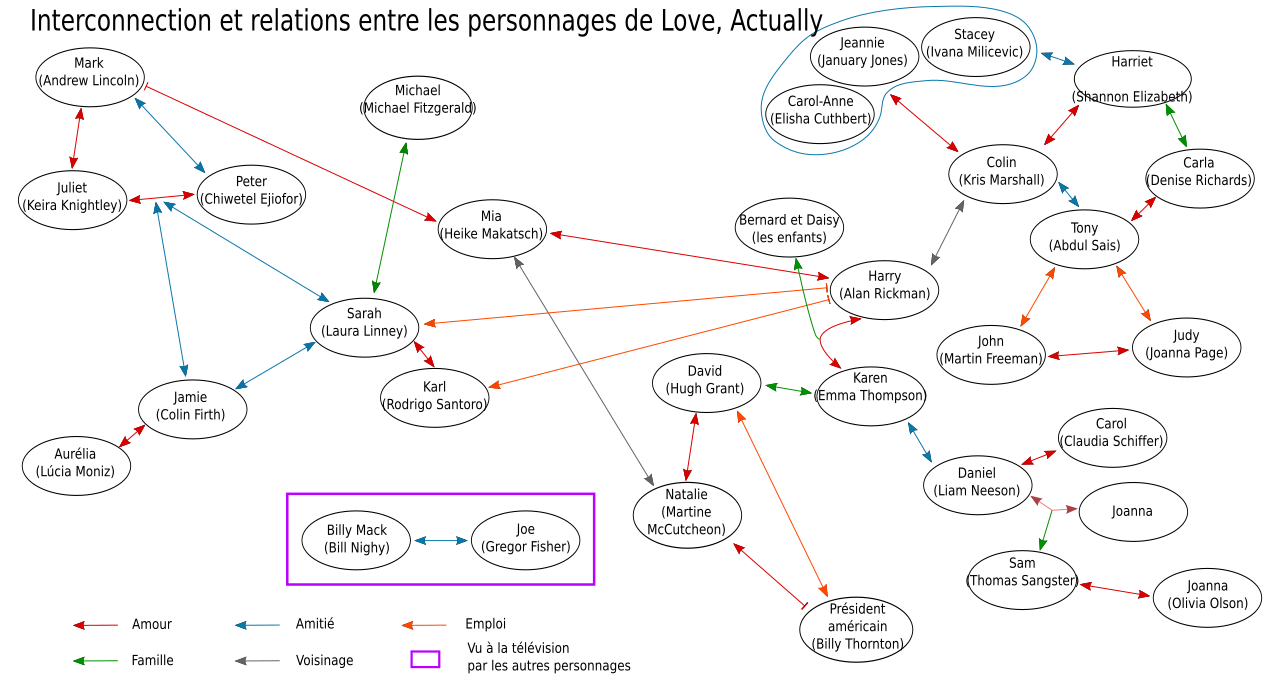
Overview: Richard Curtis's 2003 Ensemble Romantic Comedy
Love Actually is a 2003 film directed by Richard Curtis that premiered internationally through Universal Pictures and in France through Mars Distribution [1]. The film stars Hugh Grant as the British Prime Minister who performs a famous dance scene, and features an ensemble cast including Liam Neeson, Colin Firth, Keira Knightley, and Bill Nighy [1]. The film has a runtime of 135 minutes and its soundtrack includes music by Craig Armstrong [1]. Love Actually was released in the United States on November 14, 2003, and in the United Kingdom on November 21, 2003 [1].
Production and Distribution Background
Love Actually was produced by StudioCanal, Working Title Films, and DNA Films [1]. The film was distributed internationally by Universal Pictures and in France by Mars Distribution [1]. These production companies brought together a British ensemble cast and crew to create what would become one of the most recognizable romantic comedies of the 2000s.
Cast and Characters
The film features an ensemble cast led by Hugh Grant as the British Prime Minister, alongside Liam Neeson, Colin Firth, Keira Knightley, and Bill Nighy [1]. Each actor portrays interconnected storylines exploring different facets of love during the Christmas season. The cast's chemistry and performances became a defining element of the film's enduring popularity.
Musical Score and Soundtrack
The film's soundtrack includes music by Craig Armstrong [1], whose compositions became integral to the film's emotional tone. The Pointer Sisters' song "Jump (For My Love)" features prominently in the Downing Street dance recreation scene [3], connecting the film's musical elements to real-world political events.
The Prime Minister Dance Scene: Cinematic Moment and Real-World Replication
Hugh Grant's character as the British Prime Minister performs a famous dance scene to the Pointer Sisters' "Jump (For My Love)" in Love Actually [1,3]. This scene became the most quoted and referenced moment from the film, known for its blend of awkward humor and romantic optimism. The dance sequence showcases Grant's comedic timing and has become a cultural touchstone.
Choreography and Performance Details
The dance scene features Hugh Grant's Prime Minister character dancing through Number 10 Downing Street [3]. The choreography combines awkward movements with genuine enthusiasm, creating a moment that is both humorous and endearing. This specific performance style became replicable and would later be reproduced in real-world political settings.
Cultural Impact and References
The dance scene's popularity extended beyond the film itself, becoming referenced in political contexts [3]. Its recognizability made it an ideal candidate for political satire and recreation, as the visual of a prime minister dancing in an official residence is both surprising and memorable to audiences familiar with the film.
Musical Connection to Pointer Sisters
The Pointer Sisters' "Jump (For My Love)" provides the soundtrack for the dance scene [3]. This connection between the film's musical choice and the subsequent political recreation demonstrates how specific audio-visual elements from cinema can be repurposed in unexpected contexts.
Influencer Replication at Downing Street
Luke Hamnett is an influencer who posted a video dancing to the Pointer Sisters' "Jump (For My Love)" through No 10 Downing Street [3]. This real-world recreation brought the fictional film scene into the actual official residence of the British Prime Minister, creating a direct link between cinematic fiction and political reality.
Context of the Replication
The influencer's choice to dance through Downing Street specifically references the location from the film [3]. By selecting this particular location, Luke Hamnett intentionally connected his performance to Hugh Grant's fictional prime ministerial dance, creating a deliberate anachronism between fiction and reality.
Social Media Amplification
The video posted by Luke Hamnett gained significant attention on social media platforms [3]. The replication leveraged the viral nature of both the original film scene and influencer content, creating a multiplier effect that amplified the reach beyond typical political commentary.
Political Satire Implications
Using a fictional dance scene from a romantic comedy as the basis for real-world performance at the seat of British political power inherently carries satirical implications [3]. The choice to perform at Downing Street transforms a lighthearted film moment into commentary on the nature of political performance and public image.
Andy Burnham's 'Unserious' Label and Political Reaction
Andy Burnham, the UK Labour Party leader, was labelled 'unserious' after the influencer recreated Hugh Grant's prime ministerial dance scene from Love Actually at Downing Street [3]. This reaction from a major political figure highlights how the recreation was perceived not merely as entertainment but as relevant to serious political discourse.
Perception of Political Appropriateness
The labelling of Andy Burnham as 'unserious' suggests that the dance recreation was viewed as inappropriate or trivializing by some political observers [3]. This perception reflects broader debates about the boundaries between entertainment, political performance, and serious governance.
Comparison of Fictional and Actual Officeholders
Kemi Badenoch criticized the dance recreation, stating it was jarring because Hugh Grant was pretending to be Prime Minister while Andy Burnham actually is the Prime Minister [3]. This distinction between actor and officeholder became central to the political reaction, highlighting the importance of authenticity in political imagery.
Public Figure Responses
The reaction from both Andy Burnham and Kemi Badenoch demonstrates how quickly cultural moments from cinema can intersect with political reality [3]. Political figures must navigate the boundary between acknowledging cultural references and maintaining the dignity of their offices.
Kemi Badenoch's Critique and Authenticity Concerns
Kemi Badenoch criticized the dance recreation, stating it was jarring because Hugh Grant was pretending to be Prime Minister while Andy Burnham actually is the Prime Minister [3]. Her critique focused on the authenticity of the political representation, arguing that the recreation blurred the line between fiction and reality in a way that was confusing or misleading.
Distinction Between Actor and Officeholder
The core of Kemi Badenoch's criticism was the distinction between an actor performing a role and an actual holding political office [3]. This distinction matters for public perception of political figures and the ways in which cultural moments can be co-opted for political messaging or critique.
Framing of the Controversy
Badenoch framed the controversy around the jarring nature of the mismatch [3]. By highlighting the discrepancy between fictional portrayal and actual officeholding, she drew attention to how seriously the public and political figures take the representation of political power in popular culture.
Broader Implications for Political Satire
The critique raises questions about the limits of political satire when it relies on cultural references that may not translate accurately [3]. What works as humor in one context may become confusing or inappropriate when the underlying assumptions about who holds office are different.
Timeline of Events: From Film Release to Political Replication
Love Actually was released in the United States on November 14, 2003, and in the United Kingdom on November 21, 2003 [1]. This timing placed the film's release during the early 2000s, when it would eventually become part of popular culture references years later.
Initial Reception and Legacy
Upon its release, Love Actually received positive reviews for its ensemble cast and interwoven storylines [1]. The film's dance scene featuring Hugh Grant as Prime Minister became one of its most memorable moments, though its full cultural impact would not be realized until nearly two decades later when it was reproduced at Downing Street.
Influencer Action and Political Reaction
Years after the film's initial release, influencer Luke Hamnett posted a video dancing to "Jump (For My Love)" through No 10 Downing Street [3]. This action triggered immediate reactions from political figures including Andy Burnham being labelled 'unserious' and Kemi Badenoch offering criticism about authenticity [3]. The entire sequence demonstrates how cultural artifacts can remain relevant and provoke discussion decades after their creation.
Reception and Significance: Cultural and Political Impact
The reception of the Downing Street dance recreation reveals much about the intersection of popular culture and political discourse [3]. What began as a lighthearted film moment became a talking point in serious political commentary, demonstrating the unexpected ways in which cinema can influence public conversation.
Media Coverage and Public Discourse
The incident received coverage from multiple news outlets [3], indicating that it was perceived as newsworthy beyond just entertainment gossip. The fact that serious political figures felt compelled to respond suggests that the boundary between cultural reference and political statement has become increasingly blurred.
Significance for Influencer Politics
The event highlights the growing influence of social media personalities in shaping political discourse [3]. Luke Hamnett's choice to perform at Downing Street demonstrates that influencers have access to and can impact significant political spaces, even if unintentionally.
Enduring Relevance of 2003 Cinema
That a 2003 romantic comedy could still provoke political discussion in the 2020s speaks to the film's lasting cultural resonance [1]. Love Actually has become more than just a holiday viewing tradition; it has become a cultural reference point that can be deployed in unexpected contexts.
Analysis: Why This Matters for Understanding Popular Culture and Politics
The Love Actually Downing Street incident reveals fundamental tensions between popular culture references and political reality [3]. When an influencer recreates a fictional scene at the seat of government, they create a collision point between entertainment and governance that forces audiences to confront the distinctions between actor and officeholder, fiction and fact.
The Power of Cinematic Imagery
Hugh Grant's dance scene demonstrates the power of cinematic imagery to become embedded in collective cultural memory [1]. Even years after a film's release, specific scenes can be recalled and reproduced in real-world contexts, showing how movies function as cultural infrastructure that outlives their initial release.
Political Performance and Public Image
The reactions from Andy Burnham and Kemi Badenoch highlight how seriously political figures take their public image [3]. In an era where visual performance matters significantly, even a dance scene from a romantic comedy can become a matter of political consequence when it occurs at significant locations.
Lessons for Future Cultural-Political Intersections
This incident may set precedents for how future cultural-political intersections will be handled [3]. As social media continues to blur the lines between entertainment and reality, we can expect more instances where fictional moments from film, television, or other media are reproduced in political spaces, requiring new frameworks for understanding and responding to such events.