
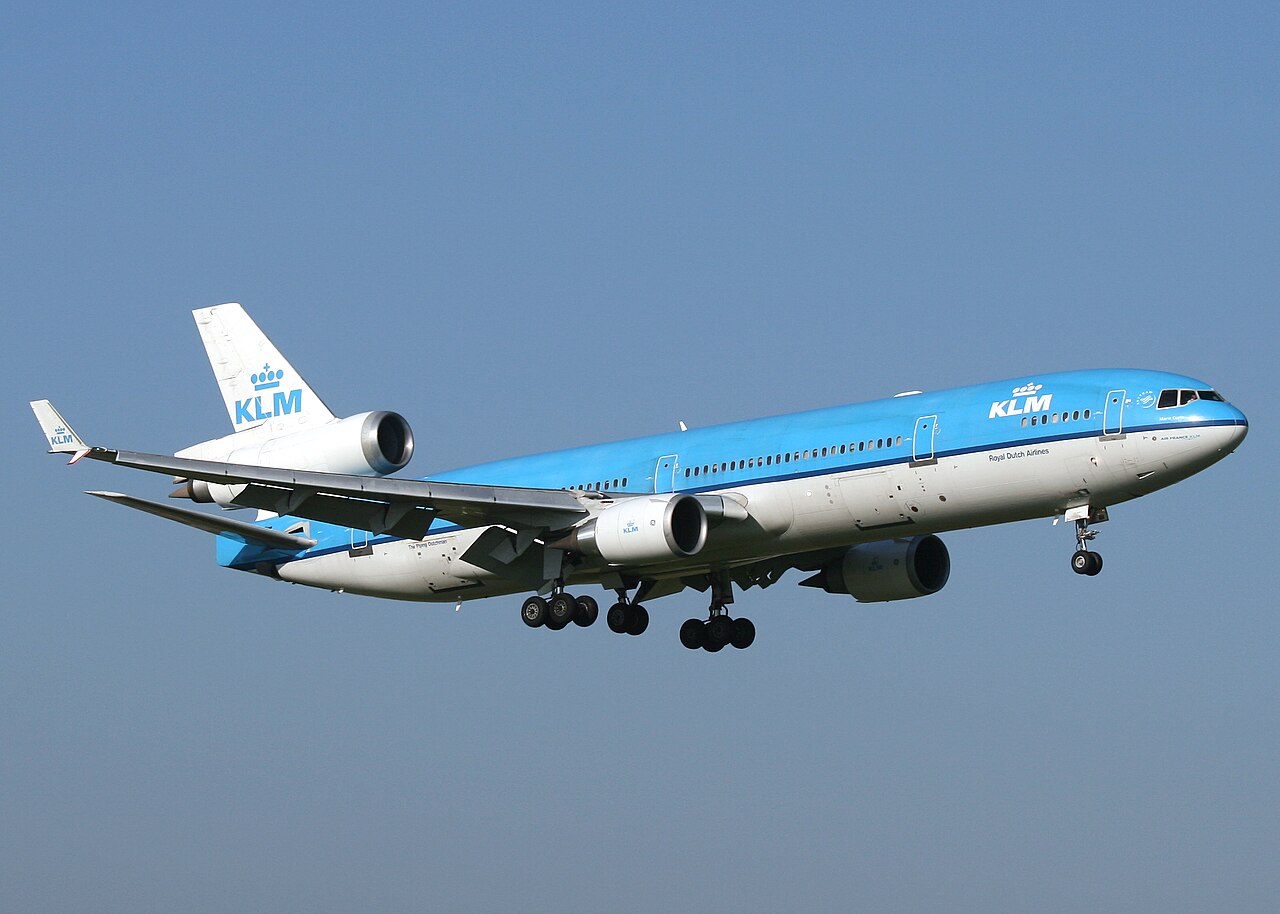
Background and Development
The McDonnell Douglas MD-11 traces its origins to the DC-10, sharing a similar trijet layout but featuring a lengthened fuselage, increased wingspan, and new engines. McDonnell Douglas designed the MD-11 to offer improved efficiency and range over its predecessor, targeting the long-haul wide-body market. [1] The aircraft was conceived as a modernized derivative, leveraging existing type type ratings while incorporating aerodynamic refinements.
Design Evolution from DC-10
Key design changes included a supercritical wing, refined engine nacelles, and a glass cockpit that reduced crew workload. The MD-11's fuselage stretch accommodated up to 30 more passengers in typical configurations compared to the DC-10. These improvements were intended to meet evolving airline requirements for range and fuel economy on intercontinental routes. [1]
First Flight and Certification
The MD-11 made its first flight on January 10, 1990, marking the beginning of an extensive flight-test program. Certification by aviation authorities followed, paving the way for entry into service later that year. The first flight represented a significant milestone for McDonnell Douglas as it sought to compete in the long-range wide-body segment against twin-engine competitors emerging in the market.
Entry into Service
Finnair became the launch customer, introducing the MD-11 into commercial service on December 20, 1990. The airline's initial operations demonstrated the aircraft's capabilities on European and Asian routes. Finnair's role as launch customer validated the aircraft's design and provided McDonnell Douglas with valuable early operational data.
Production and Manufacturing Transition
Production Run and Variants
McDonnell Douglas produced the MD-11 in passenger and freighter configurations. The passenger version typically seated between 246 and 368 travelers depending on layout, while the MD-11F freighter variant offered a large main-deck cargo door and extended range for freight operations. Production continued through the 1990s as airlines worldwide evaluated the type for fleet modernization.
Merger and Boeing Takeover
A pivotal industry event occurred in 1997 when McDonnell Douglas merged with Boeing. Following the merger, Boeing Commercial Airplanes assumed responsibility for MD-11 production and support. Boeing continued manufacturing the type until 2000, after which no new MD-11s were built. This transition marked the end of an era for McDonnell Douglas-designed commercial jets.
Supply Chain and Engine Options
The MD-11 was offered with two engine families: General Electric CF6 and Pratt & Whitney PW4000. This engine option flexibility allowed airlines to select the powerplant best suited to their operational requirements, whether prioritizing range, thrust, or maintenance considerations. The availability of two major engine options represented a strategic advantage in attracting diverse customers.
Finnair and Launch Customer Operations
Finnair's MD-11 Fleet
Finnair, as the launch customer, operated the MD-11 for many years, incorporating the aircraft into long-haul routes across Europe, Asia, and North America. The airline's MD-11s featured a three-class configuration that became familiar to passengers on transcontinental services. Finnair's experience with the type provided valuable insights into passenger comfort and operational performance.
Route Performance
Finnair utilized the MD-11 on routes connecting Helsinki to destinations such as Tokyo, New York, and Bangkok. The aircraft's range and payload capabilities enabled these non-stop or minimal-stop services, which would have been more challenging with earlier-generation wide-bodies. The MD-11's performance on these routes demonstrated its intercontinental viability.
Fleet Retirement
Finnair eventually retired its MD-11 fleet as part of fleet modernization efforts, replacing the type with more modern twin-engine wide-bodies. The retirement marked the end of an era for Finnair's long-haul operations that had featured the trijet configuration. The airline's transition reflected broader industry trends toward twinjet efficiency.
Passenger Airline Service and Retirements
KLM's Passenger Operations
KLM operated the MD-11 as a passenger aircraft for many years, incorporating the type into its long-haul fleet. The Dutch carrier's MD-11s served routes across Europe, Africa, and Asia, offering passengers a three-class experience distinctive to the trijet design. KLM's operations contributed to the type's visibility in European skies.
Last Passenger Flight
KLM flew the last scheduled MD-11 passenger flight on October 25, 2014, marking the conclusion of passenger service for the type after more than two decades in commercial service. The retirement of KLM's passenger fleet followed similar retirements by other European carriers. This date represents a symbolic endpoint for the MD-11's passenger career.
Other Passenger Operators
Beyond Finnair and KLM, various passenger airlines including Lufthansa, American Airlines, and Delta Air Lines incorporated the MD-11 into their fleets at different times. American Airlines and Delta Air Lines ultimately replaced their MD-11s with Boeing 777s, reflecting the type's gradual displacement by newer-generation aircraft. These fleet replacements illustrate the competitive dynamics of the wide-body market.
Lufthansa Cargo's Role
Lufthansa Cargo received the very last MD-11 produced, cementing its position as the final major airline to order the type. The cargo operator's continued use of the MD-11F freighter variant highlights the aircraft's enduring utility in freight operations even as passenger services ceased. Lufthansa Cargo's fleet represents one of the last remaining MD-11 operator groups.
Cargo Operations and Freighter Conversions
FedEx Express as Primary Operator
FedEx Express has become the world's largest MD-11 operator, maintaining a mixed fleet of aircraft powered by both General Electric and Pratt & Whitney engines. The express carrier's MD-11s form a critical component of its global air freight network, offering the range and capacity needed for long-haul cargo missions. FedEx's extensive MD-11 fleet reflects the type's adaptability to demanding cargo operations.
Fleet Conversion Pattern
Several airlines initially operating MD-11s as passenger aircraft later converted their fleets to freighter configuration. China Airlines, which had five MD-11s, converted all units to freighters. Similarly, EVA Air, which operated nine MD-11s, converted its entire fleet to freighter configuration. This conversion pattern demonstrates the type's economic viability in cargo roles even after passenger operations ended.
Conversion Process and Economics
The conversion of passenger MD-11s to freighters typically involves removing passenger amenities, installing cargo handling systems, and reinforcing the main deck floor. For airlines like China Airlines and EVA Air, this transformation extended the economic life of aircraft that had completed their passenger service. The freighter conversions represented a pragmatic approach to maximizing asset value in a changing market.
Remaining Cargo Fleet
As of the early 2020s, a significant number of MD-11Fs remain in cargo service worldwide, with FedEx Express operating the largest portion. Other cargo operators include UPS, which also acquired converted MD-11s, and various freight airlines across Asia and Europe. The continued cargo operations extend the type's service life beyond its passenger service years.
Fleet Replacement and Succession
Boeing 777 Replacement
American Airlines and Delta Air Lines both replaced their MD-11 fleets with Boeing 777s, reflecting the natural succession pattern in airline fleet modernization. The Boeing 777 family offered common type ratings with existing fleets, two-engine efficiency, and advanced technology that the older MD-11 could not match. This replacement pattern was repeated across multiple major carriers.
Fleet Modernization Economics
The decision to replace MD-11s with newer types was driven by economics, including lower maintenance costs, improved fuel efficiency, and reduced crew training requirements associated with common type ratings. Newer twin-engine aircraft offer operating cost advantages that became increasingly important as fuel prices fluctuated. The MD-11's trijet configuration, while distinctive, could not compete with the efficiency of modern twinjets on long routes.
China Airlines and EVA Air Transition
Following their freighter conversions, China Airlines and EVA Air eventually transitioned to other aircraft types for their cargo operations. The MD-11's eventual replacement by newer freighter models reflects the ongoing evolution of the air cargo market. Both carriers have incorporated more modern aircraft types that offer similar range and payload capabilities with lower operating costs.
Technical Specifications and Performance
Dimensions and Capacity
The MD-11 features a length of approximately 61.3 meters (201 feet 1 inch) and a wingspan of 51.8 meters (170 feet). The aircraft typically seats between 246 and 368 passengers in three-class or two-class configurations, with a maximum range exceeding 12,000 kilometers (6,500 nautical miles). These dimensions positioned the MD-11 between the DC-10 and the larger Boeing 747 in McDonnell Douglas's product line.
Engine and Performance Characteristics
The MD-11 is powered by two high-bypass turbofan engines, available as the General Electric CF6-80E or the Pratt & Whitney PW4000. The aircraft's performance characteristics include a cruise speed of Mach 0.84 and a service ceiling above 12,000 meters (40,000 feet). The choice of engine families allowed operators to optimize for specific route requirements, whether prioritizing range, thrust, or maintenance commonality.
Flight Deck and Systems
The MD-11 incorporates a glass cockpit with six large color CRT displays, representing a significant advancement over the DC-10's analog flight deck. The glass cockpit design reduced crew workload and improved situational awareness. The aircraft also features fly-by-wire flight controls, enhancing stability and precision during flight operations. These technological features reflected McDonnell Douglas's investment in modernizing the type.
Market Reception and Industry Impact
Airline Evaluation and Orders
During the 1990s, major airlines worldwide evaluated the MD-11 for fleet modernization programs. The type received orders from carriers including Finnair, KLM, Lufthansa, American Airlines, Delta Air Lines, China Airlines, and EVA Air, among others. The diversity of operators reflected the aircraft's versatility across different market segments and regional requirements. However, the emergence of competitive twin-engine designs influenced ordering patterns.
Comparison with Competitors
The MD-11 competed in the long-range wide-body market against aircraft such as the Boeing 777-200ER, 777-300, and the Airbus A340. While the MD-11 offered a trijet configuration and extended range, twin-engine competitors increasingly offered comparable performance with lower operating costs. This competitive dynamic influenced airline purchasing decisions and contributed to the MD-11's eventual market position.
Production Numbers and Legacy
A total of 200 MD-11 aircraft were built during production run, including passenger, freighter, and convertible variants. This production total reflects the type's commercial performance relative to initial expectations. The MD-11's legacy endures through continued cargo operations and the aircraft's distinctive place in commercial aviation history as the last major trijet airliner produced.
Operational History and Milestones
First Entry into Service
The MD-11 entered commercial service on December 20, 1990, with Finnair as the launch customer. This date marks the beginning of the type's operational history in revenue service. Finnair's early operations provided the first real-world data on the aircraft's performance, reliability, and passenger reception.
Key Retirement Dates
KLM flew the last scheduled MD-11 passenger flight on October 25, 2014, effectively ending the type's passenger service career after more than two decades. This retirement date represents a significant milestone in the MD-11's operational timeline. Following KLM's retirement, only cargo operations continued with the type.
Final Production Aircraft
Lufthansa Cargo received the very last MD-11 produced, marking it as the last major airline to order the type. This final aircraft represents the conclusion of the MD-11 production line and the end of new deliveries to customers. The receipt of this aircraft by Lufthansa Cargo symbolized the close of an era in commercial aviation manufacturing.
FedEx's Continued Operations
FedEx Express remains the world's largest MD-11 operator, with plans to retire its fleet by 2032. The express carrier's continued operations highlight the type's enduring utility in the cargo sector. FedEx's MD-11 fleet, comprising both GE and PW engine variants, has become integral to its global air express network.
Safety and Reliability Record
Accident and Incident History
The MD-11 has been involved in a small number of notable accidents and incidents throughout its operational history. These events have contributed to ongoing safety improvements and operational procedures. The aircraft's safety record, like all commercial jet types, has been subject to rigorous investigation and regulatory oversight.
Reliability and Maintenance
Operators have generally reported the MD-11 as a reliable aircraft when properly maintained. The trijet configuration, with three engines, offered certain operational advantages for extended over-water operations, though two-engine ETOPS capabilities of modern twins have largely superseded this advantage. Maintenance requirements and associated costs have been factors in airline fleet replacement decisions.
Operational Limitations
The MD-11's three-engine configuration imposed certain operational limitations compared to modern twin-engine aircraft, particularly regarding ETOPS (Extended-range Twin Engine Operations) certification. These limitations influenced route planning and airport selection for some operators. However, the type's range and payload capabilities made it valuable for specific mission profiles, particularly in cargo operations.
Cultural and Historical Significance
Last Trijet Design
The MD-11 holds the distinction of being the last major trijet airliner produced for commercial service, marking the end of an era in jet aircraft design. Trijet configurations, while offering certain operational flexibility, ultimately could not compete with the efficiency of modern twin-engine designs. The MD-11's production conclusion signifies the industry's definitive shift toward twinjet dominance.
Aviation Enthusiast Appeal
The MD-11 has developed a dedicated following among aviation enthusiasts and spotters, appreciated for its distinctive three-engine layout, sound profile, and aerodynamic design. The type's retirement from passenger service has increased its historical significance, with many enthusiasts seeking final opportunities to observe or photograph the aircraft. This cultural appreciation reflects the MD-11's unique place in aviation history.
Industry Transition Marker
The MD-11's development, production, and eventual retirement serve as a marker for the broader aerospace industry's transition from trijet and four-engine designs to twin-engine configurations. The type's story encompasses lessons about market dynamics, technological evolution, and airline fleet management. As newer aircraft continue to enter service, the MD-11's legacy provides context for understanding commercial aviation's ongoing evolution.