
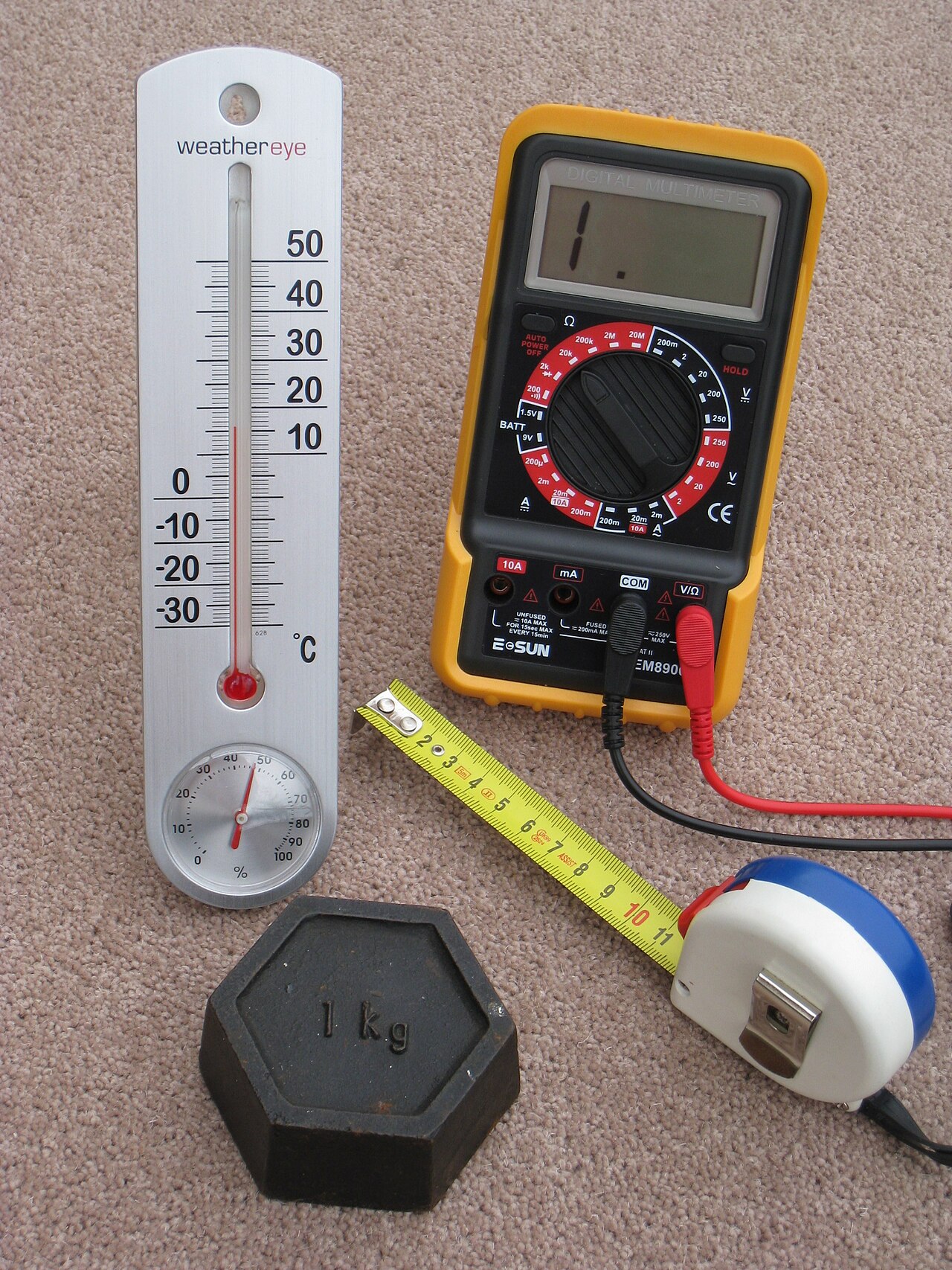
Overview: The Foundation of Quantification
Measurement is the quantification of attributes of an object or event, used to compare with other objects or events [1]. This fundamental process underpins not only the sciences but also engineering, construction, and almost all everyday activities [2]. By establishing a common language for describing the physical world, measurement enables consistent communication and comparison across diverse fields and contexts.
Historical Evolution of Measurement Systems
Throughout history, humans have developed various measurement systems to quantify attributes such as length, mass, and capacity. Early systems often relied on body parts or local standards, leading to inconsistencies. The development of standardized units resolved these issues, allowing for reliable comparison and trade across regions. This historical progression reflects the growing need for precision in human endeavors.
Core Principles of the Measurement Process
At its core, measurement involves comparing an unknown quantity with a known quantity to produce a numeric value with units [3]. This seemingly simple process requires careful selection of appropriate instruments and units to ensure accuracy. The comparison method forms the basis of all measurement, whether using sophisticated laboratory equipment or simple rulers and scales.
Physical Quantities and Their Measurement
Length: Measuring Spatial Extent
Length quantifies the spatial extent of objects and is one of the most commonly measured physical quantities. Physical quantities that can be measured include length, alongside mass, capacity (volume), and temperature [3]. The measurement of length allows us to describe the size of objects from microscopic scales to astronomical distances, forming the basis for construction, manufacturing, and navigation.
Common Units of Length
Common units of length include centimeters, meters, kilometers, millimeters, miles, yards, feet, and inches [3]. These units serve different purposes depending on the context: meters and kilometers for larger distances in scientific and everyday contexts, while inches and feet are commonly used in the United States for height and shorter measurements. The existence of multiple unit systems reflects the historical development of measurement traditions across different cultures.
Practical Applications of Length Measurement
Length measurement finds practical application in countless daily activities, from measuring fabric for sewing to determining distances for travel. In construction, precise length measurement ensures structural integrity and proper fitting of components. The choice of unit often depends on the scale of the measurement and the conventions of the relevant field or region.
Mass: Quantifying Matter Content
Mass vs. Weight: Understanding the Distinction
Mass quantifies the amount of matter in an object, representing a fundamental property that does not change with location. While often confused with weight, mass specifically refers to the quantity of matter, whereas weight measures the force of gravity acting on that mass. This distinction becomes particularly important when measurements are taken in different gravitational environments, such as on the Moon versus Earth.
Common Units of Mass
Common units of mass include milligrams, grams, kilograms, centigrams, pounds, ounces, tonnes, and tons [3]. The metric system uses grams and kilograms as base units, while the imperial system employs pounds and ounces. Tonnes and tons, though similar in name, have different masses: a metric tonne equals 1,000 kilograms, while a short ton equals 2,000 pounds. This variety reflects the coexistence of metric and imperial systems in global usage.
Applications of Mass Measurement
Mass measurement is critical in fields ranging from chemistry, where precise amounts of reagents are necessary for reproducible reactions, to commerce, where goods are bought and sold by weight. In healthcare, mass measurement of patients monitors health status. The ability to accurately measure mass underpins scientific experimentation, industrial production, and everyday transactions.
Capacity and Volume: Measuring Space Occupancy
Distinguishing Capacity from Volume
Capacity and volume relate to the amount of space a substance or object occupies, though they carry subtle distinctions. Capacity typically refers to the maximum amount that a container can hold, while volume describes the three-dimensional space an object occupies. In practice, these terms are often used interchangeably, particularly when discussing liquid measurement.
Common Units of Capacity and Volume
Common units of capacity/volume include liters, milliliters, kiloliters, fluid ounces, cups, pints, quarts, and gallons [3]. The metric system primarily uses liters and milliliters, with kiloliters for larger quantities. The imperial and US customary systems employ fluid ounces, cups, pints, quarts, and gallons, with variations between the US and UK gallon definitions. This diversity reflects different historical development paths for measurement systems.
Everyday and Scientific Applications
Capacity measurement appears in countless daily contexts, from measuring ingredients for cooking to fueling vehicles. In science, precise volume measurement is essential for preparing solutions, conducting reactions, and analyzing substance properties. The medical field relies on accurate volume measurement for administering medications. The choice of units often depends on the specific application and regional conventions.
Temperature: Measuring Thermal Energy
Temperature Scales and Their Definitions
Temperature measures the thermal energy content of a system, indicating how hot or cold an object is. Common units of temperature include Kelvin, Fahrenheit, and Celsius [3]. Each scale has different zero points and unit sizes: Celsius sets its zero at the freezing point of water, Fahrenheit adjusts this scale differently, while Kelvin begins at absolute zero, the theoretical point where molecular motion ceases. Understanding these differences is essential for accurate temperature measurement and conversion.
Practical Temperature Measurement
Temperature measurement finds application in weather reporting, cooking, industrial processes, and scientific research. The Celsius scale dominates most of the world for daily weather reports, while Fahrenheit remains common in the United States. Kelvin serves as the standard in scientific contexts, particularly in physics and chemistry, because of its absolute nature. Thermometers and other temperature-sensing devices convert thermal energy into measurable quantities.
Temperature Conversion and Practical Implications
Converting between temperature scales requires understanding their different zero points and unit sizes. For example, 0°C equals 32°F and 273.15 K. These conversions matter in international communication, scientific collaboration, and when following recipes or instructions from different regions. The practical implications of temperature measurement extend to climate science, material properties, and human health.
Dimensional Considerations: Length, Width, and Height
Understanding Rectangle Dimensions
When describing rectangles and other two-dimensional figures, dimensional terminology provides clarity. In describing rectangles, length should refer to the longest dimension, while width refers to the shorter dimension [4]. This convention ensures consistent communication about size and shape, particularly in fields like geometry, architecture, and manufacturing where precise dimensions are crucial.
Height and Depth: Vertical and Horizontal Extents
Height labels how high (tall) a rectangle or figure is, particularly when drawn with horizontal and vertical sides [4]. This dimension becomes especially important when figures are oriented with vertical sides, as it distinguishes the vertical extent from horizontal measurements. Depth often refers to the third dimension in three-dimensional objects, measuring how far back an object extends from its front face.
Applications in Measurement and Design
Understanding these dimensional distinctions proves valuable in design, architecture, and everyday description of objects. When furniture is described as "6 feet long by 3 feet wide," the convention establishes which dimension is length and which is width. Similarly, height measurements determine whether objects will fit through doorways or in designated spaces. These conventions reduce ambiguity in communication about size and spatial relationships.
Measurement Uncertainty and Accuracy
Inherent Limitations in Measurement
All measurements carry some degree of uncertainty, reflecting the inherent limitations of measurement processes. No measurement can be perfectly precise, as factors like instrument precision, environmental conditions, and human technique all contribute to potential error. Understanding and quantifying this uncertainty represents a critical aspect of scientific and technical measurement.
Sources of Measurement Error
Measurement errors can arise from multiple sources, including instrument calibration, environmental factors like temperature and humidity, and the skill of the person performing the measurement. Random errors fluctuate unpredictably, while systematic errors consistently bias results in one direction. Recognizing these different error types helps in designing better measurement protocols and interpreting results more accurately.
Reducing Uncertainty Through Best Practices
Scientists and engineers employ various strategies to minimize measurement uncertainty, including using calibrated instruments, taking multiple measurements and averaging results, controlling environmental conditions, and applying statistical analysis to data. These best practices improve reliability and allow for meaningful comparison between measurements taken under different conditions or by different observers.
The Metric and Imperial Systems
Metric System: Base Units and Prefixes
The metric system, also known as the International System of Units (SI), provides a coherent system of measurement based on seven base units including meter for length, kilogram for mass, and second for time. This system uses a decimal system of prefixes (kilo-, centi-, milli-) to denote multiples and fractions of units. The metric system's logical structure facilitates calculation and conversion, as units relate by powers of ten.
Imperial and US Customary Systems
The imperial system, historically used in the British Empire, and the US customary system, derived from it, employ different units for similar quantities. While both systems measure length, mass, and capacity, they use different base units and conversion factors. For example, 12 inches equal 1 foot, 3 feet equal 1 yard, and 1,760 yards equal 1 mile in the length measurement system. This complexity contrasts with the metric system's decimal simplicity.
Global Usage and Standardization Efforts
Today, the metric system enjoys widespread international usage for science, medicine, and many national governments, while the imperial system persists primarily in the United States for many everyday applications. International standards organizations work toward harmonization, with many countries transitioning toward metric usage for trade and technical fields. This ongoing transition reflects the global push for standardization while respecting historical and cultural attachments to existing systems.
Measurement in Technology and Innovation
Digital Measurement Technologies
Modern technology has transformed measurement capabilities through digital sensors, computer-aided measurement, and automated data collection. Devices like laser rangefinders, digital scales, and smart thermometers offer greater precision and ease of use compared to analog predecessors. These technologies integrate with computers and smartphones, enabling real-time monitoring and data analysis across various fields.
Applications in Engineering and Construction
Engineering and construction rely heavily on precise measurement for design, material estimation, and quality control. Computer-aided design (CAD) software incorporates measurement tools that ensure accuracy in blueprints and models. Construction projects use laser levels, theodolites, and other precision instruments to establish correct positions and dimensions. These measurement capabilities directly impact structural integrity and project success.
Emerging Frontiers in Measurement
Ongoing research explores new measurement frontiers, from nanoscale dimensions at the atomic level to astronomical measurements of cosmic distances. Advanced techniques like atomic force microscopy enable measurement of features far smaller than visible light wavelengths, while space-based telescopes measure distances to celestial objects using methods like parallax. These expanding capabilities open new possibilities in science and technology.