
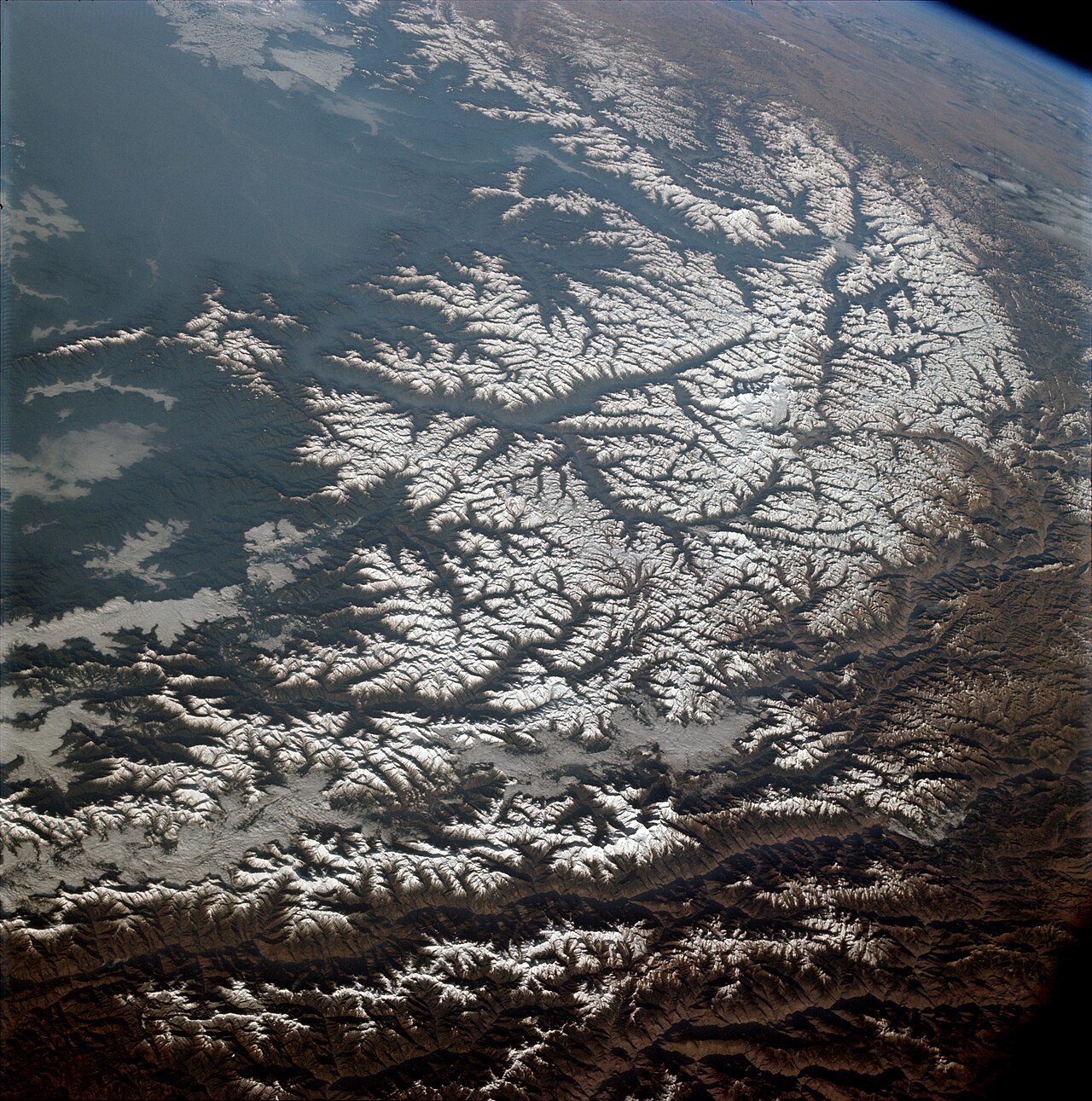
Overview: Definition and Planetary Context
A mountain range is defined as a series of mountains or hills arranged in a line and connected by high ground, a geological feature that extends beyond Earth into the Solar System [2]. Most significant ranges on our planet arise from plate tectonics, where interacting lithospheric plates generate the compressional forces necessary to uplift vast tracts of crust [2]. Beyond Earth, mountain ranges are found on many planetary mass objects, suggesting this is a common feature of terrestrial planets [2]. This overview establishes the breadth of the topic, from planetary geology to specific Earthly examples.
Anatomy of a Range
The Himalayas: Earth's Highest Plateau
The Himalayas stand as the highest mountain range on Earth, culminating in Mount Everest at 8,849 metres, the planet's highest point [1]. This immense elevation results from the ongoing collision between the Indian and Eurasian plates, a convergent boundary that has been active for tens of millions of years [2]. The range's height makes it a critical driver of atmospheric circulation and the monsoon systems of South Asia.
Glaciation and Biodiversity
The Karakoram Range: Second Elevation Frontier
The Karakoram mountain range includes K2, the second-highest peak on Earth at 8,611 metres, spanning the borders of Pakistan, China, India, Tajikistan, and Afghanistan [1]. Like the Himalayas, the Karakoram owes its existence to the collision of the Indian and Eurasian tectonic plates, but its tectonic regime includes significant transpression and strike-slip faulting that distinguishes its internal structure [2]. The range's rugged topography and extreme altitude make it one of the most challenging mountaineering regions in the world.
Geopolitical and Glaciological Significance
The Hindu Kush: Central Asian Spine
The Hindu Kush mountain range spans Afghanistan, Pakistan, and Tajikistan, with Tirich Mir as its highest point at 7,708 metres [1]. This range forms a critical climatic and geographic barrier between the basins of the Indus and Amu Darya rivers, influencing precipitation patterns and agricultural zones across Central and South Asia [2]. The Hindu Kush is often considered the western extension of the Himalayan system, though it possesses distinct geological characteristics.
Cultural and Historical Crossroads
The Pamirs: The Roof of the World
The Pamirs mountain range spans Tajikistan, Kyrgyzstan, China, Afghanistan, and Pakistan, often associated with Kongur Tagh, and is sometimes called the "Roof of the World" due to its extreme elevation [1]. This range serves as a nexus where several major mountain systems converge, including the Himalayas, Karakoram, Hindu Kush, and Tian Shan [2]. The Pamirs' central position makes them a critical area for studying the interactions between different tectonic regimes.
Tectonic Convergence and Seismic Activity
Plate Tectonics: The Engine of Mountain Building
The overwhelming majority of significant mountain ranges on Earth are the result of plate tectonics, where the movement and interaction of lithospheric plates generate the forces that uplift crustal material [2]. Convergent boundaries, where plates collide, are the primary sites of orogeny, the process of mountain building that can raise kilometers of sedimentary rock to extreme elevations in geologically short timeframes.
Diverse Mechanisms of Uplift
Mountain Ranges Beyond Earth
Mountain ranges are also found on many planetary mass objects in the Solar System and are likely a feature of most terrestrial planets, indicating that the processes generating mountains are not unique to Earth [2]. On Mars, the Tharsis rise and Valles Marineris represent massive tectonic and volcanic features that, while not classic ranges in the Earth sense, involve similar scales of crustal deformation [3]. On Io, one of Jupiter's moons, volcanic activity produces mountains of sulfur and silicate rock, demonstrating that tidal heating can build topography independent of plate tectonics [3].
Comparative Planetology and Implications for Life
Erosion, Climate, and the Lifecycle of Ranges
Once uplifted, mountain ranges begin a cycle of erosion that gradually wears down their elevation, with rivers, glaciers, and weathering processes transporting material to lower elevations [2]. The rate of erosion relative to tectonic uplift determines whether a range maintains its height over geological time or is slowly reduced to a plateau or lowland [2]. This dynamic balance is evident in the varying states of preservation observed across different mountain systems.
Climatic Influence and Rain Shadows
Human Interaction and Mountain Hazards
Human populations have long inhabited mountain ranges, adapting to high altitude, steep terrain, and extreme weather conditions [1]. The Himalayas, Karakoram, and Hindu Kush are home to millions of people who practice agriculture, pastoralism, and trade at elevations that challenge human physiology [1]. Infrastructure such as roads, tunnels, and settlements must contend with landslides, avalanches, and seismic shaking, all of which are heightened by the steep topography and active tectonics of these regions [2].