
Overview
The NFL playoff format determines which teams advance to the Super Bowl through a four-round elimination tournament. Since 2020, 14 teams qualify — seven from the NFC and seven from the AFC — up from the previous 12-team format. The structure rewards division winners with higher seeds and byes, while wild-card teams must win three games to reach the championship [5].
Seeding and Qualification
Fourteen teams make the playoffs, seven from both the NFC and AFC [5]. The seeding format assigns the No. 1 seed to the best record in the conference, No. 2 to the second-best division winner, No. 3 to the third-best division winner, No. 4 to the fourth-best division winner, and Nos. 5-7 to the three wild-card teams based on record [5]. Division winners are seeded Nos. 1-4, and the three wild-card teams in each conference are seeded Nos. 5-7. There is no reseeding in the NFL playoffs; the host of each game is determined by seeding number, not position in the bracket [5].
Division Winners and Wild-Card Teams
Each conference sends seven teams to the postseason. The format includes four division winners and three wild-card teams in each conference [5]. Division winners are guaranteed a top-four seed based on their conference record, while wild-card teams fill the Nos. 5-7 seeds. The three wild-card teams in each conference are the teams with the next-best records after the four division winners, regardless of division affiliation.
The wild-card round matchups are predetermined by seed: No. 7 seed at No. 2 seed, No. 6 seed at No. 3 seed, and No. 5 seed at No. 4 seed [5]. The No. 1 seed receives a bye and automatically advances to the divisional round. This means the No. 1 seed cannot play until the divisional round, while the No. 7 seed faces the No. 2 seed in the opening round.
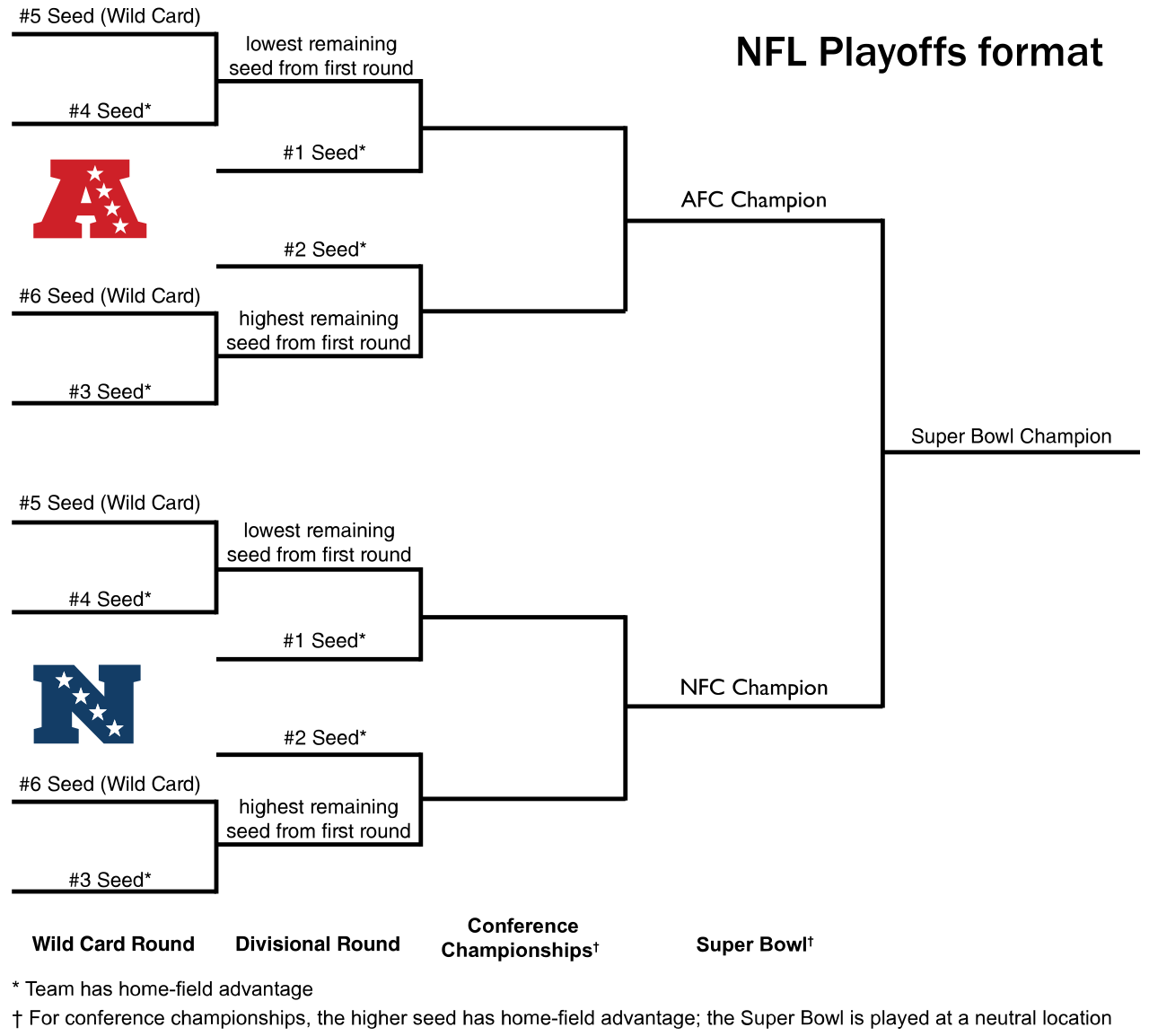
The playoff bracket proceeds from the wild-card round through the divisional round, conference championship round, and ultimately the Super Bowl [5]. There are four rounds in the NFL Playoffs: wild-card round, divisional round, conference championship round, and Super Bowl. The No. 1 seed and the lowest surviving seed from the wild-card round receive byes or advantageous positioning, but the bracket structure remains fixed without reseeding after each round.
Byes and Home-Field Advantage
The No. 1 seed in each conference receives a bye and advances automatically to the divisional round [5]. This bye is the primary reward for owning the best record in the conference. Home-field advantage throughout the playoffs is determined by seeding number, with higher seeds hosting lower seeds at their stadiums. Since there is no reseeding, the matchups and hosting assignments are fixed before the postseason begins.
Tiebreaker Procedures
Tiebreakers within a division are resolved using head-to-head record, division record, common games, conference record, strength of victory, strength of schedule, combined ranking, net points, net touchdowns, and coin toss [5]. These procedures determine seeding when teams finish with identical records. Tiebreakers for wild-card teams follow a separate set of rules from division tiebreakers, ensuring that teams outside the division structure are ranked by conference-wide criteria rather than division-specific metrics.
Format History and Expansion
The NFL introduced a new playoff format in 2020 focused on more teams and an expanded wild-card round [5]. This expansion increased the postseason field from 12 to 14 teams, adding an extra wild-card team per conference. The change was part of the league's broader strategy to extend the postseason schedule and generate additional regular-season and playoff revenue.
The 2020 expansion meant that the wild-card round now featured more matchups, with the No. 7 seed joining the traditional No. 5-6 matchups. This structure has remained in place through the 2024 season, making the 14-team format the current standard for NFL postseason qualification.
How the Bracket Unfolds
The wild-card round consists of three games per conference, with the No. 1 seed sitting out while the No. 7, No. 6, and No. 5 seeds play the No. 2, No. 3, and No. 4 seeds respectively [5]. The three surviving winners from the wild-card round join the No. 1 seed in the divisional round, where the remaining matchups are No. 1 seed vs. lowest surviving seed and No. 2 seed vs. No. 3 seed. The conference championship round then pits the surviving AFC and NFC representatives against each other, with the winners advancing to the Super Bowl.
No Reseeding Rule
A defining characteristic of the NFL playoff format is the absence of reseeding [5]. Unlike some other sports leagues, the NFL does not reshuffle the bracket after the wild-card round. The divisional round, conference championship, and Super Bowl matchups are predetermined by the initial seeding. This means a higher-seeded team could face a lower-seeded opponent in subsequent rounds based on the outcomes of earlier games, but the pairing order remains fixed from the start of the postseason.
Key Facts at a Glance
- Fourteen teams make the NFL playoffs, seven from both the NFC and AFC [5]
- The playoff format includes four division winners and three wild-card teams in each conference [5]
- The No. 1 seed in each conference receives a bye and advances automatically to the divisional round [5]
- The wild-card round matchups are: No. 7 seed at No. 2 seed, No. 6 seed at No. 3 seed, and No. 5 seed at No. 4 seed [5]
- There are four rounds in the NFL Playoffs: wild-card round, divisional round, conference championship round, and Super Bowl [5]
- There is no reseeding in the NFL playoffs; the host of each game is determined by seeding number, not position in the bracket [5]
- Tiebreakers within a division are resolved using head-to-head record, division record, common games, conference record, strength of victory, strength of schedule, combined ranking, net points, net touchdowns, and coin toss [5]
- The NFL introduced a new playoff format in 2020 focused on more teams and an expanded wild-card round [5]
- The seeding format assigns the No. 1 seed to the best record in the conference, No. 2 to the second-best division winner, No. 3 to the third-best division winner, No. 4 to the fourth-best division winner, and Nos. 5-7 to the three wild-card teams based on record [5]