
Founding and Structural Origins
The American Professional Football Association was established in 1920 in Canton, Ohio, later renamed the National Football League. This founding moment set the framework for a professional competition structure that would eventually organize teams into conferences and divisions to manage scheduling and championship contention [1].
Early Organization and Evolution
In its formative decades the APFA/ NFL experimented with regional schedules and informal championships before adopting a national league format. The conference division system emerged as the most practical way to balance competitive equity with geographic travel constraints.
Transition to Modern Conferences
The split into American Football Conference and National Football Conference occurred as the league expanded and merged with rival circuits. This alignment created the two‑conference architecture that still governs standings, playoff qualification, and the annual Super Bowl matchup.
Conference and Division Breakdown
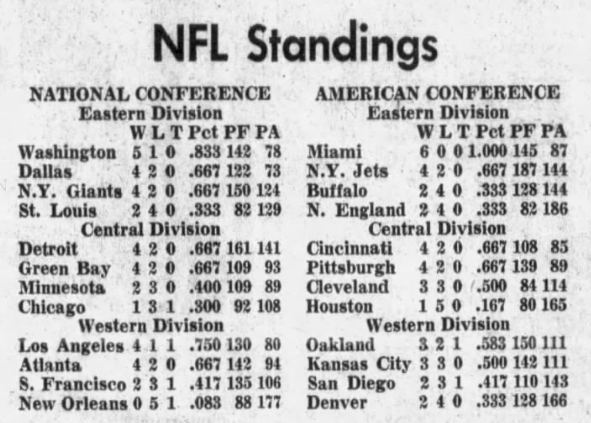
Each conference — AFC and NFC — is subdivided into four divisions labeled East, North, South, and West. This divisional alignment determines the majority of a team’s regular season opponents and directly influences standings outcomes [2][5].
AFC Divisional Composition
The AFC East, North, South, and West each contain a mix of historic franchises and recent expansion teams. Division winners earn automatic playoff berths while runner‑up records feed into wild‑card seeding.
NFC Divisional Composition
The NFC follows the same four‑division structure, with teams arranged by geography and historical rivalry. Division races often decide which team secures the coveted top seed and a first‑round bye.
2026 Season Standings Overview
The 2026 NFL regular season follows the established 17‑game format per team, with records tracked within each conference and division to determine playoff eligibility [1].
AFC East Leadership
The Buffalo Bills have risen to the top of the AFC East posting a 9‑1‑0 record and a .900 winning percentage through the first ten weeks of the 2026 season [2]. Their strong start positions them as the early division favorite.
AFC Wild‑Card Contenders
Kansas City Chiefs and Denver Broncos both hold identical 8‑2‑0 records with .800 winning percentages in the 2026 campaign [2][5]. Their near‑even records keep them in the wild‑card conversation despite not winning their division.
NFC Top of the Conference
San Francisco 49ers have dominated the NFC leaderboard in 2026 carrying a 9‑1‑0 record and a .900 winning percentage that mirrors the Bills’ AFC performance [5]. Their defensive efficiency has been a key factor in the strong start.
NFC Wild‑Card Race
Detroit Lions join the wild‑card fray with an 8‑2‑0 record and .800 winning percentage in 2026 [5]. Their consistency has earned them a playoff spot despite not capturing the NFC North title.
Tiebreaking Dynamics
When teams finish with identical records the NFL employs tiebreakers such as head‑to‑head record conference record and strength of victory. These rules shape final seeding and can elevate a wild‑card team above a division runner‑up.
Playoff Qualification Rules
The NFL regular season concludes with each team having played 17 games. The postseason then opens as a single‑elimination tournament involving seven teams from each conference [1].
Division Winners and Seeding
Four teams from each conference qualify as division winners earning the top four seeds based on overall record. The team with the best conference record typically secures the No. 1 seed and a first‑round bye.
Wild‑Card Entries
Three additional teams per conference — the three non‑division winners with the best records — fill the wild‑card slots at seeds five through seven. These teams must win a wild‑card round game before advancing.
Super Bowl and Championship Path
The NFL playoff tournament culminates in the Super Bowl where the AFC champion faces the NFC champion. The winner is declared the league champion for that season.
Home‑Field Advantage
Higher seeds enjoy home‑field advantage throughout the playoffs meaning the No. 1 seed hosts the lowest surviving wild‑card in the divisional round and championship game if they advance.
Historic Super Bowl Trends
Teams that secure the No. 1 seed have a strong historical correlation with Super Bowl appearances though the wild‑card format has produced numerous upsets over the decades.
2026 Season Narratives and Implications
The early season separation between the Bills and 49ers at 9‑1 records creates a narrative of conference dominance that will be tested as the schedule progresses and injury variables emerge.
Impact on Draft Order
Standings directly influence the upcoming NFL draft order with non‑playoff teams picking earlier. The league’s reverse‑order system rewards weaker records while playoff berths protect teams from sliding too far.
Coaching and Front Office Evaluation
Early season records often trigger discussions about coaching efficacy and front office decision‑making. A strong start can extend contract extensions while a poor showing may lead to mid‑season changes.
Historical Evolution of Standings Formats
From the APFA’s first championship determination in 1920 to the current 17‑game schedule the NFL has refined its standings methodology to accommodate expansion teams and balanced competition.
Era‑Specific Rules
Different periods in NFL history featured tiebreaking procedures divisional championships and playoff formats that reflected the league’s growth. The modern system prioritizes win‑loss percentage and conference record above all.
Notable Standings Anomalies
Certain seasons have seen division winners finish with losing records or wild‑card teams reach the Super Bowl illustrating how the standings system can produce unexpected championship pathways.
Fan Engagement and Media Coverage
Standings drive daily fan debate fantasy football lineups and media analysis across networks. The race for division titles and playoff seeds becomes a storyline that persists through Week 17.
Betting and Odds Movement
Sportsbooks adjust odds in real time based on standings movement. A team’s winning percentage shift can dramatically alter Super Bowl futures and weekly point‑spread values.
Social Media and Fan Communities
Platforms such as Twitter and Reddit amplify standings discussions with fans tracking tiebreaker scenarios and projecting clinching probabilities. The visual of a standings table often trends during late‑season stretches.
Comparison with Other Major Leagues
The NFL’s 17‑game season and seven‑team playoff format distinguishes it from MLB’s 162‑game schedule NBA’s 82‑game season and NHL’s 82‑game format each of which uses different standings calculations.
College Football Contrast
College football’s playoff expansion to 12 teams operates under a completely different regular season structure where conference championships carry more weight than regular season win‑loss percentages alone.
International Parallels
Association football (soccer) leagues use promotion and relegation rather than fixed playoff brackets meaning league standings determine survival and European competition qualification entirely.
Projected End‑Of‑Season Scenarios
With one‑third of the 2026 season complete the current standings suggest a tight race for the remaining playoff spots in both conferences.
Tiebreaker Scenarios to Watch
Several teams sit within one game of each other in the wild‑card hunt meaning head‑to‑head results and conference record will likely decide final seeding. Fans should monitor these mathematical possibilities as the season progresses.
Injury and Roster Adjustments
Mid‑season injuries to key players can alter a team’s winning percentage and shift the standings landscape. Depth chart moves and trade deadline acquisitions often reshape the playoff picture.
Statistical Leaders and Efficiency Metrics
Beyond pure win‑loss records advanced metrics such as point differential turnover differential and third‑down conversion rate provide deeper insight into a team’s true competitiveness.
Offensive and Defensive Rankings
Teams with high winning percentages often lead in scoring offense or takeaway defense. The 2026 season has already seen several squads combine strong records with top‑ten efficiency rankings.
Quarterback Performance Correlations
Quarterback passer rating and touchdown‑to‑interception ratio frequently align with team standings. The Bills’ and 49ers’ 9‑1 starts correlate with elite quarterback play in the early going.
Refereeing and Rule Impact on Standings
On‑field officiating decisions such as pass interference calls or clock management can directly affect game outcomes and therefore shift weekly standings.
Reviewable Plays and Their Consequences
The NFL’s replay review system allows coaches to challenge certain calls. Successful challenges can swing momentum and alter the result of close games that decide division ties.
Rule Changes Over Time
Recent rule emphases on player safety and offensive pass protection have increased scoring which in turn influences winning percentages and the volatility of standings from season to season.