
Overview
General Description
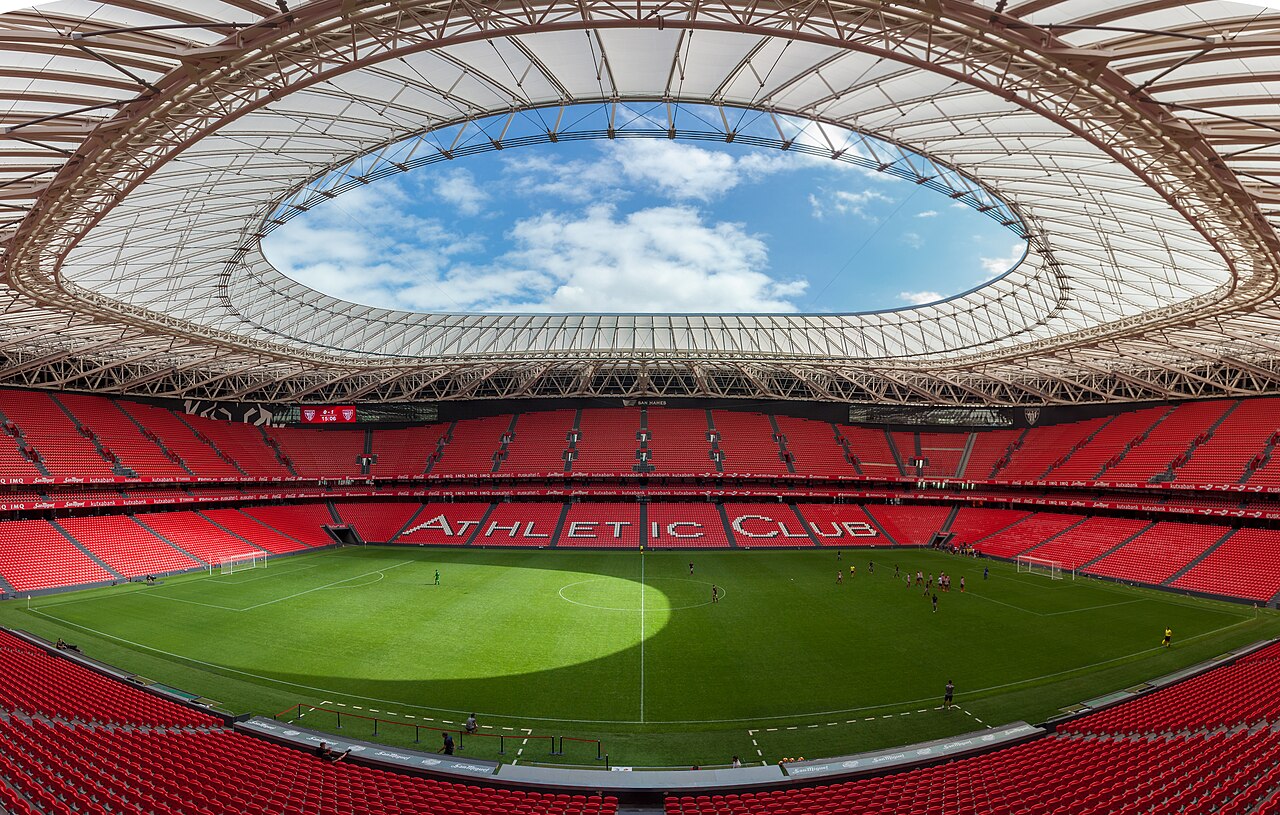
San Mamés Stadium is a football stadium situated in Bilbao, Spain, serving as the home ground for Athletic Club [1]. The current facility replaced the original 1913 ground and was delivered in two construction phases, the first completed on 16 September 2013 and the full stadium finished on 25 August 2014 [1]. It offers a seating capacity of 53,331 spectators, making it one of the largest stadiums in the Basque Country [1]. Ownership is shared among San Mamés Barria, S.L., Athletic Bilbao, the Basque Government, Biscay Provincial Council and BBK Bank [1]. The architectural design was led by IDOM together with César Azkarate [1].
Location and Role
Located in the San Mamés district of Bilbao, the stadium functions as a major sports venue and a civic landmark for the city and the wider Basque region [1]. Its position near the city centre allows easy access for supporters and contributes to local economic activity on match days [1]. The venue hosts LaLiga fixtures, Copa del Rey matches and European competitions, reinforcing Bilbao’s status in Spanish football [1].
Original Stadium History
Construction and Opening
The original San Mamés Stadium was built on 20 January 1913 and officially opened on 21 August 1913, marking the beginning of a century‑long tenure as Athletic Club’s home [2]. Its construction reflected early 20th‑century stadium engineering and quickly became a symbol of Basque football identity [2].
Operational Period
For 100 years the 1913 ground hosted countless league, cup and European fixtures, witnessing the club’s golden eras and fostering a passionate supporter culture [2]. The stadium’s longevity made it one of Spain’s most historic football venues before its closure [2].
Original Stadium Specifications
Capacity and Design
The 1913 stadium offered a capacity of 39,750 seats, a figure that placed it among the larger Spanish grounds of its era [2]. Its layout featured a traditional oval bowl with standing terraces that were later converted to all‑seating configurations [2].
Notable Features
Distinctive elements included the iconic “Lezama” arch and a steeply raked main stand that amplified crowd noise, contributing to the venue’s reputation for an intimidating atmosphere [2]. These characteristics became part of Athletic Club’s heritage and were remembered during the transition to the new stadium [2].
Closure and Demolition
Final Match and Closure Date
The original stadium closed on 5 June 2013 after hosting its last official match, ending a century of continuous operation [2]. The closure ceremony celebrated the ground’s history while preparing supporters for the new facility [2].
Demolition Timeline
Demolition commenced the following day, 6 June 2013, and proceeded rapidly to clear the site for the new construction phases [2]. The swift removal allowed the first phase of the replacement stadium to be inaugurated on schedule in September 2013 [2].
New Stadium Construction Phases
First Phase Completion
The first construction phase reached completion on 16 September 2013, delivering a functional lower bowl and essential infrastructure that permitted the official inauguration ceremony [1]. This milestone enabled Athletic Club to begin playing competitive matches while upper tiers remained under construction [1].
Full Completion
The entire stadium, including all stands, roofing and façade systems, was finished on 25 August 2014, marking the official handover of the 53,331‑seat venue to the club and its partners [1]. The phased approach minimized disruption to the football calendar and spread capital expenditure over two seasons [1].
Inauguration and Opening
Official Inauguration Ceremony
The new San Mamés Stadium was inaugurated on 16 September 2013 with a ceremony attended by club legends, regional officials and representatives of the ownership consortium [1,2]. The event highlighted the stadium’s modern amenities and its symbolic continuity with the 1913 ground [1,2].
Public Opening
Following the inauguration, the stadium opened to the public for its first competitive fixture shortly thereafter, allowing supporters to experience the new seating, concourses and hospitality areas [1]. The phased opening ensured that safety certifications and operational systems were fully tested before full capacity crowds arrived [1].
Capacity, Ownership, and Management
Seating Capacity
The completed arena provides 53,331 seats, an increase of over 13,000 compared with the former 39,750‑seat venue, enhancing match‑day revenue potential and fan experience [1]. All seats are covered by a continuous roof that improves comfort and acoustics [1].
Ownership Structure
Ownership is shared among San Mamés Barria, S.L., Athletic Bilbao, the Basque Government, Biscay Provincial Council and BBK Bank, reflecting a public‑private partnership model that financed the project and governs long‑term management [1]. This structure aligns the interests of the club, regional authorities and financial stakeholders [1].
Architectural Design and Façade Innovation
Permeable Façade System
The stadium’s exterior incorporates a permeable façade composed of more than 2,700 vertical louvre‑like elements, each measuring 5.40 by 1.20 metres and featuring a double‑curved geometry that mediates airflow and daylight [5]. This system creates a dynamic visual identity while contributing to natural ventilation of the concourse areas [5].
Louvre Geometry and Materials
Each louvre element is fabricated from lightweight metal alloy panels that achieve the required curvature through precision forming, allowing the façade to respond to wind loads and solar orientation without compromising structural integrity [5]. The repetitive yet varied geometry gives the building a distinctive rhythm visible from the surrounding urban fabric [5].
Sustainable Lighting and Energy Efficiency
LED Façade Lighting
The new stadium utilizes efficient LED systems for façade illumination, enabling programmable colour schemes for events and branding while maintaining low power draw [5]. The LED arrays are integrated into the louvre framework, ensuring uniform light distribution across the curved surfaces [5].
Energy Savings Performance
Compared with traditional floodlighting, the LED installation can reduce energy consumption by up to 50 %, contributing to the venue’s sustainability targets and lowering operational costs over the stadium’s lifecycle [5]. This performance aligns with the Basque Government’s environmental policies for public infrastructure [5].