
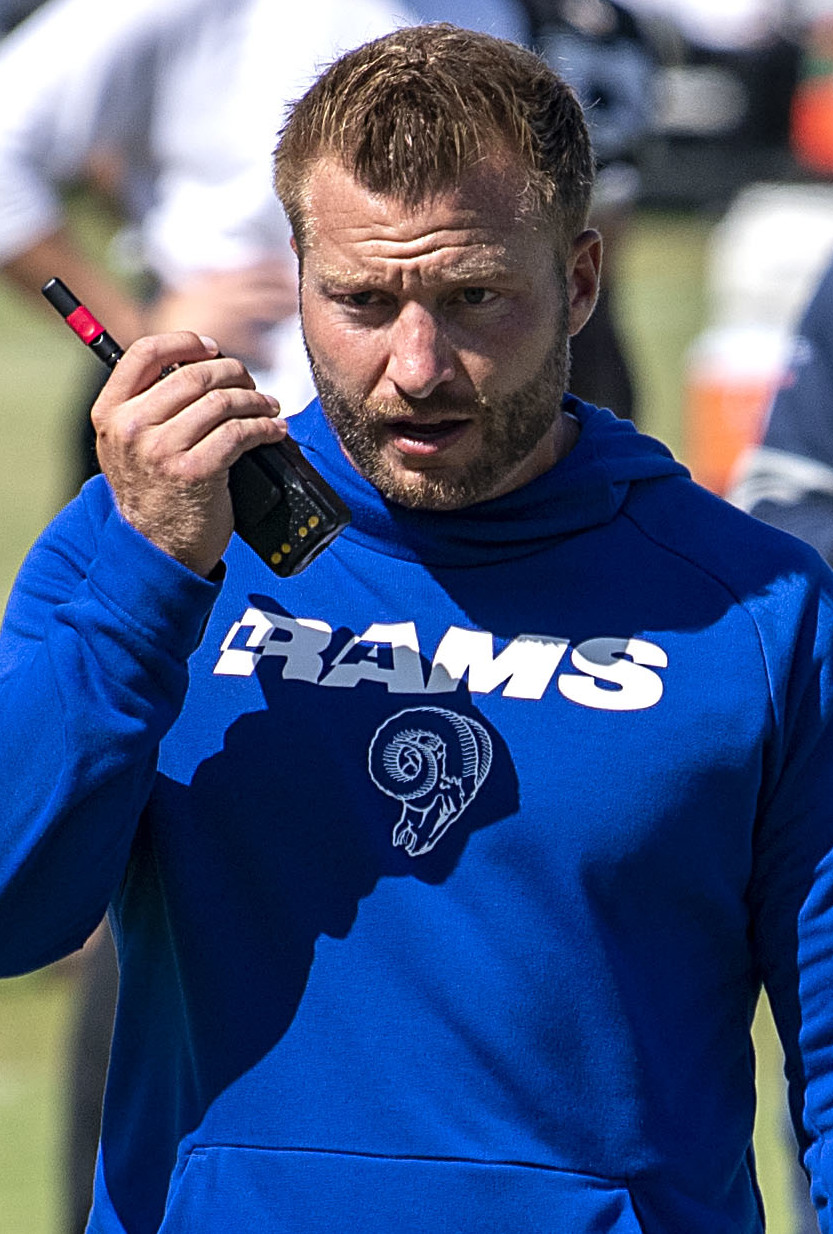
Background and Early Foundations
Sean McVay was born on January 24, 1986, in Dayton, Ohio, into a family deeply rooted in professional football [1]. His grandfather, John McVay, served as a longtime executive with the Washington Redskins, exposing Sean to the inner workings of the NFL from a young age. This familial connection provided his first formal introduction to coaching concepts and organizational dynamics [1].
College Playing Years
McVay attended Brown University, where he played tight end and graduated in 2008 with a degree in American civilization. While his playing career was modest, the experience deepened his understanding of offensive schemes and player responsibilities [1].
Entry into Coaching
Following his graduation, McVay began his professional coaching career with the Washington Redskins as a volunteer offensive assistant in 2010, leveraging his family connections and football IQ to secure his first position [1].
Washington Redskins Tenure (2010-2016)
McVay spent seven seasons with the Washington Redskins, working his way up from offensive assistant to tight ends coach and eventually passing game coordinator. During this period, he developed his offensive philosophy, emphasizing speed, versatility, and schematic innovation [1].
Coaching Progression
He served under head coaches Mike Shanahan and Jay Gruden, absorbing different offensive approaches while gradually earning more responsibility. His work with tight ends and wide receivers helped refine his ability to develop skill players [1].
Transition to Los Angeles
After the 2016 season, McVay resigned from his coordinator role to pursue a head coaching opportunity. His reputation as an offensive prodigy preceded him, and the Los Angeles Rams identified him as their top target to revitalize a stagnant franchise [1].
Hired as Rams Head Coach and Historic Milestone
In January 2017, the Los Angeles Rams hired McVay as head coach, making him the youngest person ever to hold the position in NFL history at age 30. The appointment signaled a new direction for the franchise, which had not posted a winning season in several years [1].
Immediate Impact
McVay's offensive innovations were immediately apparent. He installed a system that maximized the talents of quarterback Jared Goff and running back Todd Gurley, while also creating opportunities for emerging receivers. The Rams improved win-loss records dramatically in his first season [1].
Coach of the Year and League Recognition
His performance earned him AP NFL Coach of the Year honors in 2017, validating his approach and establishing him as a leading young mind in professional football. The recognition cemented his status as a transformative figure in the league [1].
Super Bowl LVI Championship
The pinnacle of McVay's early tenure came following the 2021 season, when he led the Los Angeles Rams to a victory in Super Bowl LVI. The championship represented the franchise's second Super Bowl title and validated McVay's player management and game-planning abilities on the sport's biggest stage [1].
Season Context and Playoff Run
The 2021 Rams season featured a series of strategic moves, including mid-season acquisitions that bolstered both offense and defense. McVay's ability to adjust schematics during the playoffs was a key factor in the team's success [1].
Legacy of the Victory
Winning a Super Bowl as a young head coach reinforced McVay's reputation as one of the most accomplished offensive minds of his generation. The victory also provided the organization with a championship culture moving forward [1].
Offensive Philosophy and Coaching Style
McVay is widely recognized for his innovative offensive schemes that emphasize pre-snap motion, versatile personnel groupings, and quick-passing concepts. His background working with tight ends and wide receivers informed an attack that seeks to exploit mismatches across the formation [1].
Quarterback Development
Under McVay's guidance, quarterbacks have benefited from a system that simplifies reads while providing multiple progression options. This approach has helped players like Jared Goff and later Matthew Stafford operate efficiently within the offensive framework [1].
Player Development
Beyond the quarterback, McVay has a reputation for developing skill players. His work with receivers and tight ends often results in increased productivity, as evidenced by the progression of several players during their tenure in his system [1].
Recent Roster Management and Player Health
In recent seasons, McVay has been at the center of roster decisions involving key skill players. His communication regarding player health and availability reflects the balance between competitive urgency and long-term welfare [4].
Puka Nacua Injury Update
McVay confirmed that wide receiver Puka Nacua underwent season-ending MCL surgery, a significant loss for the Rams' receiving corps. The injury occurred during a period where Nacua had emerged as a primary target [4].
Uncertainty Regarding Future
When asked about Nacua's long-term status with the organization, McVay stated he could not say for certain anything regarding the receiver's future with the Rams. This cautious language reflects the unpredictable nature of recovery timelines and roster planning [4].
Support and Perspective
Despite the injury uncertainty, McVay expressed continued support for Nacua, stating 'you love the human' and noting that the player is growing and making steps in the right direction. This comment humanizes the high-stakes decision-making process [4].
Public Perception and Media Relations
McVay's relationship with the media is characterized by openness mixed with strategic restraint. He frequently addresses injury updates, roster moves, and game preparation with transparency, while protecting sensitive internal evaluations [4][5].
Handling of Injury Reports
His comments on Puka Nacua's situation exemplify a balanced approach: acknowledging the severity of the medical issue while maintaining optimism about the player's trajectory. This dual focus satisfies both fan curiosity and organizational caution [4][5].
Comparisons to Peers
Media analysis often contrasts McVay's communication style with that of other young NFL head coaches. His willingness to discuss player development openly, combined with a clear understanding of medical timelines, sets a particular standard for the position [4][5].
Statistical and Tactical Contributions
While much of the discourse around McVay focuses on his youth and championship, his tactical contributions deserve examination. His offensive schemes consistently rank among the league's most efficient in terms of yards per play and third-down conversion rates during his tenure [1].
Scheme Adaptability
McVay's willingness to adjust his system based on personnel availability has been a hallmark of his career. From his time in Washington to his Super Bowl-winning season in Los Angeles, he has demonstrated flexibility in play-calling [1].
Long-Term Offensive Trends
The broader NFL has been influenced by the success of McVay's approach. Many younger coaches now incorporate similar motion and pre-snap adjustments, suggesting a lasting impact on how offensive football is played at the professional level [1].
Personal Life and Off-Field Influence
Outside of his professional duties, McVay maintains a relatively private personal life. His upbringing in a football family and his rapid rise to prominence have made him a subject of interest beyond the field, though he generally lets his work speak for itself [1].
Family Background
As noted earlier, his grandfather John McVay's influence remains a defining element of his identity within the sport. This lineage provides a historical context for understanding McVay's early exposure to NFL operations [1].
Community Engagement
McVay has participated in various community initiatives in the Los Angeles area, though he tends to keep these efforts low-profile. His focus remains primarily on team performance and player development [1].
Future Trajectory and Ongoing Challenges
As McVay continues his tenure with the Rams, he faces the ongoing challenge of sustaining competitiveness while managing roster transitions. The league's parity rules and salary cap structures present constant obstacles for maintaining a championship-caliber team [1].
Roster Construction
The decisions McVay and the front office make regarding player contracts, draft selections, and free agency will shape the team's trajectory for the foreseeable future. His ability to maximize limited resources is a key metric of his effectiveness [1].
Adaptation to League Evolution
Defensive coordinators have had a full cycle of film study to prepare for McVay's schemes, meaning he must continuously innovate to maintain an edge. His willingness to evolve play-calling and personnel usage will determine whether the Rams remain contenders [1].