
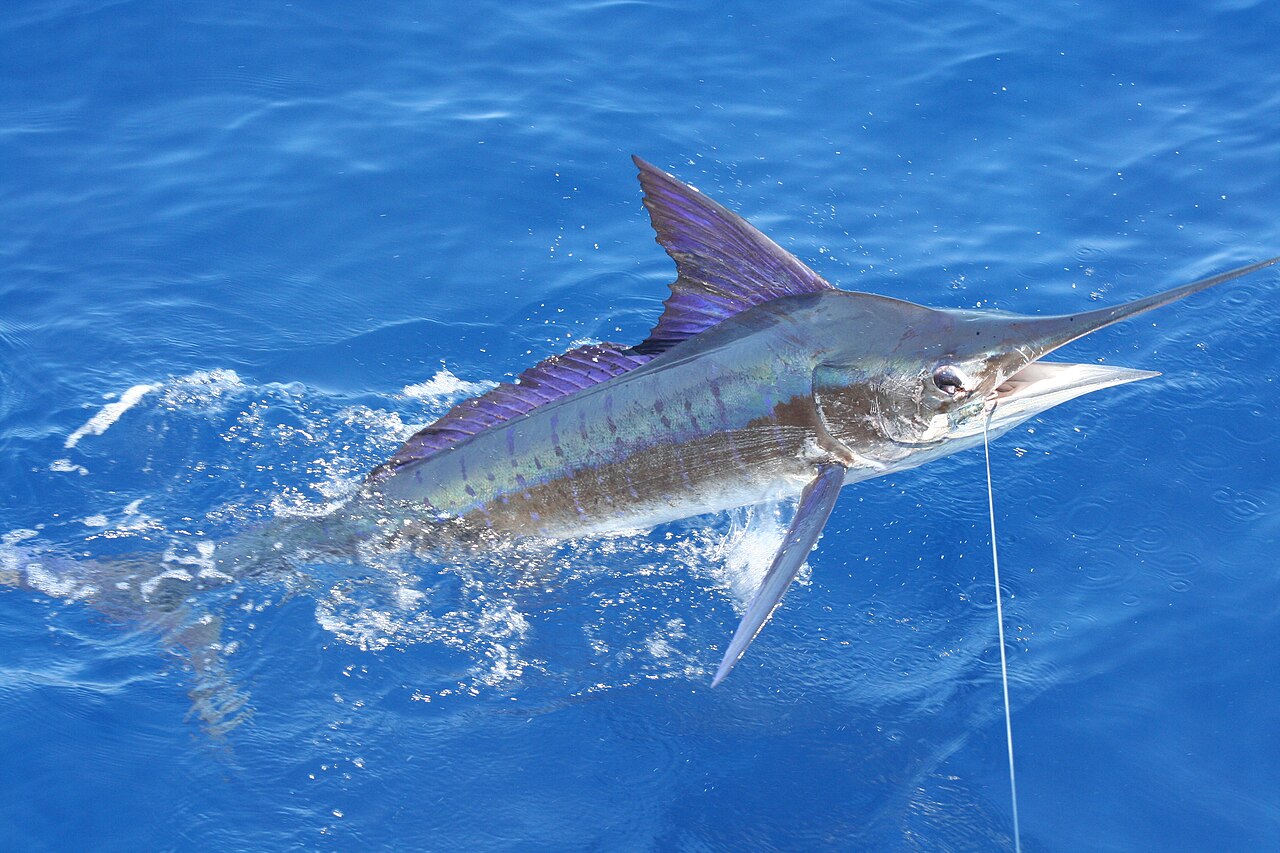
Overview of the Striped Marlin Species
The Striped Marlin belongs to the group of broadly distributed billfish [4]. Its official scientific designation is Kajikia audax [1]. The species has been known under several different names throughout its history, including Histiophorus audax, Istiophorus audax, Makaira audax, Marlina audax, and Tetrapturus audax [1]. This diversity in nomenclature reflects earlier taxonomic understanding of the species [1].
Taxonomic History
The historical synonyms listed for the Striped Marlin—such as Marlina audax and Tetrapturus audax [1]—demonstrate the evolving scientific classification of this marine species [1]. Modern assessments utilize the name Kajikia audax [1].
Ecological Niche
As a billfish, the Striped Marlin occupies a specific ecological role within its diverse habitats across the Pacific [4]. Its broad distribution contributes to the complexity of managing its various regional populations [4].
Geographic Distribution and Catch Methods
The Striped Marlin is characterized by its wide dispersal across the Pacific Ocean [4]. A primary method of its capture involves being caught as bycatch within mixed tuna and swordfish fisheries, typically using longline gear [4]. This incidental catch highlights its integration into commercial pelagic fisheries [4].
Bycatch Dynamics
Its frequent capture as bycatch rather than as a primary target in certain fisheries is a key aspect of its commercial interaction [4]. This necessitates careful monitoring within the context of tuna and swordfish operations [4].
Historical Catch Trends
Catch data reveals a significant shift over time; the average annual catch for this species between 1977 and 1999 was approximately 7,200 tonnes [4]. More recently, in the period spanning 2018 to 2020, the annual catches have decreased to around 2,500 tonnes [4].
Current Stock Assessment Status in the North Pacific
The 2023 ISC benchmark assessment indicated that the Western and Central North Pacific striped marlin stock is currently overfished [4]. Furthermore, this stock is assessed as being likely subject to overfishing when evaluated against reference points derived from Maximum Sustainable Yield (MSY) and rebuilding targets [4].
Biomass Comparison
In 2020, the estimated spawning biomass for the Western and Central North Pacific population was about 1,696 tonnes [4]. This figure is considerably lower than the established rebuilding benchmark, which stands at 3,660 tonnes [4].
Fishing Mortality Rates
Between 2018 and 2020, the observed fishing mortality rate was approximately 28% higher than the level deemed compatible with achieving the rebuilding target for this specific North Pacific stock [4]. This indicates elevated fishing pressure relative to recovery goals [4].
Advanced Research and Population Dynamics
Uncertainty in stock assessment results across different Pacific regions has prompted specialized research by the IGFA [5]. This uncertainty covers the western, central north Pacific, and southwestern Pacific stocks [5].
Genetics Study Focus
The IGFA is actively conducting a population genetics study specifically focused on the Pacific striped marlin to address these assessment uncertainties [5]. This genetic work aims to refine regional stock understandings [5].
Movement Patterns Revealed by Tagging
New data derived from the IGFA Great Marlin Race tagging initiative suggests that striped marlin undertake long-distance migrations throughout the Pacific Ocean more often than previous scientific understanding indicated [5]. This implies greater connectivity than previously modeled [5].
Implications for Fisheries Management
The findings regarding overfishing and low biomass [4] directly inform the need for adaptive management strategies in the Western and Central North Pacific [4]. Management must reconcile historical catch levels with current sustainability benchmarks [4].
Rebuilding Targets
The disparity between the 2020 spawning biomass (1,696 tonnes) and the rebuilding benchmark (3,660 tonnes) [4] underscores the magnitude of the recovery effort required for the North Pacific stock [4].
Monitoring Requirements
The combination of high fishing mortality [4] and genetic uncertainty [5] necessitates robust, ongoing monitoring across multiple Pacific sub-regions to ensure effective conservation measures [5, 4].
Historical Context of Commercial Exploitation
The period from 1977 to 1999 represented a higher phase of commercial exploitation, with average annual catches reaching 7,200 tonnes [4]. This contrasts sharply with the lower levels observed in the 2018–2020 timeframe [4].
Shifting Catch Volumes
The reduction in catch volume from the near 7,200 tonnes average to approximately 2,500 tonnes in the most recent assessment period [4] suggests a potential response to, or consequence of, management pressures or stock decline [4].
Fishery Interaction Type
Its role as longline bycatch in mixed tuna/swordfish fisheries [4] means that efforts to manage tuna/swordfish fleets are intrinsically linked to the conservation of the Striped Marlin [4].
Scientific Tools in Conservation
Tagging data from the IGFA Great Marlin Race provides crucial insights into the migratory behavior of the Striped Marlin [5]. This data challenges prior assumptions regarding the extent of their Pacific movements [5].
Genetic Profiling
Population genetics studies by the IGFA are essential for distinguishing and assessing the health of geographically distinct populations within the Pacific [5]. This aids in designing targeted regional management [5].
Assessment Benchmarks
The use of MSY- and rebuilding-based reference points [4] provides the quantitative framework against which the current overfished status of the Western & Central North Pacific stock is measured [4].
Challenges in Pacific Stock Management
Managing the Striped Marlin is complicated by the vastness of the Pacific and the uncertainty surrounding different regional stocks [5]. The IGFA is addressing this through dedicated population genetics work [5].
Regional Stock Differentiation
The assessment uncertainty specifically covers western, central north Pacific, and southwestern Pacific stocks [5], meaning a single management approach may be inadequate across the entire range [5].
Data Integration Needs
Effective management requires integrating catch data [4], biomass estimates [4], genetic information [5], and movement tracking [5] to create a comprehensive picture of the species' status [4, 5].
Future Directions in Research
Continued research, particularly involving tagging and genetics, will refine our understanding of Striped Marlin ecology [5]. This scientific advancement supports more precise and effective fishery regulations [5].
Refining Migration Models
The evidence of frequent, long-distance Pacific movements [5] requires updated models for stock connectivity, moving beyond static regional assessments [5].
Informing Policy
The data from the 2023 ISC assessment [4] provides a critical, evidence-based impetus for policymakers to enact measures aimed at reducing fishing mortality below the rebuilding target [4].