
Foundations and Core Principles
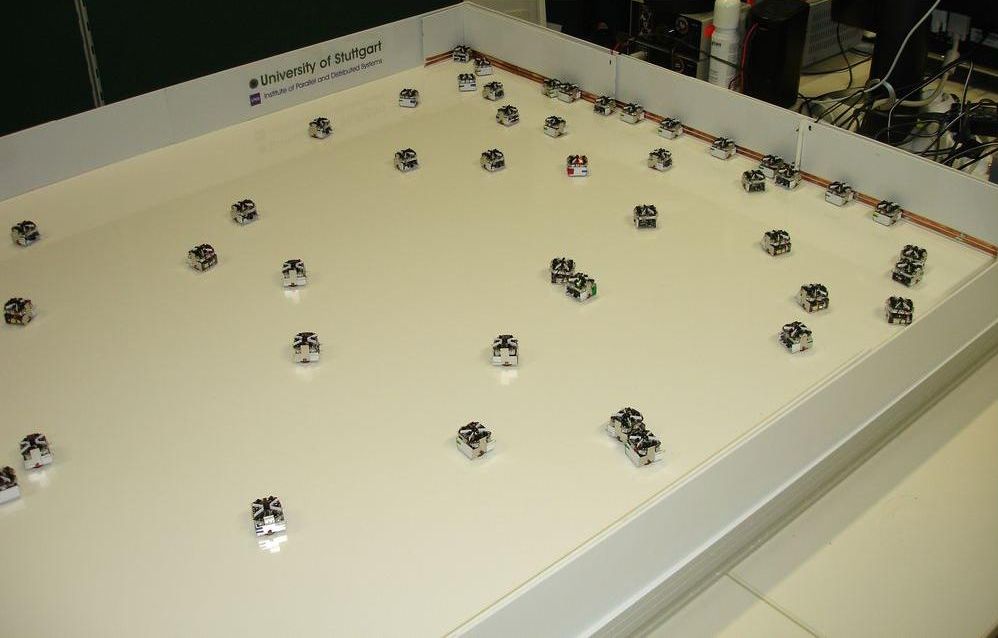
Swarm robotics is the study of how to design independent systems of robots without centralized control, where the emerging swarming behavior is created through interactions between individual robots and the environment [1]. The design of such systems is guided by swarm intelligence principles that promote fault tolerance, scalability, and flexibility [1]. A key component is the communication between group members that builds a system of constant feedback [1]. Relatively simple individual rules can produce a large set of complex swarm behaviors [1], and the swarm behavior involves constant change of individuals in cooperation with others, as well as the behavior of the whole group [1]. Robots in swarm robotics are autonomous [1].
Distributed Control and Coordination
Unlike traditional robotics that relies on a central controller, swarm robotics employs distributed control where each robot operates based on local information. This design ensures fault tolerance; if one robot fails, the swarm continues functioning. Coordination emerges from simple rules governing how robots interact with neighbors and the environment, allowing the system to scale without reengineering.
Emergence and Self-Organization
The core mechanism in swarm robotics is emergence: complex global patterns arise from local interactions between individuals. Robots do not need to know the overall goal; they follow simple rules such as aggregation, dispersion, or following a leader. Self-organization allows the swarm to adapt its structure and function in real time, responding to environmental changes or robot failures without external intervention.
Algorithms and Collective Behaviors
Collective Decision-Making and Consensus
Swarm robotics algorithms enable collective decision-making and consensus among robots. Through local communication, robots can agree on a common direction, task, or goal without a central commander. This consensus-building process is essential for tasks requiring coordinated action, such as forming a shape or moving toward a target location.
Task Allocation and Role Differentiation
Effective swarms differentiate roles among robots to complete complex tasks. Algorithms enable task allocation where robots decide locally whether to engage in a task based on their capabilities and the current state of the swarm. This role differentiation allows a single swarm to perform multiple functions, such as transport, inspection, and coverage, simultaneously.
Collective Transport and Manipulation
One of the most studied behaviors is collective transport, where robots cooperate to move an object larger than any individual robot. Through distributed perception and local interaction, robots push or pull an object together, adjusting their forces based on feedback from peers. This behavior demonstrates the power of simple rules achieving complex physical outcomes.
Platforms and Enabling Technologies
Large-Scale and Bio-Inspired Robot Swarms
Swarm robotics today encompasses a wide spectrum of systems, ranging from ground, aerial, surface, and underwater robot swarms to nanoscale cooperative robots designed for targeted medical treatments [2]. Bio-inspired robot swarms mimic the behavior of social insects such as ants, bees, and termites, leveraging evolution-tested strategies for navigation, foraging, and nest building. These platforms demonstrate the versatility of swarm principles across different morphologies and environments.
Modular and Reconfigurable Robotic Systems
Modular robotics allows individual units to reconfigure into different shapes or formations depending on the task. Sensors and communication methods are integrated into each module, enabling the swarm to adapt its physical structure to changing requirements. Edge and cloud computing support real-time coordination, while blockchain and distributed ledgers explore new models for trust and resource allocation among robots.
Large Language Models and Foundation Models for Swarm Robotics
Recent research explores how large language models and foundation models can enhance swarm coordination. These models provide a high-level interface for humans to command swarms using natural language, translating abstract commands into low-level behaviors. This integration bridges the gap between human intent and robotic execution, making swarm systems more accessible to non-experts.
Applications in Agriculture, Environment, and Infrastructure
Agriculture and Precision Farming
Swarm robotics offers transformative potential for agriculture and precision farming. Robot swarms can monitor crop health, assess soil conditions, and apply water or fertilizers with high precision. By distributing tasks across many robots, farmers can cover large fields efficiently, reduce chemical use, and increase yields. The scalability of swarms means that adding more robots simply increases coverage without redesigning the system.
Environmental Monitoring and Sustainability Challenges
Environmental monitoring is another key application area. Robot swarms can be deployed to track pollution levels, monitor wildlife, or assess damage in fragile ecosystems. Because the swarms are autonomous and distributed, they can cover vast areas continuously, collecting data that would be impossible for a single robot to gather. This data supports sustainability efforts and climate change research.
Infrastructure Inspection and Maintenance
Inspecting and maintaining infrastructure such as bridges, pipelines, and power lines benefits from swarm robotics. Robot swarms can simultaneously inspect multiple points of a structure, sharing data in real time to identify cracks, corrosion, or other issues. This capability reduces inspection time, improves safety by keeping humans away from hazardous environments, and enables predictive maintenance schedules.
Search and Rescue, Military, and Medical Applications
Search and Rescue Operations
Search and rescue operations are greatly enhanced by robot swarms. In disaster scenarios, swarms can quickly cover large debris fields to locate survivors, using distributed perception to map the environment and identify signs of life. The redundancy of the swarm ensures that even if some robots are damaged or lose communication, the mission continues. This capability speeds up rescue times and improves the chances of survival for trapped individuals.
Military Swarms and Defense Applications
Military applications of swarm robotics include reconnaissance, surveillance, and autonomous offensive systems. Robot swarms can swarm enemy positions, overwhelm defenses, or conduct ISR (intelligence, surveillance, reconnaissance) missions in contested environments. The decentralized nature of swarms makes them resilient to jamming or cyberattacks that target a central command. However, military use raises ethical and legal questions about autonomous weapons and the future of warfare.
Nanoscale Cooperative Robots for Medical Treatments
The field extends to nanoscale cooperative robots designed for targeted medical treatments. These tiny robots could navigate the human body to deliver drugs, perform surgery, or diagnose diseases at the cellular level. While still largely in the research phase, such systems promise minimally invasive treatments that work from the inside out, guided by swarm intelligence principles.
The Reality Gap and Simulation-to-Real Transfer
From Theory to Practice in the Early 2000s
The early 2000s marked the transition of swarm robotics from theory to practice as researchers began demonstrating large groups of robots that coordinate in real-world setups [2]. This shift was driven by advances in hardware, computing power, and algorithm design. Researchers could now build physical swarms that exhibited the emergent behaviors previously observed only in simulation, validating the theoretical foundations of the field.
Overcoming the Reality Gap with Behavior Selection
A persistent challenge in swarm robotics is the reality gap: algorithms trained in simulation often fail when transferred to real robots because simulators simplify physics, sensing, and communication [5]. Researchers at IRIDIA, the artificial intelligence laboratory of the Université libre de Bruxelles, showed how to get around the reality gap for robot swarms [5]. Instead of letting the learning algorithm set each wheel's speed directly, the algorithm chooses moment by moment among a handful of tried-and-tested behaviors such as moving toward a light, aggregating with peers, and exploring [5]. This restriction keeps the robots from learning to exploit quirks of the simulator that don't exist in reality [5]. What is left to learn is the part that matters: when to switch from one behavior to another so that the group works together [5]. Mauro Birattari, who led the research, stated that the reality gap is, at its core, a problem of overfitting: a design method that is too flexible learns the simulator rather than the task [5].
Benchmarking, Open-Source Frameworks, and Future Directions
Foundations and Open-Source Benchmarking
Foundations of Swarm Robotics include distributed control and coordination, emergence and self-organization, evolutionary approaches, multi-agent reinforcement learning, swarm engineering methods, modeling and simulation, and benchmarking with open-source frameworks [2]. Open-source platforms allow researchers to compare algorithms, share code, and reproduce experiments, accelerating the pace of innovation. Standardized benchmarks help evaluate swarm performance across different tasks, robot types, and environmental conditions, ensuring that new methods are rigorously tested before deployment.
Evolutionary Approaches and Multi-Agent Reinforcement Learning
Evolutionary approaches optimize swarm behavior by simulating generations of robots, selecting the fittest controllers, and breeding them to the next generation. Multi-agent reinforcement learning enables robots to learn optimal behaviors through trial and error, receiving rewards for successful coordination. Both methods have produced swarms that can adapt to dynamic environments, self-repair after damage, and perform complex tasks without human tuning.
Future Research Challenges and Opportunities
Future research in swarm robotics aims to address challenges such as scalability to thousands of robots, reliable communication in noisy environments, and the integration of artificial intelligence for higher-level decision making. As the field matures, swarm robotics will likely expand into new domains such as space exploration, disaster response, and personalized medicine. The continued convergence of hardware, algorithms, and AI will determine how quickly these systems transition from laboratory prototypes to everyday tools.