
Overview
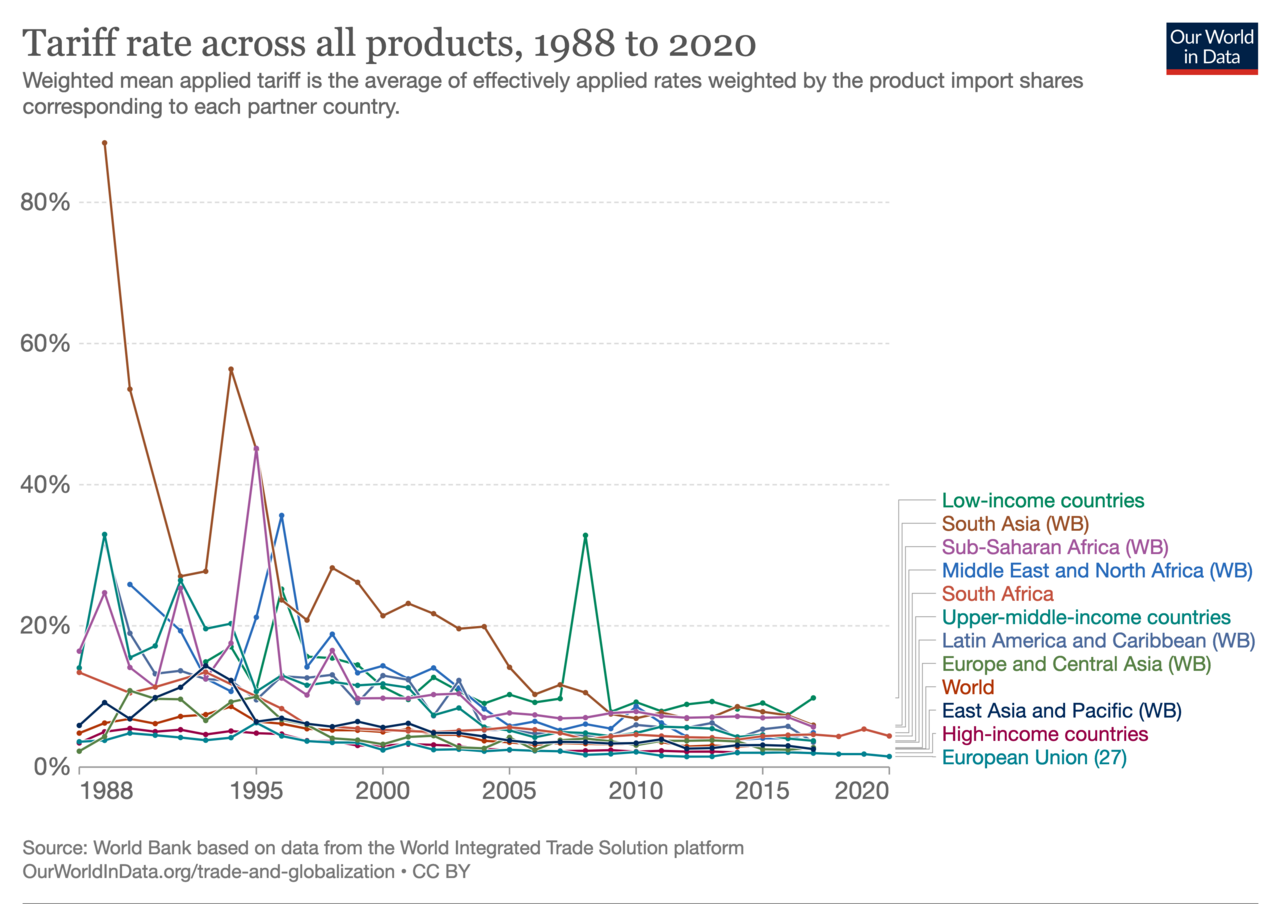
A tariff is a tax levied on imported goods, typically calculated as a percentage of a good's value and paid to the government by businesses importing products [1]. The United States has announced new tariffs on 14 trading partners, including China and the European Union [1]. The proposed tariffs will affect goods from China, the European Union, Singapore, Switzerland, Indonesia, Malaysia, Cambodia, Thailand, Korea, Vietnam, Taiwan, Bangladesh, Japan, and India [1]. The US Trade Representative (USTR) announced the proposed tariffs together with extensive reports of how each jurisdiction's trade practices purportedly impact American commerce [1].
Definition and mechanism
Tariffs function as import taxes that raise the cost of foreign goods entering a country. Because they are typically calculated as a percentage of a good's value, more expensive products face larger absolute charges [1]. Importing businesses remit the payment to the government, which can shift the burden into domestic supply chains [1].
Scope of the announcement
The latest US proposal covers fourteen named trading partners spanning Asia and Europe [1]. The breadth of the list signals that the measure is not aimed at a single bilateral dispute but at a wide set of trading relationships at once [1].
Proposed tariff rates by country
China faces the highest tariff rate of up to 40%, followed by Vietnam at up to 35% [1]. Japan, the European Union and others face up to 20% tariff rates [1]. Thailand and India face up to 25% tariff rates [2]. These figures represent the upper bounds of the proposed schedules rather than uniform charges on every product [1].
Highest rates
The 40% ceiling for China and 35% ceiling for Vietnam place these two economies at the top of the proposed tariff structure [1]. The gap between the top rate and the 20% ceiling for Japan and the EU is substantial, suggesting differentiated treatment based on the USTR's assessment of trade practices [1].
Mid-range rates
Thailand and India sit in the middle tier with proposed rates up to 25% [2]. Singapore, Switzerland, Indonesia, Malaysia, Cambodia, Korea, Taiwan, and Bangladesh are also named among the affected jurisdictions, though their specific ceilings are not detailed in the available sources [1].
Countries not affected
The UK is not included in the list of countries facing new tariffs [2]. There was no move against the UK's digital services tax [2]. However, the UK remains caught by the forced labour provisions, albeit at a rate of 10% extra on global tariffs [2].
UK position
The UK's exclusion from the new country-specific tariff list distinguishes it from the fourteen named partners [2]. At the same time, the continued application of forced labour provisions means UK exporters are not entirely insulated from US trade measures [2].
Forced labour provisions
The new tariffs will largely replace the previous findings on forced labour provisions [2]. The UK remains caught by those provisions at a 10% extra rate on global tariffs [2], indicating a partial carryover even as the broader tariff framework changes [2].
Timeline and legal process
The new tariffs are set to take effect after rounds of public consultation and potentially hearings [1]. The proposed tariffs will not take effect until next year and have to go through rounds of public consultation and, potentially, hearings [1]. The rates are also not due to come in until January or possibly February, after a period of consultation [2].
Consultation phase
Before any duties are imposed, the administration must conduct public consultation rounds and potentially hold hearings [1]. This procedural step creates a window during which affected governments and businesses can submit arguments against the proposed rates [1].
Effective dates
The proposed tariffs will not take effect until next year [1], with rates potentially coming in during January or possibly February [2]. The staggered timing reflects the administrative need to complete consultation before implementation [2].
Judicial context
Trump's 'Liberation Day' tariffs were struck down by the Supreme Court earlier this year [1,2]. Twenty-five states have taken the Trump administration to court to strike down the forced labour tariffs [2]. Around the world the view is that this is an attempt to shore up the domestic legal underpinning of these tariffs, more than a fundamental change in the Trump trade agenda [2].
Administration rationale
Trump has repeatedly threatened or imposed tariffs during his second term, arguing they will boost US manufacturing and create jobs [1]. Trump is also seeking to cut the US trade deficit - the gap between the value of goods it buys from other countries and those it sells to them [1]. The USTR announced the proposed tariffs together with extensive reports of how each jurisdiction's trade practices purportedly impact American commerce [1].
Manufacturing and jobs
The stated goal of boosting US manufacturing and job creation rests on the idea that higher import costs will make domestically produced goods more competitive [1]. This rationale connects the tariff instrument directly to domestic industrial policy objectives [1].
Trade deficit reduction
By raising the price of imported goods, the administration hopes to reduce the volume of imports and narrow the gap between the value of goods the US buys from other countries and those it sells to them [1]. Whether tariffs achieve this outcome depends on how foreign exporters and US consumers respond to the higher prices [1].
Economic reception
Economists have warned tariffs can fuel inflation and push prices up for consumers if businesses pass on higher costs [1]. Because importers pay the tax to the government, the added expense may be transmitted through supply chains to retail prices [1].
Inflationary pressure
If businesses pass on higher import costs, consumers face higher prices, which can fuel inflation across the economy [1]. This transmission mechanism means tariffs function partly as a indirect tax on households rather than solely on foreign producers [1].
Business response
Importing businesses must decide whether to absorb the tariff cost, seek alternative suppliers, or raise prices for customers [1]. Each choice carries different consequences for profit margins, supply chain resilience, and consumer demand [1].
Historical and statutory context
The most interesting direction of travel here is over the half of Canada tariffs authorised under 'Section 338' of the 1930s Smoot-Hawley act [2]. This reference points to the use of Depression-era trade statutes to justify contemporary tariff measures [2].
Smoot-Hawley invocation
Authorising tariffs under Section 338 of the Smoot-Hawley act connects current policy to a 1930s law historically associated with protectionist trade barriers [2]. The continued relevance of this statute shows how older legal frameworks are being repurposed for modern trade disputes [2].
Legal underpinning
The Supreme Court's earlier decision to strike down Trump's 'Liberation Day' tariffs [1,2] creates pressure to build new tariff proposals on stronger statutory grounds [2]. The observation that the current effort is an attempt to shore up domestic legal underpinning rather than a fundamental change in the trade agenda suggests continuity in objectives despite new legal packaging [2].
International implications
The proposed tariffs will affect goods from China, the European Union, Singapore, Switzerland, Indonesia, Malaysia, Cambodia, Thailand, Korea, Vietnam, Taiwan, Bangladesh, Japan, and India [1]. The EU says the tariff on European goods entering the US will remain at a previously agreed 15% [2].
EU response
The EU's statement that the tariff on European goods entering the US will remain at a previously agreed 15% [2] contrasts with the US proposal of up to 20% for the EU [1]. This divergence sets up a potential dispute over which rate applies to European exports [1,2].
Asian economies
China, Vietnam, Thailand, India, and several Southeast Asian economies face some of the highest proposed ceilings [1,2]. The concentration of steep rates in Asia suggests the measure will reshape trade flows across the Pacific region [1].
Significance
The combination of high proposed ceilings, a fourteen-country scope, and ongoing legal challenges makes this one of the most consequential US trade policy actions in recent years [1,2]. The interaction between the new tariffs, the forced labour provisions, and the Supreme Court's earlier ruling will determine the final shape of US import policy [1,2].
Policy continuity
The view around the world that this is an attempt to shore up domestic legal underpinning, more than a fundamental change in the Trump trade agenda [2], indicates that the administration's objectives remain consistent even as tactics adjust [2].
Economic stakes
With economists warning of inflationary consequences [1] and the administration targeting manufacturing growth and deficit reduction [1], the tariffs sit at the intersection of trade, fiscal, and industrial policy [1]. The final rates and implementation timeline will affect businesses and consumers across all fourteen named jurisdictions [1].