
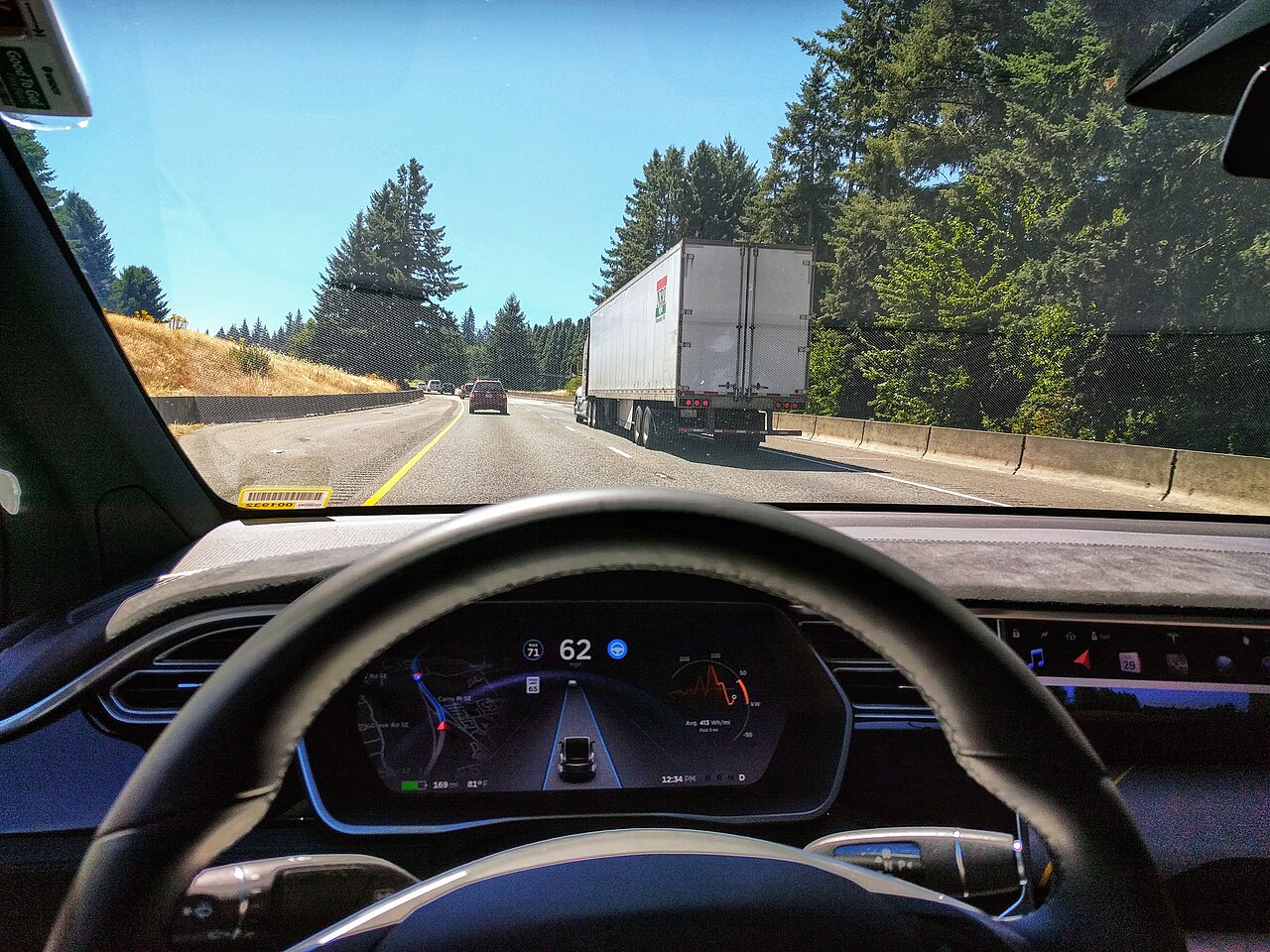
Overview of Tesla's Vision-Based FSD Architecture
A critical innovation within this architecture is the use of occupancy networks, which predict 3D volumes of surrounding vehicles, cyclists, and pedestrians to anticipate movement trajectories [5]. By modeling the environment as a continuous 3D occupancy grid rather than discrete detections, the system can better handle occluded objects and complex intersection scenarios. Path planning leverages Monte Carlo tree algorithms to optimize safe trajectories, balancing efficiency with collision avoidance on both highways and city streets [5]. Control loops execute steering, braking, and throttle commands at 36Hz, ensuring precise vehicle responses to dynamic traffic conditions [5].
Beyond individual vehicle perception, Tesla's FSD fleet operates on a continuous learning loop. Over-the-air updates refine behavior weekly, drawing from billions of supervised miles contributed by the fleet [5]. This fleet learning mechanism ensures that improvements made in one vehicle, such as enhanced navigation of a particular construction zone or improved handling of erratic vehicles, are propagated to the entire fleet. The result is a system that evolves over time, with real-time adjustments to speed limits, school zones, and inclement weather conditions [3].
Highway and City Street Performance
On highways, FSD has demonstrated smooth lane merges, speed adaptation to traffic flow, and emergency braking for debris [5]. The system's ability to maintain lane discipline while adapting to varying traffic densities showcases the maturity of its path planning algorithms. However, city streets present a different set of challenges. Urban environments expose limitations with unprotected left turns and construction zones, scenarios that Tesla addresses through parameter refinements in its HW4 hardware generation [5]. These refinements involve adjusting the neural network's thresholds for detecting drivable surfaces and obstacle types, improving reliability in previously problematic areas.
Tesla's real-world testing in South Korea further illustrates the system's operational design domain. FSD test scenarios there included expressways, city streets, and bus lanes operating between 10 a.m. and 6 p.m., providing data across different traffic patterns and lighting conditions [5]. The system's performance in these scenarios revealed its capability to handle real-time adjustments to erratic vehicles and precise gap selection at intersections. Nighttime rain and glare are managed through integrated wiper and camera exposure adjustments, ensuring sensor reliability across diverse weather and lighting scenarios [5].
FSD v15: Targeting Key Weaknesses
Tesla's release of FSD v15 marked a significant update targeting the system's biggest weaknesses, including sign detection, potholes, and speed handling in school zones [3]. This version introduced an upgraded vision encoder shared between FSD, Robotaxi, and Optimus, trained on millions of internet videos. This shared training approach improved the critical intervention rate by 25x, indicating a substantial leap in the system's ability to self-correct and handle edge cases [3]. The end-to-end learned model now processes route preference data from the fleet, improving navigation efficiency and reducing the likelihood of suboptimal routing decisions [3].
FSD v15 also brought improvements to parking and driver monitoring. The system now improves parking location selection by using personalized parking history, and the map displays multiple parking options at the destination [3]. Driver monitoring saw enhancements with increased vision-based attention monitoring availability, even with hats and sunglasses, and a decrease in strictness for higher speed driver profiles [3]. Detection capabilities were broadened to include road signs, small animals, road debris, and chains, as well as potholes, road details, and avoidance of deep standing water [3]. Additionally, the update added Bike Rack Mode for FSD with a bike rack or similar hitch accessory, and the system can now slow down for speed cameras [3]. The Reality View feature provides a detailed, rendered version of the street around the car beyond the current FSD visualization, offering drivers a richer contextual understanding of their surroundings [3].
Safety Gains and Comparative Analysis
Safety remains a central focus of Tesla's FSD development. A study by MIT's CSAIL found that vision-based networks reduce collision probabilities by 35% compared to traditional lane-following systems [5]. This statistically significant improvement underscores the effectiveness of Tesla's camera-centric approach over more conventional radar or lidar-dependent systems. The combination of occupancy networks for 3D prediction and Monte Carlo tree algorithms for path planning contributes to this safety margin, particularly in scenarios involving sudden obstacles or complex maneuvering.
It is important to note that FSD operates at Level 2+ supervision, meaning the vehicle can steer, accelerate, and brake autonomously but requires constant human oversight [5]. The system logs interventions—moments when the human driver takes over—to provide feedback for continual learning. This human-in-the-loop design ensures that while the technology handles routine driving tasks, the driver remains responsible for monitoring the road and intervening when necessary. The intervention data feeds back into the fleet learning pipeline, creating a feedback loop that drives incremental safety improvements with each over-the-air update [5].
Technical Deep Dive: Sensors and Neural Networks
The technical underpinning of Tesla's FSD system lies in its sensor fusion and neural network architecture. The eight cameras provide a 360-degree view around the vehicle, with overlapping fields of view that enable redundancy and improved object tracking. The 1.2MP image resolution is processed by custom neural networks that perform real-time semantic segmentation, classifying each pixel as part of a drivable surface, a traffic signal, or an obstacle [5]. This high-frequency processing is essential for the system's ability to make split-second decisions at highway speeds.
Occupancy networks represent a sophisticated approach to 3D perception. Instead of predicting discrete bounding boxes around objects, the network outputs a probability field indicating whether each point in 3D space is occupied [5]. This allows the system to anticipate the future movement of pedestrians or cyclists more accurately, particularly in scenarios where the object's path is not immediately clear. Combined with Monte Carlo tree search for path planning, the vehicle can evaluate numerous potential trajectories and select the one that maximizes safety and efficiency [5].
Fleet Learning and Over-the-Air Updates
The scale of Tesla's data collection is unparalleled in the automotive industry. With over two billion miles driven on Autopilot and FSD Beta, the fleet generates a continuous stream of real-world driving data [5]. This data is not merely stored; it is actively used to train and refine the neural networks that power FSD. Weekly over-the-air updates mean that the system's capabilities can improve faster than traditional vehicle software cycles, which often span years [5]. The feedback loop is closed through intervention logging: when a driver takes over, the event is recorded, analyzed, and used to adjust the model's parameters. This iterative process has led to measurable reductions in collision rates and improvements in navigation behavior across the fleet [5].
This fleet learning approach also enables Tesla to address region-specific driving patterns. Data from markets like South Korea, where FSD was tested on expressways and bus lanes, informs adjustments to the model's behavior in similar traffic environments globally [5]. The result is a somewhat adaptive system that, while not yet capable of full autonomy without supervision, offers increasingly tailored assistance depending on the driving context.