
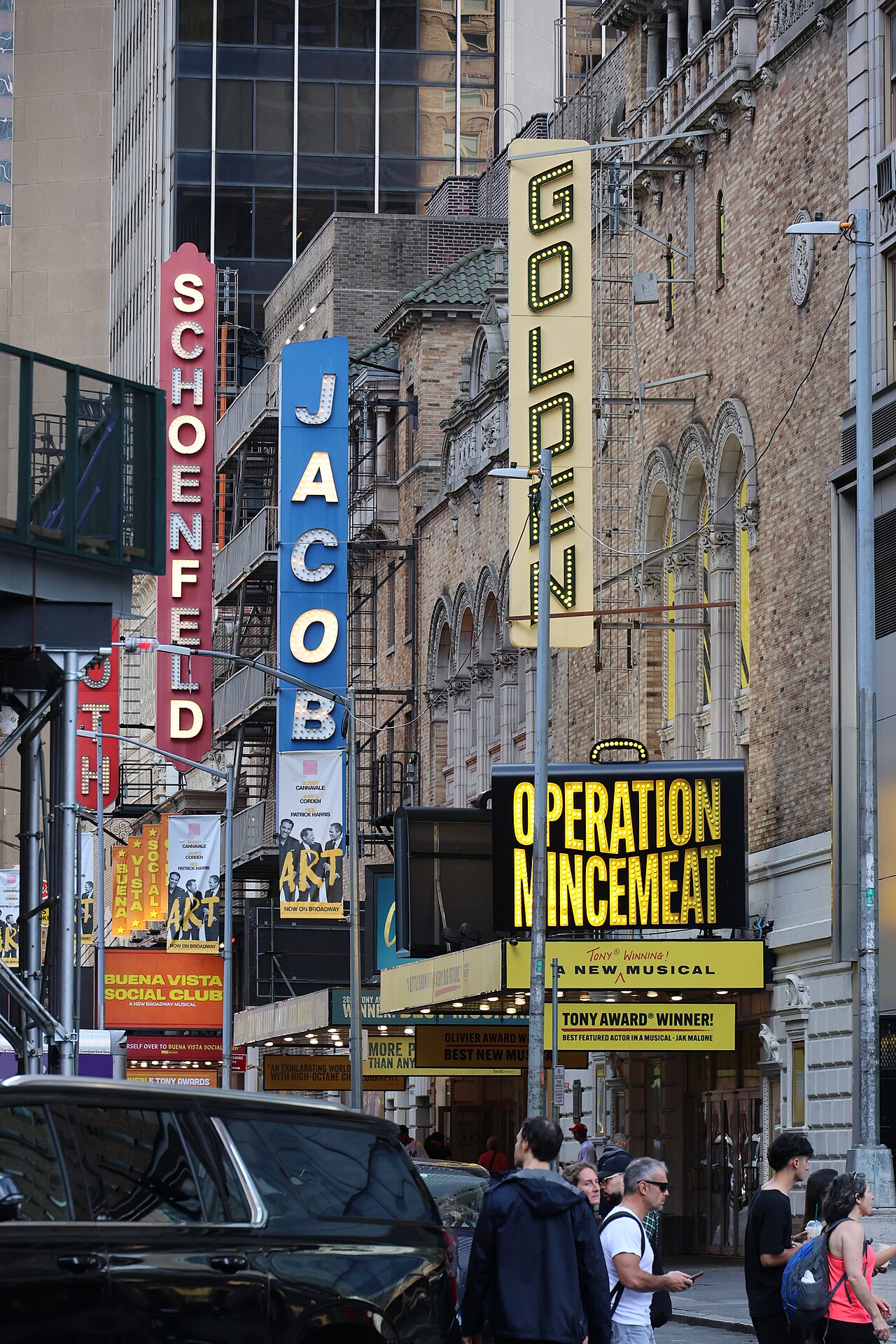
Overview of the Broadway Theatre Genre
Broadway theatre is defined as a theatrical genre featuring performances held within 41 designated professional theaters [1]. These venues are situated within the Theater District and Lincoln Center, specifically along Broadway in Midtown Manhattan, New York City [1]. The classification of a Broadway theater is formally rooted in a 1949 agreement established by Actors' Equity involving smaller theaters within New York [2]. This genre holds significant cultural weight, sharing the highest commercial standing of live theater in the English-speaking world with London's West End [1].
Geographic Concentration in Manhattan
The operational theaters are concentrated in Midtown Manhattan [1]. The specific areas noted for these professional venues include the Theater District and Lincoln Center [1]. The general criteria for inclusion in this category involve the venue primarily hosting legitimate theater productions, being situated within Manhattan's Theater District, and possessing a seating capacity exceeding 500 seats [2].
Defining Characteristics of a Broadway Venue
A core characteristic of a Broadway theater involves its physical specifications, requiring a minimum capacity of 500 seats [1]. The contemporary legal standard for what constitutes a Broadway theater is derived from the 1949 Actors' Equity agreement pertaining to smaller New York theaters [2]. Furthermore, the primary function of these venues is hosting legitimate theater productions, which is a key component of the general rule for classification [2].
Specific Theaters on Broadway Street
It is important to note that only three theaters are physically located directly on Broadway itself [1]. These specific venues include the Broadway Theatre, the Palace Theatre, and the Winter Garden Theatre [1]. This highlights a distinction between venues *on* Broadway street and those *in* the broader Broadway Theatre District [1].
Historical Context and Early Development
The history of large-scale theater in the city traces back to the Park Theatre [2]. This venue, constructed in 1798 on Park Row, which is located just off Broadway, holds the distinction of being the first large, long-term theater established in the city [2]. This early development set a precedent for the large-scale theatrical presentations seen today [2].
Evolution of Theater Standards
The evolution of the genre is tied to formal agreements, such as the 1949 Actors' Equity agreement [2]. This agreement serves as the basis for the current legal definition of a Broadway theater [2]. The progression from early structures like the Park Theatre to the modern 41 professional venues reflects a long development in theatrical infrastructure [1, 2].
The Scope of Commercial Live Theater
The commercial stature of Broadway is internationally recognized [1]. When considered alongside London's West End, the combined entities of Broadway and the West End represent the highest level of commercial activity within the English-speaking theater world [1]. This dual recognition underscores the global importance of these theatrical markets [1].
Market Comparison and Prestige
The comparison with the West End establishes a benchmark for commercial success in English-speaking theater [1]. Both markets operate at the highest commercial tier [1]. This shared status demonstrates a high level of artistic and financial achievement in both locations [1].
Operational Criteria for Classification
To qualify as a Broadway theater, several operational and physical criteria must be met [2]. The general rule requires the venue to predominantly host legitimate theater productions [2]. Additionally, its location must generally be within Manhattan's Theater District [2]. Crucially, the capacity must surpass 500 seats [2].
Distinguishing Venue Types
The distinction between a theater on Broadway street and one within the broader Theater District is important [1]. Only three specific theaters—the Broadway Theatre, Palace Theatre, and Winter Garden Theatre—are situated directly on Broadway [1]. The remaining 38 professional theaters are located within the defined Theater District and Lincoln Center areas [1].
The Legal Foundation of Broadway Status
The current legal framework defining a Broadway theater is not arbitrary but is based on a specific agreement [2]. This foundation originates from the 1949 Actors' Equity agreement, which involved smaller theaters operating in New York [2]. This historical agreement dictates the modern criteria for classification [2].
Implications of the 1949 Agreement
The 1949 Actors' Equity agreement provides the legal underpinning for the definition [2]. This historical document shapes how venues are categorized today, linking contemporary practice to past labor agreements [2]. It is the basis upon which the general rule—legitimate theater, Manhattan Theater District, over 500 seats—is applied [2].
Physical Infrastructure and Location Details
The 41 professional theaters are distributed across the Theater District and Lincoln Center in Midtown Manhattan [1]. These venues meet the threshold of having 500 or more seats each [1]. The geographical concentration within Midtown Manhattan is a defining feature of the Broadway genre [1].
Park Row's Early Significance
The Park Theatre, established in 1798 on Park Row, just adjacent to Broadway, marks a significant early milestone [2]. It is recognized as the initial large, long-term theater structure in the city [2]. This early establishment predates the modern codified definition of Broadway theatre [2].
Criteria Summary for Broadway Classification
To summarize the requirements, a venue must generally host legitimate theater productions [2]. It must be located within Manhattan's Theater District [2]. Furthermore, the capacity must exceed 500 seats [2]. This combination of function, location, and size defines the genre [2].
Key Numerical Data Points
The total number of professional theaters in this genre is 41 [1]. Each of these venues must have a minimum seating capacity of 500 seats [1]. Only three specific venues are located directly on Broadway street [1].
Global Theater Comparison
The commercial prominence of Broadway is measured against international counterparts [1]. Specifically, the combination of Broadway and London's West End represents the highest commercial level of live theater within the English-speaking world [1]. This places the New York scene in a globally elite category of live performance [1].
Defining Commercial Apex
The designation of 'highest commercial level' applies to the combined strength of Broadway and the West End [1]. This metric reflects not just artistic merit but also significant financial success in the English-speaking theater landscape [1].
The Role of Actors' Equity
The 1949 Actors' Equity agreement is central to the current legal definition of a Broadway theater [2]. This agreement was established in connection with smaller theaters operating in New York [2]. It provides the formal basis for the genre's modern classification [2].
Legal vs. General Rules
While the general rule involves legitimate theater, Manhattan Theater District location, and capacity over 500 seats [2], the *legal* definition is anchored specifically to the 1949 Actors' Equity agreement [2]. These two aspects—the practical rule and the legal basis—are distinct but interconnected [2].
Geographical Distribution Detail
The 41 professional theaters are situated across two key areas: the Theater District and Lincoln Center [1]. These areas are both located within Midtown Manhattan, New York City [1]. The concentration of these venues defines the physical scope of Broadway theatre [1].
Broadway Street Specifics
Only the Broadway Theatre, Palace Theatre, and Winter Garden Theatre are situated directly on Broadway street [1]. This contrasts with the broader inclusion of venues within the Theater District and Lincoln Center [1].
Historical Milestones in Theater Infrastructure
The Park Theatre, built in 1798 on Park Row near Broadway, represents a foundational moment [2]. It holds the distinction of being the first large, long-term theater in the city [2]. This early structure predates the modern, codified definition based on the 1949 agreement [2].
Timeline Context
The timeline moves from the 1798 establishment of the Park Theatre [2] to the formalization via the 1949 Actors' Equity agreement [2]. This progression illustrates the development from early large venues to a legally defined, modern professional genre [2].
Synthesis of Definitional Elements
A Broadway theater must satisfy multiple criteria simultaneously [2]. These include hosting legitimate theater, being in the Manhattan Theater District, and having over 500 seats [2]. Furthermore, the total count of these professional venues is 41 [1]. The location is specifically within Midtown Manhattan [1].
Core Components Checklist
The essential components involve the capacity requirement (500+ seats) [1], the location (Theater District/Lincoln Center in Midtown Manhattan) [1], the function (legitimate theater) [2], and the legal grounding (1949 Actors' Equity agreement) [2].