
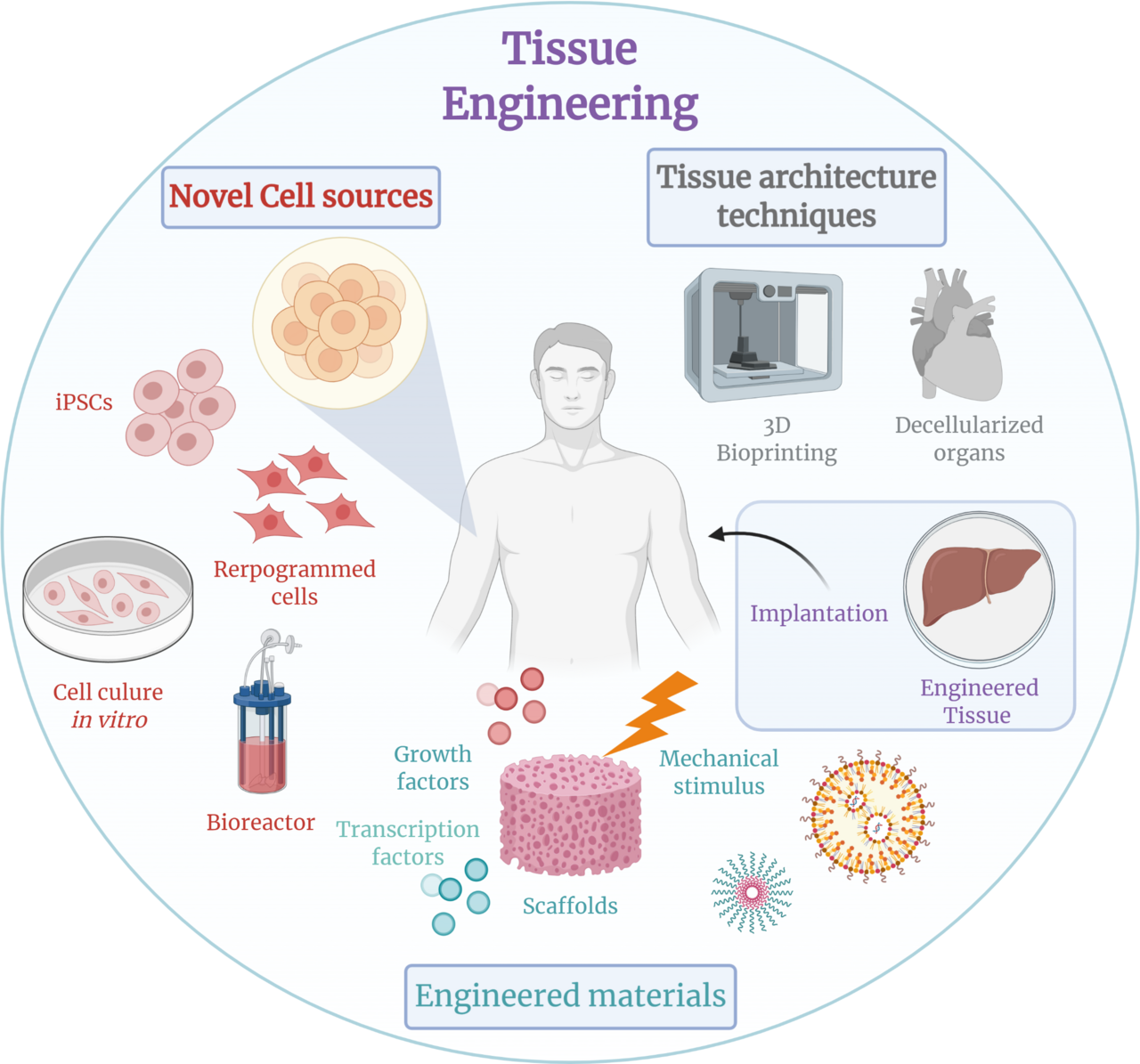
Overview of Tissue Engineering Principles
Tissue engineering functions as a biomedical engineering field that integrates cells, appropriate biochemical and physicochemical factors, and specialized engineering materials methods [1]. The ultimate goal is to restore, maintain, improve, or substitute various types of biological tissues [1]. This discipline applies the methods and core principles derived from engineering, medicine, and physiology to develop new tissues that mimic the function and characteristics of natural biological substitutes intended for implantation within the body, thereby aiding in the repair, replacement, or enhancement of organ function [2].
Core Objectives in Tissue Restoration
The primary aim involves utilizing engineered tissues as substitutes for biological components within the body [2]. This application seeks to address deficiencies by repairing existing tissues, replacing entirely damaged structures, or actively enhancing the capabilities of natural organs [2]. The integration of biological components with advanced material science is central to achieving functional biological substitutes [1].
Mechanisms of Tissue Construction
A common approach in this field involves positioning cells onto supportive tissue scaffolds [1]. This scaffold provides the necessary structural framework for cell viability and tissue development [1]. The development of engineered tissues capable of effectively restoring, maintaining, improving, or replacing biological tissues has advanced significantly over the last decade through the introduction of new cell sources, novel engineering materials, and sophisticated tissue architecture techniques [1].
Assembly Methodologies
- Self-assembly processes are employed in tissue engineering [1]
- Liquid-based template assembly is a recognized method [1]
- Additive manufacturing techniques are utilized for tissue creation [1]
- Scaffolding serves as a fundamental assembly technique [1]
Advanced Scaffold Synthesis Techniques
The synthesis of scaffolds employs a diverse range of sophisticated techniques to achieve desired material properties [1]. These methods allow for the precise control over the structure and porosity required for cell integration and nutrient transport within the engineered construct [1].
Specific Fabrication Processes
- Nanofiber self-assembly is a documented technique for scaffold creation [1]
- Electrospinning is one of the established methods used in this field [1]
- Solvent casting and particulate leaching are utilized fabrication methods [1]
- Gas foaming and emulsification freeze-drying are also employed [1]
Precision Manufacturing in Tissue Engineering
Modern tissue engineering benefits from high-precision manufacturing tools that dictate the final architecture of the tissue construct [1]. These technologies allow researchers to move beyond simple porous structures toward highly organized, functional tissue replacements [1].
Bioprinting and CAD/CAM Integration
- Laser-assisted bioprinting represents a key advanced technique [1]
- CAD/CAM technologies are integrated into scaffold synthesis [1]
- Self-assembled recombinant spider silk nanomembranes are utilized materials [1]
Evolution Over the Last Decade
Progress in the field over the last ten years has been marked by significant innovation across multiple fronts [1]. These advancements in materials, cell sourcing, and architectural control have resulted in engineered tissues that show improved capacity to restore, maintain, or replace native biological tissues [1].
Material and Cell Source Advancements
The availability of novel cell sources and engineering materials has been instrumental in the field's maturation [1]. This ongoing refinement ensures that the resulting biological substitutes are increasingly functional and biocompatible for implantation [1].
Engineering vs. Biological Function
Tissue engineering bridges the gap between mechanical engineering principles and complex biological requirements [2]. The objective is not merely structural replacement but achieving functional equivalence to the original organ or tissue [2]. This requires careful consideration of both the physical scaffolding and the biochemical cues provided to the embedded cells [1].
Physiological Integration
The application of physiological knowledge alongside engineering methods ensures that the resulting tissue can integrate successfully into the body [2]. The biochemical and physicochemical factors incorporated are designed to guide cellular behavior toward a native tissue phenotype [1].
Synthesis Techniques Detailed
Beyond the high-tech methods, several established techniques contribute to scaffold creation [1]. These methods provide foundational knowledge for current advanced practices [1].
Traditional and Emerging Synthesis Methods
- Textile technologies are employed in scaffold design [1]
- Thermally induced phase separation is a synthesis method [1]
- Emulsification freeze-drying is a known scaffold fabrication technique [1]
Significance in Regenerative Medicine
Tissue engineering is a core component of regenerative medicine efforts [2]. By providing functional biological substitutes, it offers potential solutions for conditions previously limited by the inability to repair complex organ damage [2]. The capacity to repair, replace, or enhance organ function is the ultimate clinical significance of this discipline [2].
Clinical Potential
The development of these engineered tissues aims directly at improving patient outcomes through functional biological replacement [2]. This moves beyond simple patching toward true organ-level restoration [2].
Material Science Contributions
The selection and design of engineering materials are critical for successful tissue integration [1]. These materials must support cell life while guiding tissue formation toward a functional state [1].
Biomimetic Materials
The incorporation of materials like self-assembled recombinant spider silk nanomembranes highlights the trend toward biomimicry in tissue engineering [1]. This mimics natural biological structures for enhanced cellular interaction [1].
Future Directions in Tissue Architecture
The refinement of tissue architecture techniques ensures that the engineered construct possesses the necessary spatial organization for biological function [1]. Techniques like additive manufacturing and self-assembly dictate this crucial structural quality [1].
Architectural Control
Achieving appropriate tissue architecture is vital for the biological substitute to perform its intended function within the body [2]. This control is achieved through methods ranging from liquid-based template assembly to advanced bioprinting [1].