
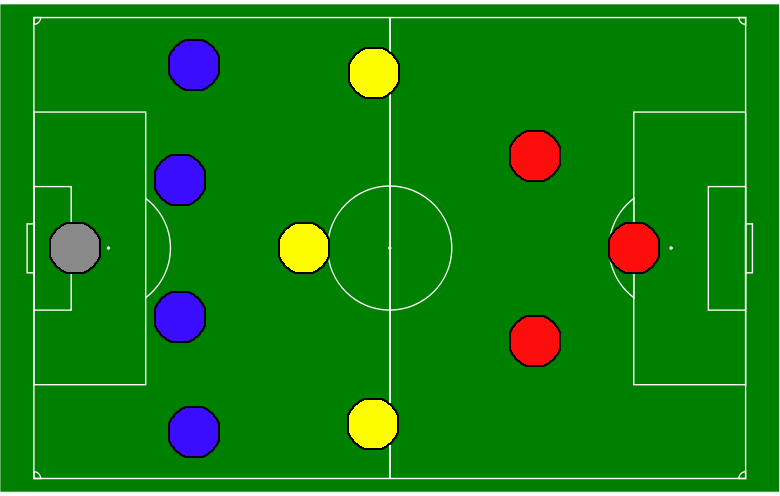
Overview of the Tactical Doctrine
Total Football, known in Dutch as totaalvoetbal, represents a sophisticated tactical theory in the sport of association football that fundamentally redefines the relationship between individual players and team structure [1,4]. Unlike traditional systems that rely on rigid positional boundaries, this approach allows any outfield player to take over the role of any other player within the team [1,4]. This flexibility ensures that the team maintains its intended organizational structure even when players move fluidly across the pitch [1,4]. The doctrine has become a cornerstone of modern tactical discussions, serving as a historical benchmark for fluidity and positional intelligence in football strategy [1,4].
Defining the Core Principle
The central tenet of Total Football is the complete interchangeability of outfield players. No outfield player is fixed in a predetermined role, meaning that a single individual can successively play as an attacker, a midfielder, and a defender during the course of a match [1,4]. This fluidity is not chaotic; rather, it is a highly disciplined system where movement is calculated to preserve defensive and offensive balance [1,4]. The only player who must stay in a specified position is the goalkeeper, who remains the sole fixed element in the tactical formation [1,4]. This exception highlights the extreme nature of the system, where every other player is a variable in the tactical equation [1,4].
Distinguishing from Modern Interpretations
While the term is often used loosely in contemporary football commentary to describe any fluid attacking style, the original doctrine is much more specific and demanding [1,4]. It requires a level of technical proficiency and tactical awareness that is rare, as every player must be comfortable performing duties outside their natural comfort zone [1,4]. The system relies on the collective understanding of the team to cover for the player who has moved out of position, ensuring that no gaps are left for the opposition to exploit [1,4]. This distinction is crucial for understanding the historical significance of the tactic, as it was not merely a style of play but a comprehensive tactical philosophy [1,4].
Historical Origins and Early Exponents
The roots of Total Football can be traced back to the 1950s, a period of significant innovation in football tactics across Europe and South America [1,4]. Several elite clubs and national teams were among the early exponents of this fluid approach, laying the groundwork for what would become a global phenomenon [1,4]. These teams recognized the limitations of rigid formations and began experimenting with positional interchange to gain a competitive edge [1,4]. The legacy of these early adopters is evident in the tactical DNA of modern football, where the principles of Total Football continue to influence coaching methodologies [1,4].
Key Clubs in the 1950s
Among the most notable early exponents of Total Football were the Dutch club Ajax, the Spanish giant Real Madrid, and the Brazilian side Santos [1,4]. These clubs possessed squads filled with versatile players who could adapt to different roles on the pitch, allowing them to implement the fluid tactics effectively [1,4]. Ajax, in particular, would go on to become synonymous with the doctrine in later decades, building upon the experimental foundations laid in the 1950s [1,4]. Real Madrid and Santos also demonstrated the effectiveness of positional interchange in high-stakes matches, proving that the system could succeed at the highest level of competition [1,4].
National Team Innovations
The Golden Team of Hungary and the English side Burnley were also recognized as early exponents of Total Football in the 1950s [1,4]. The Hungarian national team, in particular, was renowned for its fluid attacking play and the ability of its players to drift between positions, creating confusion for opposing defenses [1,4]. Burnley, an English club, similarly experimented with flexible roles, showing that the concept was not limited to continental Europe or South America [1,4]. The inclusion of these diverse teams in the historical narrative underscores the global nature of the tactical innovation [1,4].
The 1950s Tactical Context
The 1950s were a time of transition in football, moving away from the rigid WM formation towards more open and fluid systems [1,4]. The early exponents of Total Football capitalized on this shift, using positional interchange to exploit the weaknesses of teams that were still adhering to traditional structures [1,4]. The success of these teams in the 1950s helped to establish the credibility of the doctrine, paving the way for its further development and popularization in subsequent decades [1,4]. This period of experimentation was crucial in refining the tactical principles that would later be perfected by the Dutch national team [1,4].
The 1974 FIFA World Cup and Global Fame
Total Football was made famous by the Netherlands National Football Team during the 1974 FIFA World Cup, a tournament that showcased the doctrine in its most complete and devastating form [1,4]. The Dutch team, often referred to as the 'Total Football' team, captivated audiences worldwide with their fluid, interconnected play and their ability to dominate possession and space [1,4]. Although they did not win the tournament, their performance is widely regarded as one of the most tactically significant in World Cup history [1,4]. The 1974 World Cup served as a global platform for the dissemination of the Total Football philosophy, influencing coaches and players around the world [1,4].
The Dutch National Team's Performance
The Netherlands National Football Team executed Total Football with a precision and consistency that had not been seen before in international competition [1,4]. Players such as Johan Cruyff and others demonstrated the ability to interchange positions seamlessly, maintaining the team's structural integrity while creating numerical advantages in key areas [1,4]. The team's performance in the 1974 FIFA World Cup highlighted the effectiveness of the doctrine, even in the face of strong opposition from other top-tier national teams [1,4]. The global attention focused on the Dutch team during this tournament cemented the status of Total Football as a premier tactical approach [1,4].
Impact on Global Football Perception
The visibility of the Netherlands' performance in the 1974 FIFA World Cup changed the way football was perceived and analyzed globally [1,4]. Coaches and analysts began to study the Dutch team's methods, seeking to understand the underlying principles of their success [1,4]. The tournament demonstrated that Total Football was not just a theoretical concept but a practical and effective strategy for winning matches [1,4]. The legacy of the 1974 World Cup is still felt today, as teams continue to draw inspiration from the Dutch approach to positional play and tactical flexibility [1,4].
Legacy of the 1974 Campaign
The 1974 FIFA World Cup campaign by the Netherlands remains a reference point for discussions about Total Football [1,4]. It is often cited as the pinnacle of the doctrine, a moment when the theory was fully realized on the international stage [1,4]. The impact of this campaign extended beyond the tournament itself, influencing the development of football tactics in the decades that followed [1,4]. The association between the Netherlands and Total Football remains strong, with the national team's identity inextricably linked to the tactical innovations of the 1970s [1,4].
Mechanics of Positional Interchange
The mechanics of Total Football rely on a specific method of positional interchange that ensures the team's organizational structure is retained [1,4]. When a player moves out of his position, he is replaced by another player from his team, thus preserving the balance of the formation [1,4]. This process is continuous and dynamic, with players constantly rotating and adjusting their positions in response to the flow of the game [1,4]. The key to the system's success is the ability of players to anticipate and execute these changes with minimal disruption to the team's overall shape [1,4].
The Role of Replacement
The concept of replacement is central to the functioning of Total Football [1,4]. When an outfield player leaves his designated area to attack or support, another player from the same team moves into that space to maintain the defensive or midfield structure [1,4]. This ensures that the team does not become unbalanced or vulnerable to counter-attacks [1,4]. The replacement player must be capable of performing the duties of the player who moved, highlighting the need for versatility and tactical intelligence [1,4]. This mechanic is what distinguishes Total Football from simple positional shifting, as it involves a coordinated team effort [1,4].
Fluidity in Attack and Defense
In Total Football, the fluidity of movement is applied equally in both attack and defense [1,4]. Players can successively play as an attacker, a midfielder, and a defender, depending on the tactical requirements of the moment [1,4]. This flexibility allows the team to adapt quickly to changing game situations, such as transitioning from defense to attack or vice versa [1,4]. The ability to switch roles seamlessly is a hallmark of the doctrine, enabling the team to maintain pressure and control throughout the match [1,4].
The Exception of the Goalkeeper
The only player who must stay in a specified position in Total Football is the goalkeeper [1,4]. This exception is crucial, as the goalkeeper's role is distinct from that of the outfield players and requires a different set of skills and responsibilities [1,4]. The goalkeeper remains the last line of defense and does not participate in the positional interchange of the outfield players [1,4]. This fixed position provides a stable anchor point for the team, around which the fluid movements of the other players are organized [1,4].
Tactical Requirements and Player Attributes
Implementing Total Football requires a specific set of tactical and technical attributes from all players in the squad [1,4]. The system is demanding, as it places a high premium on individual skill, tactical awareness, and physical fitness [1,4]. Players must be able to perform effectively in multiple roles, which requires a broad skill set and a deep understanding of the game [1,4]. The tactical requirements of Total Football go beyond simple technical ability, encompassing elements of decision-making, spatial awareness, and teamwork [1,4].
Technical Versatility
Technical versatility is a prerequisite for success in Total Football [1,4]. Players must be comfortable handling the ball in different areas of the pitch and performing different tasks, such as defending, passing, and shooting [1,4]. This versatility allows them to interchange positions without a loss of effectiveness, ensuring that the team's performance remains consistent [1,4]. The ability to adapt to different roles is what enables the fluidity that characterizes the doctrine [1,4].
Tactical Intelligence and Awareness
Tactical intelligence and awareness are critical components of Total Football [1,4]. Players must be able to read the game, anticipate the movements of opponents and teammates, and make quick decisions about when and where to move [1,4]. This cognitive aspect of the game is as important as the physical and technical aspects, as it allows players to execute the positional interchange effectively [1,4]. The system relies on a collective understanding of the tactical principles, which is developed through training and experience [1,4].
Physical Demands
The physical demands of Total Football are significant, as players are required to cover large areas of the pitch and maintain high intensity throughout the match [1,4]. The constant movement and positional changes require a high level of fitness and endurance [1,4]. Players must be able to sustain their performance over the course of the game, which is a challenge even for elite athletes [1,4]. The physical aspect of the doctrine is often overlooked, but it is essential for the successful implementation of the tactical system [1,4].
Reception and Critical Analysis
The reception of Total Football has been largely positive, with many critics and analysts praising its elegance and effectiveness [1,4]. The doctrine is often cited as a high point in the evolution of football tactics, representing a significant departure from the rigid structures of the past [1,4]. However, it has also been subject to criticism, with some arguing that it is too difficult to implement consistently and that it relies heavily on individual talent [1,4]. The critical analysis of Total Football continues to be a subject of debate in football academia and media [1,4].
Praise for Tactical Elegance
Many football experts praise Total Football for its tactical elegance and the beauty of its execution [1,4]. The fluidity of the system and the seamless interchange of positions are often described as a form of art, showcasing the highest level of footballing skill [1,4]. The 1974 FIFA World Cup performance of the Netherlands is frequently cited as an example of this elegance, with commentators and fans alike marveling at the team's coordination [1,4]. The aesthetic appeal of Total Football has contributed to its enduring popularity and influence in the sport [1,4].
Criticism of Practicality
Critics of Total Football argue that the system is too complex and difficult to implement in practice [1,4]. They contend that it requires a level of individual talent and tactical understanding that is not available to most teams, making it a luxury rather than a viable strategy for the average club [1,4]. The high physical and mental demands of the system are also cited as reasons for its limited applicability [1,4]. These criticisms highlight the challenges of translating the theoretical principles of Total Football into a consistent and reliable competitive advantage [1,4].
Academic and Media Discourse
Total Football remains a subject of active discourse in academic and media circles [1,4]. Scholars and journalists continue to analyze the tactical principles of the doctrine and its impact on the evolution of football [1,4]. The ongoing discussion reflects the enduring relevance of the concept, even as football tactics continue to evolve [1,4]. The academic interest in Total Football underscores its significance as a foundational element of modern tactical theory [1,4].
Significance in Football History
The significance of Total Football in football history cannot be overstated, as it fundamentally changed the way the game is played and understood [1,4]. The doctrine introduced a new level of complexity and fluidity to football tactics, influencing generations of coaches and players [1,4]. Its impact is evident in the modern game, where elements of positional interchange and fluid movement are commonplace [1,4]. Total Football stands as a testament to the innovative spirit of football and the continuous pursuit of tactical excellence [1,4].
Influence on Modern Tactics
The principles of Total Football have had a lasting influence on modern football tactics [1,4]. Many contemporary teams incorporate elements of positional interchange and fluid movement into their playing style, drawing inspiration from the Dutch approach [1,4]. The doctrine has contributed to the evolution of football from a rigid, positional game to a more dynamic and adaptable one [1,4]. This influence is visible in the tactical strategies of top clubs and national teams around the world [1,4].
Cultural Impact
Total Football has also had a cultural impact, shaping the way football is perceived and appreciated by fans and experts alike [1,4]. The aesthetic appeal of the doctrine and the skill required to execute it have made it a source of admiration and inspiration [1,4]. The association of Total Football with the Netherlands has also contributed to the country's reputation as a footballing powerhouse [1,4]. The cultural significance of the doctrine extends beyond the pitch, influencing football culture and identity [1,4].
Enduring Legacy
The legacy of Total Football endures as a benchmark for tactical innovation in football [1,4]. It remains a reference point for discussions about the future of the game and the potential for further tactical development [1,4]. The doctrine continues to inspire coaches and players to push the boundaries of what is possible in football [1,4]. The enduring legacy of Total Football is a testament to its profound impact on the sport [1,4].
Distinction from the Video Game
It is important to distinguish the tactical doctrine of Total Football from the mobile video game of the same name [2]. The video game, developed and published by Gala Sports, is a separate entity that shares the name but not the tactical principles of the football doctrine [2]. The game was released on July 11, 2022, and is designed as a simulation of football gameplay [2]. This distinction is crucial for readers who may encounter the term in different contexts, such as sports analysis or gaming media [2].
About the Mobile Video Game
Total Football is also the name of a mobile football video game developed and published by Gala Sports [2]. The game was released on July 11, 2022, and is available on mobile platforms [2]. It is designed to simulate the experience of playing football, incorporating elements of strategy and skill [2]. The game's title reflects the popularity of the tactical doctrine, but its content is focused on digital entertainment rather than historical football tactics [2].
Developer and Release Details
The mobile video game Total Football was developed and published by Gala Sports [2]. The release date of the game was July 11, 2022 [2]. This information is distinct from the historical and tactical aspects of the football doctrine, which have a much longer history and a different context [2]. The existence of the video game highlights the cultural reach of the term Total Football, extending it into the realm of digital media [2].
Contextual Clarity for Readers
Readers should be aware that the term Total Football can refer to either the tactical doctrine or the mobile video game [2]. The context in which the term is used will determine which meaning is intended [2]. In sports journalism and tactical analysis, the term refers to the football doctrine [1,4]. In gaming media and app stores, the term refers to the mobile video game [2]. This dual usage underscores the need for clarity when discussing the topic [2].
Conclusion and Future Relevance
Total Football remains a pivotal concept in the history of football, representing a significant leap in tactical thinking and execution [1,4]. Its origins in the 1950s and its global fame in 1974 mark it as a enduring influence on the sport [1,4]. The doctrine's emphasis on fluidity, positional interchange, and tactical intelligence continues to resonate with coaches and players [1,4]. As football evolves, the principles of Total Football will likely remain a relevant and influential part of the tactical landscape [1,4].
Summary of Key Contributions
The key contributions of Total Football to football history include the introduction of fluid positional interchange, the elevation of tactical intelligence as a core skill, and the demonstration of the effectiveness of flexible team structures [1,4]. These contributions have shaped the modern game and continue to influence tactical approaches [1,4]. The doctrine's legacy is evident in the way teams today approach the game, with many incorporating elements of Total Football into their strategies [1,4].
Future Prospects
The future prospects of Total Football are tied to the ongoing evolution of football tactics [1,4]. As the game continues to change, the principles of the doctrine may be adapted and refined to meet new challenges [1,4]. The enduring appeal of Total Football suggests that it will remain a relevant concept in football for years to come [1,4]. The doctrine's influence on the sport is a testament to its innovative nature and its ability to transcend time [1,4].