
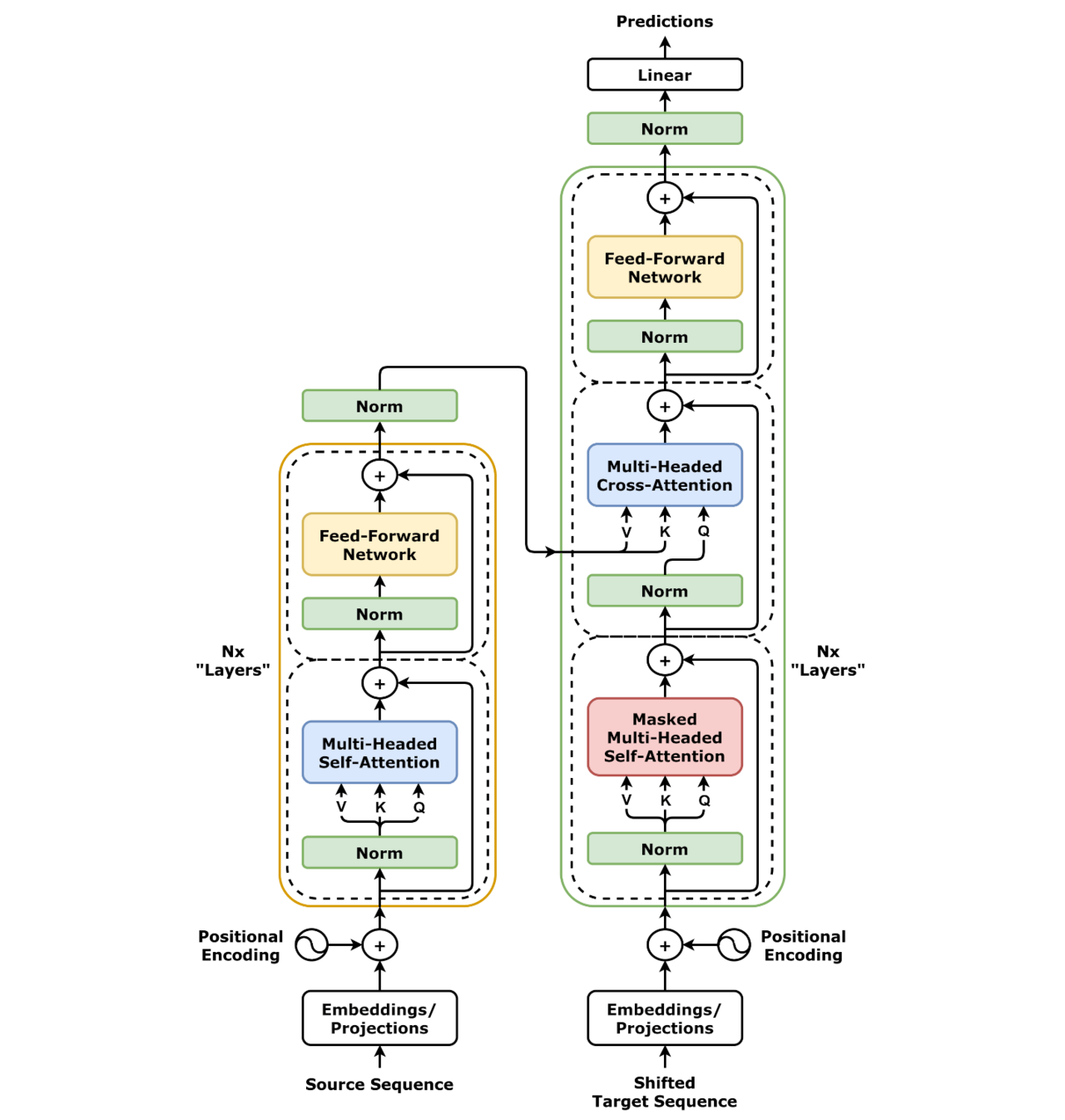
Origins and the Attention Is All You Need Paper
The Transformer architecture was introduced in the paper "Attention Is All You Need" by Ashish Vaswani and seven other authors, published on arXiv in 2017 [5]. This work emerged from Google Brain and the University of Toronto, marking a deliberate departure from the recurrent neural networks that dominated natural language processing at the time. The authors set out to model sequential data based solely on attention mechanisms, dispensing with recurrence and convolutions entirely [5].
Motivation Behind the Design
Before the Transformer, sequence transduction tasks relied heavily on recurrent neural networks and convolutional models, which suffered from sequential processing bottlenecks. The Transformer architecture achieved a BLEU score of 28.4 on the WMT 2014 English-to-German translation task, improving over existing best results including ensembles by over 2 BLEU points [5]. This performance gain demonstrated that attention-only models could outperform complex architectures. The model also established a new single-model state-of-the-art BLEU score of 41.8 on the WMT 2014 English-to-French translation task after training for 3.5 days on eight GPUs [5], proving that the architecture could achieve superior results with significantly less training time.
Key Innovations Introduced
The paper introduced several foundational elements, including scaled dot-product attention, multi-head attention, and position-wise feed-forward networks. The Transformer architecture uses an encoder-decoder configuration with attention mechanisms connecting the encoder and decoder [5]. Perhaps most significantly, the architecture enables significantly more parallelization compared to recurrent neural network models [5], allowing for faster training and inference. This architectural shift has become the dominant model architecture for sequential data and has influenced numerous subsequent AI models [1,5].
Architectural Mechanics and Design Principles
The Transformer architecture's core innovation lies in its elimination of recurrence and convolutions entirely. Instead, it relies on attention mechanisms to model dependencies between input and output sequences. This design choice allows the model to capture long-range dependencies more effectively than recurrent architectures, where information must pass through many sequential steps. The architecture uses an encoder-decoder configuration where the encoder processes the input sequence into representations that the decoder uses to generate the output sequence [5].
Attention Mechanisms and Self-Attention
The Transformer architecture employs scaled dot-product attention as its fundamental building block. This mechanism computes attention scores between all pairs of positions in the input sequence, allowing each position to attend to any other position regardless of distance. Multi-head attention extends this by running multiple attention operations in parallel with different learned linear projections, capturing different types of dependencies simultaneously. The architecture also incorporates position-wise feed-forward networks applied to each position separately and identically, creating a deep network while maintaining computational efficiency.
Positional Encoding and Sequence Order
Since the Transformer architecture processes input positions independently without recurrence, it requires positional encoding to provide information about the order of the sequence. The original paper learned fixed positional encodings using sine and cosine functions of different frequencies, allowing the model to understand relative and absolute position within the sequence. This design choice maintains the parallelization benefits while preserving the sequential structure necessary for language understanding and other sequence transduction tasks.
Training Efficiency and Performance Gains
One of the most significant advantages of the Transformer architecture is its training efficiency. The architecture requires significantly less time to train than complex recurrent or convolutional neural network models [5]. This efficiency stems from the parallelizable nature of the attention mechanisms, which can leverage modern GPU hardware far more effectively than the sequential operations of RNNs. The architecture achieves state-of-the-art results while training for only 3.5 days on eight GPUs for the English-to-French translation task [5], representing a dramatic reduction in training compute compared to previous approaches.
BLEU Score Improvements and Benchmark Results
The Transformer architecture demonstrated substantial improvements on translation benchmarks. On the WMT 2014 English-to-German task, the model achieved a BLEU score of 28.4, improving over existing best results including ensembles by over 2 BLEU points [5]. On the WMT 2014 English-to-French task, the single-model architecture achieved a BLEU score of 41.8 [5]. These results surpassed previous state-of-the-art systems and established the Transformer as the new standard for machine translation quality. The improvements were particularly notable because they were achieved with a single model, without the need for ensemble methods that were common in previous approaches.
Generalization Across Tasks
The Transformer architecture generalizes well to other tasks beyond machine translation. The architecture has been applied to English constituency parsing, both with large and limited training data [5], demonstrating its versatility. This generalization capability stems from the fundamental attention mechanism, which can capture structural relationships in various types of sequential data. The success on parsing tasks indicated that the architecture was not merely a translation tool but a general-purpose sequence modeling framework.
Broader Applications and Downstream Impact
The Transformer architecture has applications far beyond its original machine translation purpose. The architecture has been applied to various downstream tasks and has spawned subsequent work including alternative feedforward modules, normalizations, positional encodings, efficient implementations, and multimodality extensions [1]. This extensive follow-on research demonstrates the architecture's fundamental impact on the field. The architecture's applications include language modeling, where it forms the basis for many large language models, and other sequence transduction tasks across different domains.
Machine Learning and Natural Language Processing
In the realm of natural language processing, the Transformer architecture has become the foundation for countless models and systems. Its impact on language modeling has been particularly profound, enabling the development of models that can understand and generate human-like text. The architecture's ability to capture long-range dependencies and contextual relationships has improved performance on tasks including text classification, question answering, and summarization. The Transformer has effectively replaced RNNs and CNNs as the default architecture for most NLP applications.
Computer Vision and Multimodal Extensions
The success of the Transformer architecture has extended into computer vision and multimodal tasks. Researchers have adapted the attention mechanism for image processing, creating Vision Transformers (ViTs) that treat image patches as sequence tokens. The architecture's flexibility has allowed it to handle multimodal inputs combining text, images, and other data types. This extension has created new possibilities for tasks like visual question answering, image captioning, and cross-modal retrieval, demonstrating the Transformer's adaptability beyond its original natural language processing domain.
Reception, Significance, and Industry Adoption
The Transformer architecture has become the dominant model architecture for sequential data and has influenced numerous subsequent AI models [1,5]. Its impact on the field has been so significant that it has effectively reshaped the landscape of machine learning research and development. The architecture's combination of strong performance, training efficiency, and extensibility has made it the preferred choice for both research prototypes and commercial products. Industry adoption has been rapid, with major technology companies integrating Transformer-based models into their products and services.
Citation and Recognition
The original "Attention Is All You Need" paper has become one of the most cited works in machine learning history, reflecting the architecture's profound impact on the field. The paper's introduction of the encoder-decoder Transformer architecture provided a simple yet powerful framework that could be adapted to countless variants and improvements. This recognition has extended beyond academic citations, with the architecture being featured in industry reports, conference keynotes, and technology roadmaps as a foundational innovation.
Long-Term Influence on AI Research
The Transformer architecture's influence extends to the development of large language models, which have become central to current AI research and deployment. Models like BERT, GPT, and T5 all build upon the Transformer architecture, each introducing modifications and scaling innovations. The architecture's success has also inspired research into efficient Transformers, sparse attention mechanisms, and architectural variants that maintain performance while reducing computational costs. This ongoing research program ensures that the Transformer architecture will continue to evolve and shape the field.
Model Carving and Training Dynamics
Recent research has explored new methods for training Transformers more efficiently. The Model Carving paper (arXiv:2611.27962) introduces a method to train Transformers that optimize their own topology by learning both weights and architecture in a single run using learnable scalar gates on each sublayer [3]. This approach represents a significant evolution from the original architecture, adding the ability to dynamically adjust the model's structure during training.
Dynamic Topology Optimization
Model Carving allows training to remove model components during training, freeing a smaller heterogeneous network inside a larger transformer [3]. This differs from traditional pruning approaches that train a large model and then compress it afterward. By learning the architecture alongside the weights, Model Carving can identify and eliminate unnecessary components in real-time, creating a more efficient model structure that emerges from the training process itself rather than being imposed afterward.
Efficiency Gains and Performance Trade-offs
At equal training compute, carved models reach lower validation loss than dense models trained with up to 1.7 times more compute [3]. This finding suggests that the carving approach can achieve better performance with fewer resources. Carved models also outperform size-matched models produced by pruning or distillation, suggesting that carving during training is more effective than compressing a large model afterwards [3]. The approach can cost up to 34% fewer FLOPs per token and decode up to 1.6 times faster without cost in quality [3], making it particularly valuable for deployment scenarios where latency and computational efficiency are critical.
Evolution and Future Directions
The Transformer architecture continues to evolve through ongoing research addressing its limitations and extending its capabilities. The original architecture's quadratic complexity with sequence length has prompted research into more efficient attention variants, including sparse attention, linear attention, and other approximations that maintain performance while reducing computational cost. These innovations aim to make Transformers viable for very long sequences, opening applications in areas like genomics, speech processing, and document analysis.
Scaling Laws and Model Size
Research into Transformer scaling has established that performance improves predictably with increased model size, training data, and compute. This understanding has guided the development of increasingly large models, with parameter counts growing from hundreds of millions to hundreds of billions and beyond. The scaling hypothesis suggests that larger Transformers continue to improve, though at diminishing returns, and that efficient training methods will be essential for realizing the benefits of scale without prohibitive computational costs.
Architectural Innovations and Hybrid Models
The research community continues to propose novel architectural modifications to the original Transformer framework. These include alternative feedforward modules, different normalization schemes, and hybrid architectures combining Transformers with other neural network types. Some research explores combining Transformers with state-space models, while others investigate recurrent Transformers that reintroduce recurrence in modified forms. These innovations reflect the field's ongoing engagement with the fundamental design space established by the original Transformer architecture.
Comparative Analysis with Previous Architectures
The Transformer architecture represents a fundamental shift from recurrent neural networks that had dominated sequence modeling since the 2010s. Previous models like LSTMs and GRUs processed input tokens sequentially, creating bottlenecks for parallelization and limiting the effective context length due to vanishing gradients through many time steps. The Transformer architecture's elimination of recurrence allows it to process all positions in a sequence simultaneously, leveraging modern parallel computing hardware more effectively and capturing dependencies regardless of distance.
Convolutional Model Comparisons
Before the Transformer, convolutional neural networks like WaveNet and various text classification models used dilated convolutions to capture long-range dependencies. While convolutions offer parallelization benefits, they require stacking many layers to achieve receptive fields comparable to the immediate global attention of the Transformer architecture. The Transformer's attention mechanism provides a more direct path for information flow across the sequence, often achieving comparable or better performance with fewer layers and less computational overhead for moderate sequence lengths.
Training Dynamics and Optimization
The training dynamics of the Transformer architecture differ significantly from its predecessors. RNNs require careful gradient clipping and curriculum learning to stabilize training, while Transformers benefit from more straightforward optimization with Adam or similar optimizers. The architecture's normalization schemes, particularly layer normalization applied before each sublayer, contribute to more stable training dynamics. However, the Transformer requires careful attention to initialization and warmup learning rate schedules, particularly for the positional encoding and embedding layers.
Societal Impact and Ethical Considerations
The widespread adoption of the Transformer architecture has had profound societal impacts, particularly through enabling advanced language models that can generate human-like text. These capabilities have raised important questions about misinformation, academic integrity, and the potential for automated content generation to be used for manipulative purposes. The architecture's ability to produce coherent and contextually relevant text has made both beneficial applications like translation assistance and harmful uses like spam generation possible at scale.
Economic and Industrial Transformation
The Transformer architecture has driven significant economic value by enabling more capable AI systems that can automate various language-related tasks. Industries ranging from customer service to content creation to software development have integrated Transformer-based models to improve efficiency and reduce costs. This transformation has created new business models and job categories while also raising concerns about workforce displacement and the concentration of AI capabilities in the hands of a few large technology companies with the resources to develop and deploy the largest models.
Responsible AI and Future Governance
The AI research community has responded to these societal implications with increased focus on responsible AI practices, model transparency, and governance frameworks. The Transformer architecture's relative interpretability compared to some alternative approaches has facilitated research into model understanding and bias detection. Ongoing work examines how to harness the benefits of Transformer-based AI while mitigating risks, with proposals for model watermarking, usage monitoring, and standardized evaluation of societal impact.