
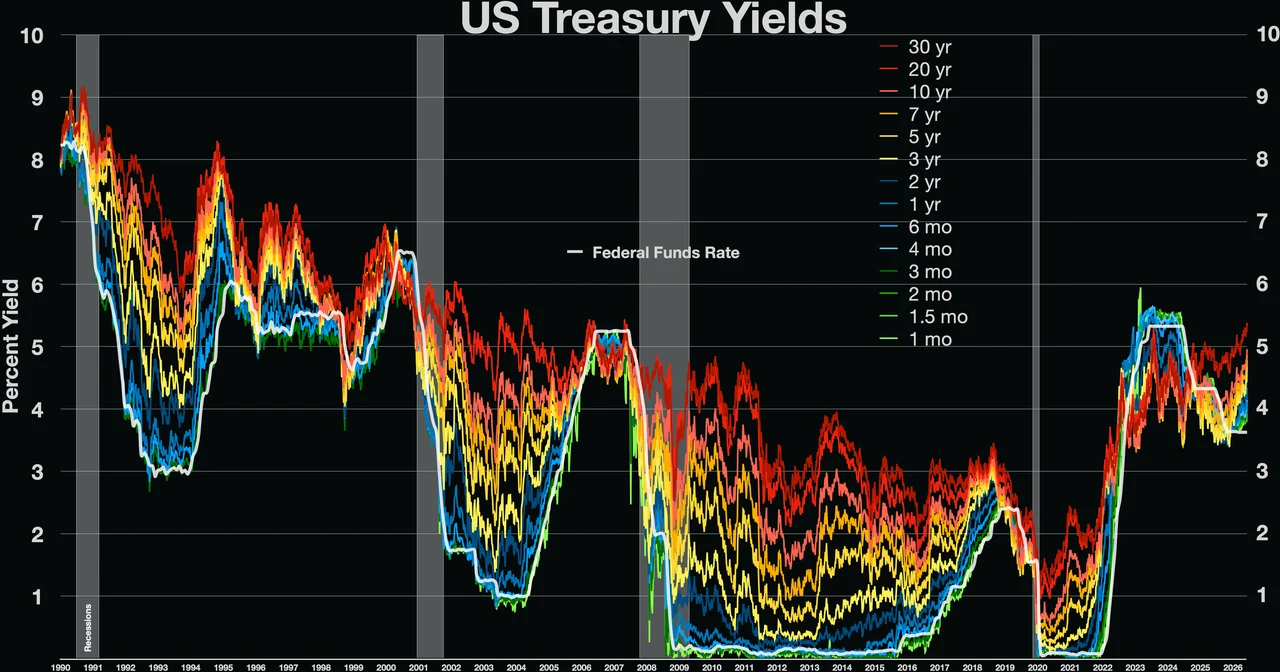
Overview of the Federal Reserve's Role
The Federal Reserve functions as the central bank for the United States, tasked with ensuring the nation possesses a monetary and financial system that is stable, safe, and flexible [1,2,3,4,5]. This critical function involves overseeing the nation's financial health [1,2,3,4,5]. The structure and operations of the Fed are detailed within the Federal Reserve Board materials [1,2,3,4,5].
Monetary and Financial Stability Mandate
A core responsibility of the Federal Reserve is maintaining the integrity and stability of the U.S. monetary and financial infrastructure [1,2,3,4,5]. This commitment guides its policy actions, ensuring predictable and resilient financial operations across the country [1,2,3,4,5].
The Federal Open Market Committee (FOMC)
Monetary policy decisions are intrinsically linked to the Federal Open Market Committee (FOMC) [1,2,3,4,5]. The FOMC plays a central role in determining the nation's monetary stance [1,2,3,4,5]. Details regarding the FOMC's activities and related policy are documented by the Federal Reserve [1,2,3,4,5].
Accessing FOMC Information
Stakeholders can consult the Federal Open Market Committee section of the Federal Reserve Board for essential information, including meeting calendars [2,3,4,5]. Furthermore, specific press releases related to the FOMC are available through the 2026 FOMC Press Releases section [3].
Understanding Federal Reserve Policy Tools
The Federal Reserve furnishes comprehensive information concerning its operational frameworks, including Policy Tools [1,2,3,4,5]. This documentation covers how the Fed implements its policies and how these policies are normalized over time [1,2,3,4,5]. Understanding these tools is crucial for grasping interest rate decisions [1,2,3,4,5].
Policy Implementation and Normalization
The Fed provides guidance on the processes of Policy Implementation and Policy Normalization [1,2,3,4,5]. These concepts describe the lifecycle of monetary policy actions, from initial implementation to subsequent adjustments [1,2,3,4,5].
Key Informational Reports
Several key reports are released by the Federal Reserve to inform the public and markets [1,2,3,4,5]. These documents include the Monetary Policy Report, the Beige Book, and updates on the Federal Reserve Balance Sheet Developments [1,2,3,4,5]. These publications offer deep insights into economic conditions [1,2,3,4,5].
Reviewing Official Documentation
The Federal Reserve Board also makes other reports available, such as the Monetary Policy Report and the Beige Book [1,2,3,4,5]. Reviewing these sources allows for a detailed understanding of the economic context influencing rate decisions [1,2,3,4,5].
Board Governance and Decision Making
The Federal Reserve Board maintains sections dedicated to the processes of Board Meetings and Board Votes [1,2,3,4,5]. This transparency allows observers to track how the Board reaches its determinations [1,2,3,4,5]. Information regarding the Board's activities is centralized within the Federal Reserve Board documentation [1,2,3,4,5].
Tracking Board Activities
Specific details on Board Meetings and the outcomes of Board Votes are published by the Federal Reserve Board [1,2,3,4,5]. This structured reporting supports the understanding of governance within the central banking system [1,2,3,4,5].
Accessing Official Federal Reserve Updates
General press releases from the Federal Reserve Board are available through the 2026 Press Releases section [4,5]. Additionally, specific 2026 FOMC Press Releases can be located separately [3]. These releases serve as official communications regarding policy [3,4,5].
Meeting Calendar Availability
For timely scheduling information, meeting calendars and related details are provided under the dedicated Federal Open Market Committee section [2,3,4,5]. This ensures public access to the timing of critical policy discussions [2,3,4,5].
Principles of Monetary Policy
The Federal Reserve offers educational resources detailing Monetary Policy Principles and Practice [1,2,3,4,5]. These principles form the theoretical foundation upon which interest rate decisions are based [1,2,3,4,5]. Understanding these foundational concepts is key to interpreting Fed actions [1,2,3,4,5].
Policy Framework Documentation
Information detailing the Fed's approach to monetary policy, including its practices, is consolidated within the Federal Reserve documentation [1,2,3,4,5]. This material outlines the theoretical underpinnings of its financial system management [1,2,3,4,5].
Significance for the Financial System
The Federal Reserve's work ensures the U.S. has a safe, flexible, and stable monetary and financial system [1,2,3,4,5]. The decisions made by bodies like the FOMC directly impact this stability [1,2,3,4,5]. This stability is a primary goal achieved through its various policy tools [1,2,3,4,5].
Impact of Fed Actions
By managing monetary policy, the Federal Reserve contributes significantly to the overall health and resilience of the national financial system [1,2,3,4,5]. The stability provided is a cornerstone of the U.S. economic environment [1,2,3,4,5].
Timeline and Event Tracking
Tracking specific events, such as those covered in the 2026 FOMC Press Releases, is possible through dedicated Federal Reserve Board sections [3,4,5]. Meeting calendars help track the timeline of these important policy discussions [2,3,4,5]. Official press releases provide dated records of Fed actions [4,5].
Navigating Official Releases
Both general 2026 press releases and specific FOMC releases are published by the Federal Reserve Board [3,4,5]. This structure allows users to follow the chronology of monetary policy announcements [2,3,4,5].
Interpreting Fed Communications
The Federal Reserve communicates its stance through multiple channels, including the Monetary Policy Report and the Beige Book [1,2,3,4,5]. These documents provide qualitative and quantitative data relevant to interest rate considerations [1,2,3,4,5]. Reviewing these sources aids in contextualizing rate decisions [1,2,3,4,5].
Sources for Economic Context
The Beige Book and the Monetary Policy Report are vital for understanding the economic environment that drives Fed decisions [1,2,3,4,5]. These reports offer the necessary background for interpreting the actions taken by the FOMC [1,2,3,4,5].