
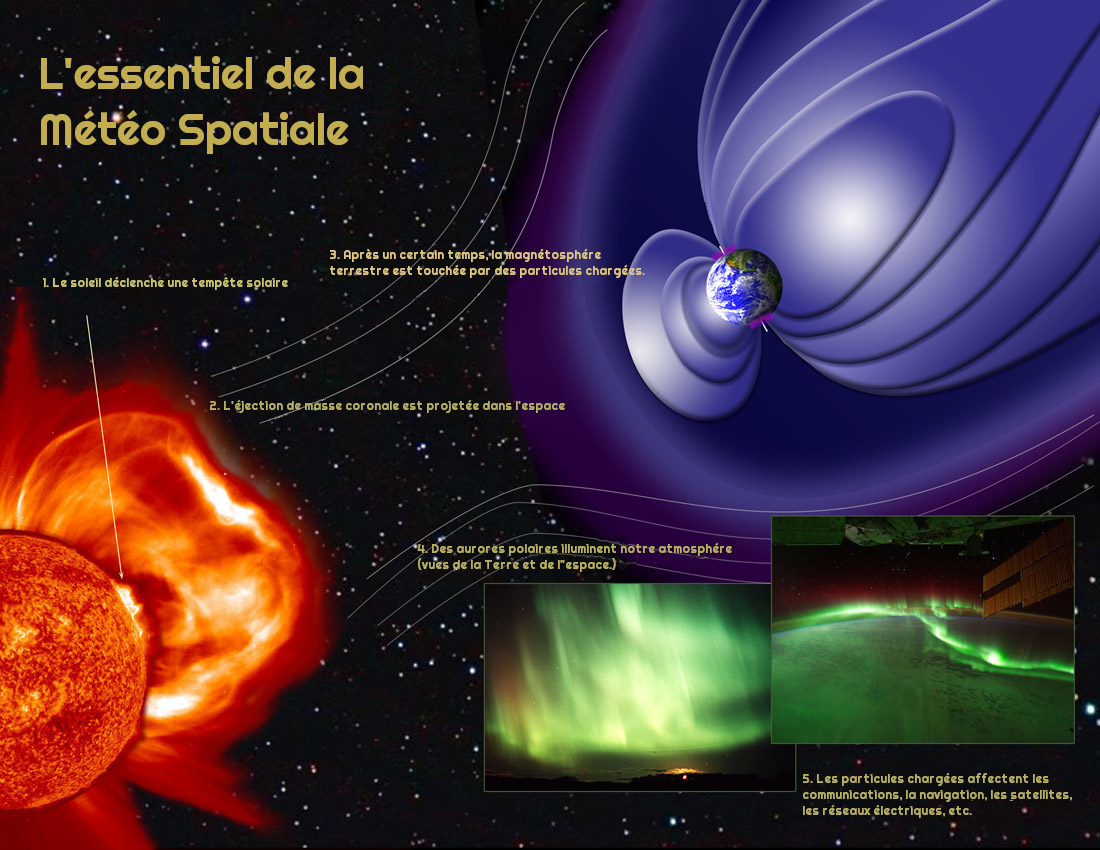
Overview of Geomagnetic Disturbances
Geomagnetic storms represent a disturbance within Earth's upper atmospheric layers [1]. This phenomenon originates from coronal mass ejections, which are significant expulsions originating from the corona, the outermost layer of the Sun's atmosphere [1]. The material ejected during these events primarily consists of protons and electrons, possessing an energy level in the range of a few thousand electron volts [1]. Understanding these solar-driven events is crucial for monitoring space weather [4,5].
The Solar Origin
Coronal mass ejections are categorized as large eruptions from the Sun's outer atmosphere, specifically the corona [1]. These solar events contribute to the broader category of space weather phenomena that also include solar wind, coronal holes, and the ionosphere [4,5]. The energy carried by the ejected material, composed mainly of protons and electrons, is quantified to be around a few thousand electron volts [1]. This energetic plasma interacts with Earth's protective magnetic field [4,5].
Monitoring and Prediction
Accurate information concerning geomagnetic storms is disseminated by the NOAA / NWS Space Weather Prediction Center [4,5]. These centers utilize specific scales, such as the Station K and A Indices, to quantify the severity of these space weather occurrences [4,5]. Continuous monitoring allows for timely alerts regarding potential technological disruptions caused by these solar events [4,5].
Components of Space Weather
Geomagnetic storms are linked to several related space weather phenomena [4,5]. These include the solar wind, the Earth's magnetosphere, the ionosphere, and the presence of coronal holes [4,5]. Aurora displays are a visible manifestation associated with these interactions [4,5]. The interaction between the solar material and Earth's magnetic field dictates the storm's characteristics [4,5].
The Role of the Magnetosphere
Earth possesses a magnetosphere, a protective magnetic bubble that interacts directly with the solar plasma [4,5]. When a coronal mass ejection impacts this region, the resulting geomagnetic storm occurs [1, 4, 5]. This interaction channels the energetic protons and electrons into the upper atmosphere, influencing ionospheric conditions [4,5]. The magnetosphere's response determines the severity of the resulting storm [4,5].
Atmospheric Layers Involved
The ionosphere is one of the atmospheric layers affected by geomagnetic activity [4,5]. Aurora sightings are a direct result of these energized particles interacting with the upper atmosphere [4,5]. The overall system involves the interplay between the solar wind, the magnetosphere, and the ionosphere [4,5]. This complex interaction defines the scope of a geomagnetic storm [4,5].
Technological Impacts of Storms
The consequences of geomagnetic storms extend across various critical technologies [4,5]. These impacts include disruptions to Electric Power Transmission systems, GPS navigation capabilities, and High Frequency (HF) Radio Communications [4,5]. Satellite communications are also susceptible to these space weather events [4,5].
Satellite System Vulnerabilities
Satellites are particularly vulnerable to the energetic particles associated with these storms [4,5]. Beyond communication issues, geomagnetic activity can induce increased Satellite Drag, affecting orbital mechanics [4,5]. Maintaining satellite integrity requires awareness of space weather predictions from NOAA [4,5]. The physical interaction of charged particles with satellite components poses a risk [4,5].
Communication and Navigation Disruptions
GPS systems rely on stable ionospheric conditions for accurate positioning, which storms can compromise [4,5]. Similarly, HF radio communications are affected by changes in the ionosphere caused by the storm [4,5]. These disruptions necessitate operational adjustments for navigation and long-distance terrestrial communication [4,5].
Quantifying Storm Severity
NOAA utilizes specific indices to measure the intensity of geomagnetic storms [4,5]. The Station K and A Indices are among the metrics employed by the NOAA / NWS Space Weather Prediction Center [4,5]. These indices provide standardized, quantifiable data for assessing the level of disturbance [4,5]. This quantification aids in risk assessment for critical infrastructure [4,5].
Purpose of Space Weather Scales
The implementation of scales like the Station K and A Indices allows scientists and operators to communicate the threat level clearly [4,5]. This standardized reporting is vital for industries dependent on space-based or electromagnetically sensitive systems [4,5]. It moves the assessment beyond mere description to measurable risk [4,5].
Data Source Authority
The NOAA / NWS Space Weather Prediction Center serves as the authoritative source for geomagnetic storm information [4,5]. Relying on this center ensures that users receive the most current and scientifically vetted data regarding solar activity and its terrestrial effects [4,5].
The Physics of Ejection Material
The material released during coronal mass ejections is composed predominantly of protons and electrons [1]. These charged particles carry a specific energy level, quantified as a few thousand electron volts [1]. This energetic plasma travels from the Sun toward Earth, driving the geomagnetic disturbance [1]. The nature of this material is central to understanding the storm's effects [1].
Particle Composition
The primary constituents of the CME material are protons and electrons [1]. This charged composition allows the material to be effectively coupled with Earth's magnetic field upon arrival [1]. The energy associated with these particles is measured in electron volts, specifically in the range of a few thousand [1]. This energy dictates the severity of the induced effects [1].
Eruption Mechanism Context
Coronal mass ejections are defined as large eruptions from the Sun's outer atmosphere, the corona [1]. These events are a key driver of geomagnetic storms [1]. While the sources detail the composition and energy, the detailed mechanism of the eruption itself is linked to solar physics beyond the provided facts [1].
Significance for Modern Infrastructure
The impact on Electric Power Transmission systems highlights a critical vulnerability in modern grids [4,5]. Geomagnetic storms can induce currents that stress power infrastructure [4,5]. GPS systems, essential for modern logistics and timing, face potential inaccuracies during these events [4,5]. This underscores the necessity of space weather monitoring [4,5].
Reliability of Global Communications
Both Satellite Communications and HF Radio Communications are demonstrably impacted by geomagnetic disturbances [4,5]. HF radio, used globally for long-distance communication, requires atmospheric stability that storms disrupt [4,5]. Maintaining reliable global communication networks depends on mitigating these space weather risks [4,5].
Orbital Mechanics Concerns
The effect of geomagnetic storms includes increased Satellite Drag [4,5]. This drag influences the orbital paths of satellites, potentially requiring orbital adjustments to maintain operational longevity [4,5]. This physical effect is a direct consequence of the enhanced atmospheric interaction during a storm [4,5].
Relationship to Solar Wind
The solar wind is one of the key space weather phenomena associated with geomagnetic storms [4,5]. Coronal mass ejections contribute to the solar wind's dynamic nature [4,5]. The interaction between the solar wind plasma and Earth's magnetosphere initiates the storm sequence [4,5]. Understanding the solar wind is fundamental to predicting geomagnetic events [4,5].
Solar Wind Dynamics
The solar wind is a continuous stream of charged particles emanating from the Sun [4,5]. When this stream is augmented or modified by a CME, the resulting geomagnetic storm is more severe [4,5]. The solar wind provides the continuous background against which episodic events occur [4,5].
CME as a Solar Wind Event
A coronal mass ejection is a powerful event within the solar wind context [4,5]. The material from the CME, rich in protons and electrons [1], dramatically alters the solar wind's interaction profile with Earth [4,5]. This episodic injection is what triggers the distinct geomagnetic storm phase [1, 4, 5].
Aurora as a Visible Indicator
Aurora is a visible manifestation linked to geomagnetic storm activity [4,5]. It results from the interaction of charged particles from the solar event with Earth's upper atmosphere [4,5]. The presence of auroras signals that the magnetosphere is actively interacting with the incoming solar material [4,5]. This visual phenomenon confirms the storm's passage [4,5].
Mechanism of Light Emission
The light emitted during an aurora occurs when solar particles excite atmospheric gases in the upper atmosphere [4,5]. This excitation and subsequent de-excitation release photons, creating the visible display [4,5]. The aurora is thus a direct atmospheric consequence of the geomagnetic disturbance [4,5].
Observational Value
Auroras serve as a real-time, visible indicator of geomagnetic activity [4,5]. While NOAA provides predictive data, the aurora offers immediate confirmation of the storm's arrival and intensity at high latitudes [4,5]. This observation complements the scientific monitoring provided by space weather centers [4,5].
Context within Solar Physics
Geomagnetic storms are part of a broader set of space weather phenomena alongside coronal holes and solar wind activity [4,5]. These events originate from the Sun's corona [1]. The study of these events integrates solar physics with terrestrial geophysics [4,5]. The Sun's outer atmosphere is the source of the energetic material [1].
Coronal Holes and Ejections
Coronal holes are structures in the Sun's corona associated with the release of material [4,5]. Coronal mass ejections are the large eruptions from this outer atmosphere [1]. These two features are linked in driving the plasma streams that affect Earth [1, 4, 5]. Their presence dictates the potential for strong geomagnetic events [4,5].
Energy Transfer Pathway
The energy transfer begins as a large eruption from the corona [1], resulting in material composed of protons and electrons with specific energies [1]. This material travels through the solar wind [4,5] and subsequently interacts with Earth's magnetosphere [4,5]. This pathway defines the progression from solar event to terrestrial impact [1, 4, 5].
Operational Guidance and Resources
For official information on geomagnetic storms, the NOAA / NWS Space Weather Prediction Center is the designated resource [4,5]. They provide the necessary data, including the Station K and A Indices, for operational planning [4,5]. Utilizing these resources ensures that decisions regarding infrastructure protection are based on verified scientific data [4,5].
Utilizing NOAA Data
Operators in power, communications, and aerospace sectors should consult the NOAA Space Weather Prediction Center for real-time updates [4,5]. The provided scales allow for a clear, actionable understanding of the current space environment [4,5]. This proactive approach minimizes potential service interruptions [4,5].
Key Monitoring Metrics
The Station K and A Indices are the established metrics for gauging storm strength [4,5]. These indices translate complex plasma interactions into easily interpretable severity levels [4,5]. Monitoring these specific values is crucial for infrastructure preparedness [4,5].