
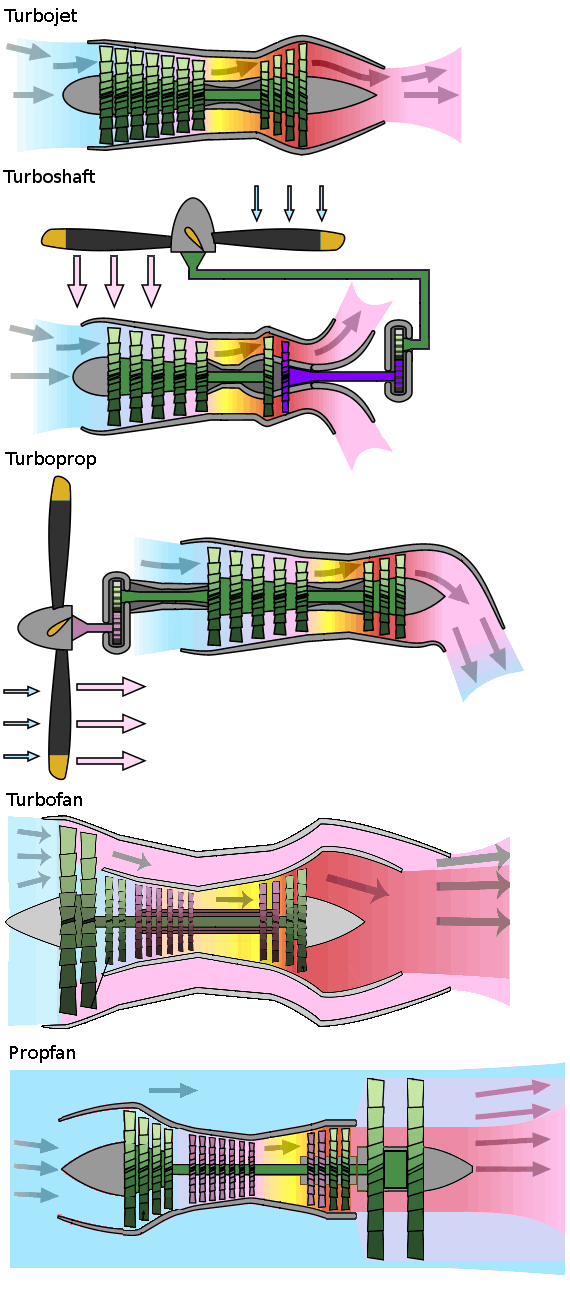
Overview of Gas Turbine Propulsion
Modern aviation, encompassing both military and passenger aircraft, relies on gas turbine engines, which are also known as jet engines [2] [high]. These engines function through a defined process: drawing air inward, compressing it, raising its temperature, and finally exhausting it [4] [high]. This cyclical operation is central to generating the necessary propulsive force [4] [high].
The Definition of Thrust
Thrust itself is quantitatively defined as the combined effect of the momentum difference observed between the air entering and the air exiting the engine, supplemented by any pressure force that is unequal between the inlet and the outlet [3] [high]. This comprehensive definition captures both momentum-based and pressure-based contributions to the total force [3] [high].
Turbojet Thrust Calculation Fundamentals
For a turbojet configuration, the specific thrust, denoted as F, is mathematically expressed as the product of the mass flow rate (m dot) and the exit velocity (Ve), minus the product of the free stream mass flow rate and the free stream velocity (V0) [2] [high]. This equation provides a precise measure of the propulsive force generated by the engine [2] [high].
Decomposition of Turbojet Thrust Terms
The first component within the turbojet thrust equation, specifically the term (m dot * Ve), is designated as gross thrust [2] [high]. This represents the total momentum thrust before accounting for the incoming air's momentum [2] [high]. The second component, (m dot * V0), is identified as ram drag [2] [high], which accounts for the momentum of the air entering the system at the flight speed [2] [high].
Net Thrust Derivation
The actual net thrust experienced by the aircraft is determined by subtracting the ram drag from the gross thrust [2] [high]. This subtraction yields the final, usable propulsive force [2] [high]. This relationship, Net Thrust = Gross Thrust - Ram Drag, is crucial for aerodynamic performance analysis [2] [high].
Historical Thrust Measurement Example
An early example, the Bristol Olympus Mk. 101 turbojet, provided specific thrust measurements [3] [high]. This engine registered a momentum thrust of 9300 lb and a pressure thrust amounting to 1800 lb [3] [high]. Consequently, the total thrust achieved by this historical unit was 11,100 lb [3] [high].
Operational Cycle of Jet Engines
The general operational sequence for jet engines involves a clear thermodynamic process [4] [high]. This process begins with the intake of ambient air, followed by its compression, subsequent heating, and finally, the expulsion of the high-energy exhaust [4] [high].
Significance in Modern Aviation
Gas turbine engines power the vast majority of contemporary passenger and military aircraft [2] [high]. Their efficiency and power density make them indispensable to modern air travel and defense capabilities [2] [high].
Analyzing Thrust Components
The distinction between gross thrust and ram drag is vital for understanding engine efficiency [2] [high]. Gross thrust reflects the total momentum imparted, while ram drag reflects the momentum lost due to the aircraft's forward motion relative to the incoming air mass [2] [high].
Mathematical Relationship Summary
The equation F = (m dot * Ve) - (m dot * V0) [2] [high] clearly shows that net thrust is the difference between the momentum thrust component (gross thrust) and the momentum drag component (ram drag) [2] [high].
Historical Context of Early Jets
The Bristol Olympus Mk. 101 serves as a documented example of early turbojet performance [3] [high]. Its measured momentum thrust of 9300 lb and pressure thrust of 1800 lb contributed to a total thrust of 11,100 lb [3] [high].
Engineering Principles in Operation
The fundamental mechanism involves sequential air processing: intake, squeezing (compression), heating, and exhaust [4] [high]. This sequence dictates the resulting thrust profile [4] [high].
Application in Aircraft Types
Both military and civilian aircraft utilize gas turbine engines, confirming their widespread adoption in modern aerospace engineering [2] [high]. The thrust characteristics derived from these engines are critical for flight performance across diverse missions [2] [high].
Detailed Thrust Component Breakdown
Gross thrust is defined by the mass flow rate multiplied by the exit velocity [2] [high]. Ram drag is defined by the free stream mass flow rate multiplied by the free stream velocity [2] [high]. Net thrust is the resultant difference between these two values [2] [high].